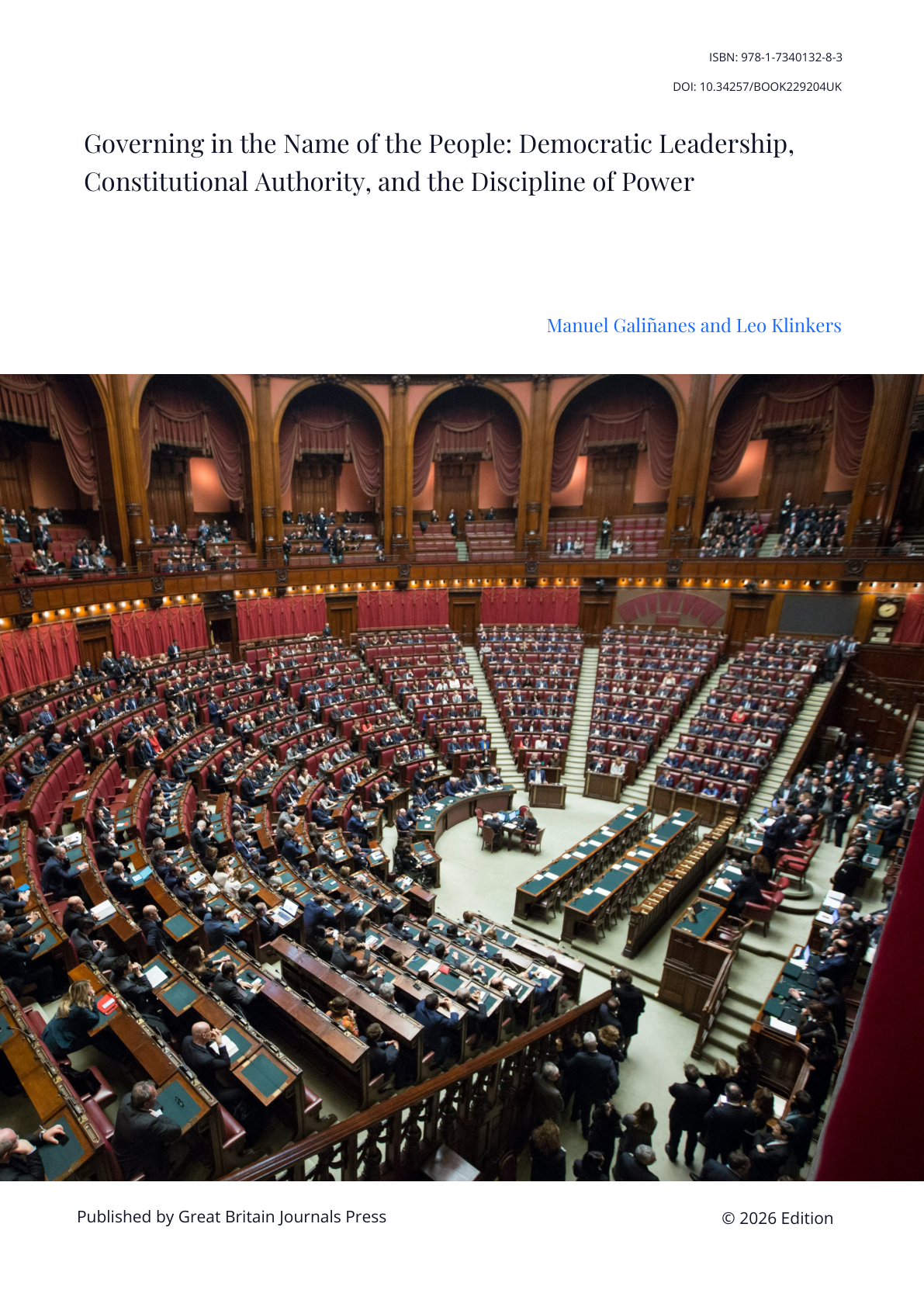
Governing in the Name of the People: Democratic Leadership, Constitutional Authority, and the Discipline of Power
Synopsis
Governing in the Name of the People: Democratic Leadership, Constitutional Authority and the Discipline of Power examines why democratic institutions cannot survive through elections, laws, and constitutional procedures alone. Its central argument is that democracy also depends on the intellectual, ethical, and institutional competence of those who exercise public authority. Leaders must understand not only how to obtain power, but why that power is limited, conditional, and accountable to the people.
The book traces the development of popular sovereignty from classical political thought through historic charters, revolutions, constitutionalism, and representative government. It distinguishes legitimate authority from mere control and warns against treating electoral victory, majority support, or legal office as permission to exercise unlimited power. Constitutional limitations, judicial oversight, separation of powers, federalism, pluralism, and political opposition are presented as essential components of democracy rather than obstacles to effective government.
The authors explore the responsibilities of political leaders and parties, particularly their duty to select competent candidates, accept electoral defeat, respect dissent, and resist populist efforts to identify one leader or faction with “the people.” They also examine how fear, polarization, misinformation, executive concentration, bureaucratic inertia, and institutional fragmentation can gradually erode democratic accountability without formally abolishing democratic structures.
Moving beyond constitutional design, the book analyses governance as a complex system involving policy formation, administration, ethical agency, institutional learning, and responsibility for harmful outcomes. Well-designed institutions can still fail when officials lack judgment, coordination, moral courage, or the capacity to correct systemic weaknesses.
The final sections propose democratic renewal through principled leadership, stronger political parties, civic participation, deliberation, institutional oversight, and continuous evaluation of democratic performance. The book ultimately argues that governing democratically means exercising temporary public power with knowledge, restraint, responsibility, and fidelity to constitutional principles. Democracy remains legitimate only when leadership, institutions, and citizens continuously work together to discipline power and protect freedom.
Author Biographies
Academic Disclosures
Dedication
To all who believe that political power derives from the people, is limited by constitutional principles, and must always be exercised in the service of the common good. May every generation possess the wisdom and civic courage to govern in the people's name with justice, integrity, and humility.
AI Use Disclosure
No generative AI was used for analysis or results.,
No statement was found indicating that AI was used to write the book manuscript.
References
ALTHUSIUS, J. Politica. [s.l.] Liberty Fund, 1995.
ARENDT, H. The Human Condition. [s.l.] University of Chicago Press, 1958.
ARENDT, H. Eichmann in Jerusalem: A Report on the Banality of Evil. [s.l.] Viking Press, 1963.
ARENDT, H. Truth and Politics. [s.l.] Viking Press, 1967.
ARENDT, H. Responsibility and Judgment. [s.l.] Schocken Books, 2005.
ARGYRIS, C. Overcoming Organizational Defenses: Facilitating Organizational Learning. [s.l.] Allyn and Bacon, 1990.
ARGYRIS, C.; SCHÖN, D. A. Organizational Learning: A Theory of Action Perspective. [s.l.] Addison-Wesley, 1978.
ARISTOTLE. Politics. [s.l.] Hackett Publishing, 1998.
ASHBY, W. R. An Introduction to Cybernetics. [s.l.] Chapman & Hall, 1956.
BAUMAN, Z. Modernity and the Holocaust. [s.l.] Cornell University Press, 1989.
BERMEO, N. On Democratic Backsliding. Journal of Democracy, v. 27, n. 1, p. 5–19, 2016.
BEVIR, M. Democratic Governance. [s.l.] Princeton University Press, 2010.
BODIN, J. On Sovereignty: Four Chapters from The Six Books of the Commonwealth. [s.l.] Cambridge University Press, 1992.
BOVENS, M. The Quest for Responsibility: Accountability and Citizenship in Complex Organisations. [s.l.] Cambridge University Press, 1998.
BRETT, A. S. Changes of State: Nature and the Limits of the City in Early Modern Natural Law. [s.l.] Princeton University Press, 2011.
BROWN, W. Undoing the Demos: Neoliberalism’s Stealth Revolution. [s.l.] Zone Books, 2015.
BURKE, K. Permanence and Change: An Anatomy of Purpose. [s.l.] University of California Press, 1984.
BURNS, J. M. Leadership. [s.l.] Harper & Row, 1978.
CHEIBUB, J. A. Presidentialism, Parliamentarism, and Democracy. [s.l.] Cambridge University Press, 2007.
COX, G. W.; MCCUBBINS, M. D. Setting the Agenda. [s.l.] Cambridge University Press, 2005.
DE TOCQUEVILLE, A. Democracy in America. [s.l.] University of Chicago Press, 2000.
DICEY, A. V. Introduction to the Study of the Law of the Constitution. [s.l.] Liberty Fund, 1982.
DRYZEK, J. S. Deliberative Democracy and Beyond. [s.l.] Oxford University Press, 2000.
DUNN, J. Western Political Theory in the Face of the Future. [s.l.] Cambridge University Press, 1969.
DWORKIN, R. Law’s Empire. [s.l.] Harvard University Press, 1986.
EASTON, D. A Systems Analysis of Political Life. [s.l.] Wiley, 1965.
ELAZAR, D. J. Exploring Federalism. [s.l.] University of Alabama Press, 1987.
ELGIE, R. Semi-Presidentialism: Sub-Types and Democratic Performance. [s.l.] Oxford University Press, 2011.
ELSTER, J. Ulysses Unbound: Studies in Rationality, Precommitment, and Constraints. [s.l.] Cambridge University Press, 2000.
ERASMUS, D. The Praise of Folly. [s.l.] Yale University Press, 2003.
FARMER, P. Pathologies of Power: Health, Human Rights, and the New War on the Poor. [s.l.] University of California Press, 2003.
FISHKIN, J. S. When the People Speak: Deliberative Democracy and Public Consultation. [s.l.] Oxford University Press, 2009.
FISHKIN, J. S. Democracy When the People Are Thinking: Revitalizing Our Politics Through Public Deliberation. [s.l.] Oxford University Press, 2018.
FRANCE. Declaration of the Rights of Man and of the Citizen. [s.l: s.n.].
FUKUYAMA, F. Political Order and Political Decay: From the Industrial Revolution to the Globalization of Democracy. [s.l.] Farrar, Straus and Giroux, 2014.
FULLER, L. L. The Morality of Law. [s.l.] Yale University Press, 1964.
FUNG, A.; WRIGHT, E. O. Deepening Democracy: Institutional Innovations in Empowered Participatory Governance. [s.l.] Verso, 2003.
GADAMER, H.-G. Truth and Method. [s.l.] Continuum, 1975.
GALIÑANES, M.; BERNHARDT, S.; KLINKERS, L. The Dual Seven Democratic Dimensions Index: A Novel and Simplified Metric to Accurately Assess Democracy. Journal of Politics and Law, v. 18, n. 4, p. 19–35, 2025.
GALIÑANES, M.; KLINKERS, L. Reimagining Checks and Balances: Establishing the Ombudsman Council as. Quarta Politica, v. 25, n. 9, p. 43–51, 2025.
GALIÑANES, M.; KLINKERS, L. Beyond Left-Right Ideology: Assessing Party Performance through Social Needs and Democratic Institutions. Journal of Politics and Law, v. 19, n. 2, p. 33–55, 2026.
GALIÑANES, M.; KLINKERS, L. Constitution for a World Federation. [s.l.] Letrame, 2026.
GALIÑANES, M.; KLINKERS, L. From Gatekeepers to Gravediggers: The Role of Political Party Leaders and Candidates in Democratic Decline?and the Case for Principled Leadership. Journal of Politics and Law, v. 19, n. 1, p. 1–21, 2026.
GALIÑANES, M.; KLINKERS, L. Journalism and the. Quarta Politica, 2026.
GALTUNG, J. Violence, Peace, and Peace Research. Journal of Peace Research, v. 6, n. 3, p. 167–191, 1969.
GIBSON, E. L. Boundary Control. [s.l.] Cambridge University Press, 2013.
GIDDENS, A. The Constitution of Society: Outline of the Theory of Structuration. [s.l.] University of California Press, 1984.
GINSBURG, T.; HUQ, A. Z. How to Save a Constitutional Democracy. [s.l.] University of Chicago Press, 2018.
GOODSELL, C. T. The Case for Bureaucracy. [s.l.] CQ Press, 2004.
GRIMMELIKHUIJSEN, S. et al. Behavioral Public Administration: Combining Insights from Public Administration and Psychology. Public Administration Review, v. 77, n. 1, p. 45–56, 2017.
HABERMAS, J. The Structural Transformation of the Public Sphere: An Inquiry into a Category of Bourgeois Society. [s.l.] MIT Press, 1989.
HABERMAS, J. Between Facts and Norms: Contributions to a Discourse Theory of Law and Democracy. [s.l.] MIT Press, 1996.
HABERMAS, J. Religion in the Public Sphere. European Journal of Philosophy, v. 14, n. 1, p. 1–25, 2006.
HACKER, J. S. The Divided Welfare State: The Battle over Public and Private Social Benefits in the United States. [s.l.] Cambridge University Press, 2002.
HAMILTON, A.; MADISON, J.; JAY, J. The Federalist Papers. [s.l.] Signet, 2003.
HART, H. L. A. The Concept of Law. [s.l.] Clarendon Press, 1961.
HELMS, L. Comparative Political Leadership. [s.l.] Palgrave Macmillan, 2012.
HIRSCHMAN, A. O. Exit, Voice, and Loyalty: Responses to Decline in Firms, Organizations, and States. [s.l.] Harvard University Press, 1972.
HOBBES, T. Leviathan. [s.l.] Cambridge University Press, 1996.
HOOD, C. The Art of the State: Culture, Rhetoric, and Public Management. [s.l.] Oxford University Press, 2000.
HOOD, C. Transparency in Historical Perspective. In: Transparency: The Key to Better Governance? [s.l.] Oxford University Press, 2006.
HUEGLIN, T. O. Early Modern Concepts for a Late Modern World: Althusius on Community and Federalism. [s.l.] Wilfrid Laurier University Press, 1999.
INGLEHART, R. Modernization and Postmodernization: Cultural, Economic, and Political Change in 43 Societies. [s.l.] Princeton University Press, 1997.
JAMIESON, K. H. Packaging the Presidency. [s.l.] Oxford University Press, 1996.
KAHNEMAN, D. Thinking, Fast and Slow. [s.l.] Farrar, Straus and Giroux, 2011.
KATZ, R. S.; MAIR, P. Changing Models of Party Organization and Party Democracy: The Emergence of the Cartel Party. Party Politics, v. 1, n. 1, p. 5–28, 1995.
KELSEN, H. General Theory of Law and State. [s.l.] Harvard University Press, 1945.
KICKERT, W. J. M.; KLIJN, E.-H.; KOPPENJAN, J. F. M. Managing Complex Networks. [s.l.] Sage, 1997.
KLINKERS, L. Collected Works on Governance and Democratic Systems. Disponível em: .
KUYPER, A. Sphere Sovereignty. In: Abraham Kuyper: A Centennial Reader. [s.l.] Eerdmans, 1998.
LANDAU, D. Abusive Constitutionalism. UC Davis Law Review, v. 47, p. 189–260, 2013.
LANDEMORE, H. Open Democracy: Reinventing Popular Rule for the Twenty-First Century. [s.l.] Princeton University Press, 2020.
LEO XIII. Rerum Novarum. [s.l: s.n.].
LEVITAS, R. The Concept of Utopia. [s.l.] Syracuse University Press, 1990.
LEVITSKY, S.; ZIBLATT, D. How Democracies Die. [s.l.] Crown, 2018.
LIJPHART, A. Patterns of Democracy: Government Forms and Performance in Thirty-Six Countries. [s.l.] Yale University Press, 1999.
LINDBLOM, C. E. The Science of `Muddling Through.’. Public Administration Review, v. 19, n. 2, p. 79–88, 1959.
LINDBLOM, C. E. Politics and Markets: The World’s Political-Economic Systems. [s.l.] Basic Books, 1977.
LINDER, W. Swiss Democracy: Possible Solutions to Conflict in Multicultural Societies. [s.l.] Palgrave Macmillan, 2010.
LINZ, J. J. The Perils of Presidentialism. Journal of Democracy, v. 1, n. 1, p. 51–69, 1990.
LINZ, J. J. The Perils of Presidentialism. Journal of Democracy, v. 1, n. 1, p. 51–69, 1990.
LIPSKY, M. Street-Level Bureaucracy: Dilemmas of the Individual in Public Services. [s.l.] Russell Sage Foundation, 1980.
LOCKE, J. Two Treatises of Government. [s.l.] Cambridge University Press, 1988.
LOUGHLIN, M. The Idea of Public Law. [s.l.] Oxford University Press, 2003.
LUHMANN, N. Social Systems. [s.l.] Stanford University Press, 1995.
MADISON, J.; HAMILTON, A.; JAY, J. The Federalist Papers. [s.l.] Signet Classics, 2003.
MAGNA CARTA. Magna Carta. In: Magna Carta. [s.l.] University of Virginia Press, 1998.
MAIR, P. Ruling the Void: The Hollowing of Western Democracy. [s.l.] Verso, 2013.
MANSBRIDGE, J.; DEMOCRACY, ET AL. A. S. A. TO D. Deliberative Systems. [s.l: s.n.].
MARMOT, M. Social Determinants of Health Inequalities. The Lancet, v. 365, n. 9464, p. 1099–1104, 2005.
MEADOWS, D. H. Thinking in Systems: A Primer. [s.l.] Chelsea Green, 2008.
MERTON, R. K. Bureaucratic Structure and Personality. Social Forces, v. 18, n. 4, p. 560–568, 1940.
METTLER, S. The Submerged State: How Invisible Government Policies Undermine American Democracy. [s.l.] University of Chicago Press, 2011.
MEZIROW, J. Transformative Dimensions of Adult Learning. [s.l.] Jossey-Bass, 1991.
MILL, J. S. Considerations on Representative Government. [s.l.] Hackett Publishing, 1977.
MILL, J. S. On Liberty. [s.l.] Hackett Publishing, 1978.
MONTESQUIEU, C. DE S. The Spirit of the Laws. [s.l.] Cambridge University Press, 1989.
MOUNK, Y. The People vs. Democracy: Why Our Freedom Is in Danger and How to Save It. [s.l.] Harvard University Press, 2018.
MÜLLER, J.-W. What Is Populism? [s.l.] University of Pennsylvania Press, 2016.
NORRIS, P. Democratic Phoenix: Reinventing Political Activism. [s.l.] Cambridge University Press, 2002.
O’DONNELL, G. Horizontal Accountability in New Democracies. Journal of Democracy, v. 9, n. 3, p. 112–126, 1998.
OSTROM, E. Governing the Commons: The Evolution of Institutions for Collective Action. [s.l.] Cambridge University Press, 1990.
OSTROM, E. Crossing the Great Divide: Coproduction, Synergy, and Development. World Development, v. 24, n. 6, p. 1073–1087, 1996.
OSTROM, E. Polycentric Systems for Coping with Collective Action and Global Environmental Change. Global Environmental Change, v. 20, p. 550–557, 2010.
PAGDEN, A. The Enlightenment and Why It Still Matters. [s.l.] Oxford University Press, 2013.
PANEBIANCO, A. Political Parties: Organization and Power. [s.l.] Cambridge University Press, 1988.
PAOLI, P. Scritti e Discorsi Politici. [s.l.] Edizioni di Storia e Letteratura, 2004.
PAPADOPOULOS, Y. Democracy in Crisis? Politics, Governance and Policy. [s.l.] Palgrave Macmillan, 2013.
PARSONS, T. The Social System. [s.l.] Free Press, 1951.
PATEMAN, C. Participation and Democratic Theory. [s.l.] Cambridge University Press, 1970.
PETERS, B. G. Advanced Introduction to Public Policy. [s.l.] Edward Elgar, 2015.
PETERS, B. G. The Politics of Bureaucracy. [s.l.] Routledge, 2018.
PIERRE, J.; PETERS, B. G. Governance, Politics and the State. [s.l.] Macmillan, 2000.
PITKIN, H. F. The Concept of Representation. [s.l.] University of California Press, 1967.
PLATTEL, M. G. Utopie en kritisch denken. [s.l.] Ambo, 1970.
POPPER, K. The Logic of Scientific Discovery. [s.l.] Routledge, 1935.
POPPER, K. The Open Society and Its Enemies. [s.l.] Routledge, 1945.
POPPER, K. R. Conjectures and Refutations: The Growth of Scientific Knowledge. [s.l.] Routledge, 1962.
PRESSMAN, J. L.; WILDAVSKY, A. Implementation. [s.l.] University of California Press, 1973.
PUTNAM, R. D. Bowling Alone: The Collapse and Revival of American Community. [s.l.] Simon & Schuster, 2000.
RAKOVE, J. N. Original Meanings: Politics and Ideas in the Making of the Constitution. [s.l.] Knopf, 1997.
RAWLS, J. Political Liberalism. [s.l.] Columbia University Press, 1993.
RODDEN, J. Hamilton’s Paradox: The Promise and Peril of Fiscal Federalism. [s.l.] Cambridge University Press, 2006.
ROSANVALLON, P. Democratic Legitimacy: Impartiality, Reflexivity, Proximity. [s.l.] Princeton University Press, 2011.
ROSENBLUM, N. L. On the Side of the Angels: An Appreciation of Parties and Partisanship. [s.l.] Princeton University Press, 2008.
ROTHSTEIN, B. The Quality of Government: Corruption, Social Trust, and Inequality in International Perspective. [s.l.] University of Chicago Press, 2011.
ROUSSEAU, J.-J. Projet de constitution pour la Corse. [s.l: s.n.].
ROUSSEAU, J.-J. Considerations on the Government of Poland. [s.l.] Hackett Publishing, 1985.
ROUSSEAU, J.-J. The Social Contract. [s.l.] Cambridge University Press, 1997.
SCHATTSCHNEIDER, E. E. Party Government. [s.l.] Farrar and Rinehart, 1942.
SCHEDLER, A. Conceptualizing Accountability. In: The Self-Restraining State: Power and Accountability in New Democracies. [s.l.] Lynne Rienner, 1999.
SCHEDLER, A. The Politics of Uncertainty: Sustaining and Subverting Electoral Authoritarianism. [s.l.] Oxford University Press, 2013.
SCHEPPELE, K. L. Autocratic Legalism. University of Chicago Law Review, v. 85, p. 545–584, 2018.
SCHMITT, C. Political Theology: Four Chapters on the Concept of Sovereignty. [s.l.] University of Chicago Press, 2005.
SCHÖN, D. A. The Reflective Practitioner: How Professionals Think in Action. [s.l.] Basic Books, 1983.
SEN, A. Development as Freedom. [s.l.] Knopf, 1999.
SHUGART, M. S.; CAREY, J. M. Presidents and Assemblies: Constitutional Design and Electoral Dynamics. [s.l.] Cambridge University Press, 1992.
SKINNER, Q. Liberty Before Liberalism. [s.l.] Cambridge University Press, 1997.
STEPAN, A. C. The Multiple Secularisms of Modern Democratic and Non-Democratic Regimes. In: Rethinking Secularism. [s.l.] Oxford University Press, 2011.
STRØM, K. Minority Government and Majority Rule. [s.l.] Cambridge University Press, 1990.
SUNSTEIN, C. R. Designing Democracy: What Constitutions Do. [s.l.] Oxford University Press, 2001.
SUNSTEIN, C. R. Why Nudge? The Politics of Libertarian Paternalism. [s.l.] Yale University Press, 2015.
SUNSTEIN, C. R. #Republic: Divided Democracy in the Age of Social Media. [s.l.] Princeton University Press, 2017.
TAYLOR, C. A Secular Age. [s.l.] Harvard University Press, 2007.
TETLOCK, P. E. Expert Political Judgment. [s.l.] Princeton University Press, 2006.
THALER, R. H.; SUNSTEIN, C. Nudge: Improving Decisions About Health, Wealth and Happiness. [s.l.] Yale University Press, 2008.
THE STATES-GENERAL OF THE NETHERLANDS. Act of Abjuration. [s.l: s.n.].
TUCK, R. Hobbes: A Very Short Introduction. [s.l.] Oxford University Press, 2002.
TUCK, R. The Sleeping Sovereign: The Invention of Modern Democracy. [s.l.] Cambridge University Press, 2016.
TULIS, J. K. The Rhetorical Presidency. [s.l.] Princeton University Press, 1987.
TUSHNET, M. The Constitution of the United States of America: A Contextual Analysis. [s.l.] Hart Publishing, 2009.
UNITED STATES. Declaration of Independence. [s.l: s.n.].
URBINATI, N. Representative Democracy: Principles and Genealogy. [s.l.] University of Chicago Press, 2006.
URBINATI, N. Democracy Disfigured: Opinion, Truth, and the People. [s.l.] Harvard University Press, 2014.
VAN SPENGLER, L. Hoe waarden veranderen: Een leerproces. [s.l.] Prometheus, 1994.
VITORIA, F. DE. Political Writings. [s.l.] Cambridge University Press, 1991.
WALDRON, J. Political Political Theory. [s.l.] Harvard University Press, 2016.
WARE, A. Political Parties and Party Systems. [s.l.] Oxford University Press, 1995.
WATTS, R. L. Comparing Federal Systems. [s.l.] McGill-Queen’s University Press, 1998.
WEBER, M. Politics as a Vocation. In: From Max Weber: Essays in Sociology. [s.l.] Oxford University Press, 1946.
WEBER, M. Economy and Society. [s.l.] University of California Press, 1978.
WIENER, N. Cybernetics: Or Control and Communication in the Animal and the Machine. [s.l.] MIT Press, 1948.
WILLIAMS, B. In the Beginning Was the Deed: Realism and Moralism in Political Argument. [s.l.] Princeton University Press, 2005.
WRIGHT, E. O. Envisioning Real Utopias. [s.l.] Verso, 2010.
YOUNG, I. M. Responsibility for Justice. [s.l.] Oxford University Press, 2011.
[1]Althusius, J. 1995. Politica. Liberty Fund.
[2]Arendt, H. 1963. Eichmann in Jerusalem: A Report on the Banality of Evil. Viking Press.
[3]Arendt, H. 2005. Responsibility and Judgment. Schocken Books.
[4]Arendt, H. 1958. The Human Condition. University of Chicago Press.
[5]Arendt, H. 1967. Truth and Politics. Viking Press.
[6]Argyris, C. 1990. Overcoming Organizational Defenses: Facilitating Organizational Learning. Allyn and Bacon.
[7]Argyris, C., Schön, D.A. 1978. Organizational Learning: A Theory of Action Perspective. Addison-Wesley.
[8]Aristotle 1998. Politics. Hackett Publishing.
[9]Ashby, W.R. 1956. An Introduction to Cybernetics. Chapman & Hall.
[10]Bauman, Z. 1989. Modernity and the Holocaust. Cornell University Press.
[11]Bermeo, N. 2016. On Democratic Backsliding. Journal of Democracy. 27, 1 (2016), 5–19.
[12]Bevir, M. 2010. Democratic Governance. Princeton University Press.
[13]Bodin, J. 1992. On Sovereignty: Four Chapters from The Six Books of the Commonwealth. Cambridge University Press.
[14]Bovens, M. 1998. The Quest for Responsibility: Accountability and Citizenship in Complex Organisations. Cambridge University Press.
[15]Brett, A.S. 2011. Changes of State: Nature and the Limits of the City in Early Modern Natural Law. Princeton University Press.
[16]Brown, W. 2015. Undoing the Demos: Neoliberalism’s Stealth Revolution. Zone Books.
[17]Burke, K. 1984. Permanence and Change: An Anatomy of Purpose. University of California Press.
[18]Burns, J.M. 1978. Leadership. Harper & Row.
[19]Cheibub, J.A. 2007. Presidentialism, Parliamentarism, and Democracy. Cambridge University Press.
[20]Collected Works on Governance and Democratic Systems: http://www.leoklinkers.nl.
[21]Cox, G.W., McCubbins, M.D. 2005. Setting the Agenda. Cambridge University Press.
[22]De Tocqueville, A. 2000. Democracy in America. University of Chicago Press.
[23]Dicey, A.V. 1982. Introduction to the Study of the Law of the Constitution. Liberty Fund.
[24]Dryzek, J.S. 2000. Deliberative Democracy and Beyond. Oxford University Press.
[25]Dunn, J. 1969. Western Political Theory in the Face of the Future. Cambridge University Press.
[26]Dworkin, R. 1986. Law’s Empire. Harvard University Press.
[27]Easton, D. 1965. A Systems Analysis of Political Life. Wiley.
[28]Elazar, D.J. 1987. Exploring Federalism. University of Alabama Press.
[29]Elgie, R. 2011. Semi-Presidentialism: Sub-Types and Democratic Performance. Oxford University Press.
[30]Elster, J. 2000. Ulysses Unbound: Studies in Rationality, Precommitment, and Constraints. Cambridge University Press.
[31]Erasmus, D. 2003. The Praise of Folly. Yale University Press.
[32]Farmer, P. 2003. Pathologies of Power: Health, Human Rights, and the New War on the Poor. University of California Press.
[33]Fishkin, J.S. 2018. Democracy When the People Are Thinking: Revitalizing Our Politics Through Public Deliberation. Oxford University Press.
[34]Fishkin, J.S. 2009. When the People Speak: Deliberative Democracy and Public Consultation. Oxford University Press.
[35]France 1789. Declaration of the Rights of Man and of the Citizen.
[36]Fukuyama, F. 2014. Political Order and Political Decay: From the Industrial Revolution to the Globalization of Democracy. Farrar, Straus and Giroux.
[37]Fuller, L.L. 1964. The Morality of Law. Yale University Press.
[38]Fung, A., Wright, E.O. 2003. Deepening Democracy: Institutional Innovations in Empowered Participatory Governance. Verso.
[39]Gadamer, H.-G. 1975. Truth and Method. Continuum.
[40]Galiñanes, M., Klinkers, L. 2026. Beyond Left-Right Ideology: Assessing Party Performance through Social Needs and Democratic Institutions. Journal of Politics and Law. 19, 2 (2026), 33–55.
[41]Galiñanes, M., Klinkers, L. 2026. Constitution for a World Federation. Letrame.
[42]Galiñanes, M., Klinkers, L. 2026. From Gatekeepers to Gravediggers: The Role of Political Party Leaders and Candidates in Democratic Decline?and the Case for Principled Leadership. Journal of Politics and Law. 19, 1 (2026), 1–21.
[43]Galiñanes, M., Klinkers, L. 2026. Journalism and the. Quarta Politica. (2026).
[44]Galiñanes, M., Klinkers, L. 2025. Reimagining Checks and Balances: Establishing the Ombudsman Council as. Quarta Politica. 25, 9 (2025), 43–51.
[45]Galiñanes, M. et al. 2025. The Dual Seven Democratic Dimensions Index: A Novel and Simplified Metric to Accurately Assess Democracy. Journal of Politics and Law. 18, 4 (2025), 19–35.
[46]Galtung, J. 1969. Violence, Peace, and Peace Research. Journal of Peace Research. 6, 3 (1969), 167–191.
[47]Gibson, E.L. 2013. Boundary Control. Cambridge University Press.
[48]Giddens, A. 1984. The Constitution of Society: Outline of the Theory of Structuration. University of California Press.
[49]Ginsburg, T., Huq, A.Z. 2018. How to Save a Constitutional Democracy. University of Chicago Press.
[50]Goodsell, C.T. 2004. The Case for Bureaucracy. CQ Press.
[51]Grimmelikhuijsen, S. et al. 2017. Behavioral Public Administration: Combining Insights from Public Administration and Psychology. Public Administration Review. 77, 1 (2017), 45–56.
[52]Habermas, J. 1996. Between Facts and Norms: Contributions to a Discourse Theory of Law and Democracy. MIT Press.
[53]Habermas, J. 2006. Religion in the Public Sphere. European Journal of Philosophy. 14, 1 (2006), 1–25.
[54]Habermas, J. 1989. The Structural Transformation of the Public Sphere: An Inquiry into a Category of Bourgeois Society. MIT Press.
[55]Hacker, J.S. 2002. The Divided Welfare State: The Battle over Public and Private Social Benefits in the United States. Cambridge University Press.
[56]Hamilton, A. et al. 2003. The Federalist Papers. Signet.
[57]Hart, H.L.A. 1961. The Concept of Law. Clarendon Press.
[58]Helms, L. 2012. Comparative Political Leadership. Palgrave Macmillan.
[59]Hirschman, A.O. 1972. Exit, Voice, and Loyalty: Responses to Decline in Firms, Organizations, and States. Harvard University Press.
[60]Hobbes, T. 1996. Leviathan. Cambridge University Press.
[61]Hood, C. 2000. The Art of the State: Culture, Rhetoric, and Public Management. Oxford University Press.
[62]Hood, C. 2006. Transparency in Historical Perspective. Transparency: The Key to Better Governance? Oxford University Press.
[63]Hueglin, T.O. 1999. Early Modern Concepts for a Late Modern World: Althusius on Community and Federalism. Wilfrid Laurier University Press.
[64]Inglehart, R. 1997. Modernization and Postmodernization: Cultural, Economic, and Political Change in 43 Societies. Princeton University Press.
[65]Jamieson, K.H. 1996. Packaging the Presidency. Oxford University Press.
[66]Kahneman, D. 2011. Thinking, Fast and Slow. Farrar, Straus and Giroux.
[67]Katz, R.S., Mair, P. 1995. Changing Models of Party Organization and Party Democracy: The Emergence of the Cartel Party. Party Politics. 1, 1 (1995), 5–28.
[68]Kelsen, H. 1945. General Theory of Law and State. Harvard University Press.
[69]Kickert, W.J.M. et al. 1997. Managing Complex Networks. Sage.
[70]Kuyper, A. 1998. Sphere Sovereignty. Abraham Kuyper: A Centennial Reader. Eerdmans.
[71]Landau, D. 2013. Abusive Constitutionalism. UC Davis Law Review. 47, (2013), 189–260.
[72]Landemore, H. 2020. Open Democracy: Reinventing Popular Rule for the Twenty-First Century. Princeton University Press.
[73]Leo XIII 1891. Rerum Novarum.
[74]Levitas, R. 1990. The Concept of Utopia. Syracuse University Press.
[75]Levitsky, S., Ziblatt, D. 2018. How Democracies Die. Crown.
[76]Lijphart, A. 1999. Patterns of Democracy: Government Forms and Performance in Thirty-Six Countries. Yale University Press.
[77]Lindblom, C.E. 1977. Politics and Markets: The World’s Political-Economic Systems. Basic Books.
[78]Lindblom, C.E. 1959. The Science of `Muddling Through.’. Public Administration Review. 19, 2 (1959), 79–88.
[79]Linder, W. 2010. Swiss Democracy: Possible Solutions to Conflict in Multicultural Societies. Palgrave Macmillan.
[80]Linz, J.J. 1990. The Perils of Presidentialism. Journal of Democracy. 1, 1 (1990), 51–69.
[81]Linz, J.J. 1990. The Perils of Presidentialism. Journal of Democracy. 1, 1 (1990), 51–69.
[82]Lipsky, M. 1980. Street-Level Bureaucracy: Dilemmas of the Individual in Public Services. Russell Sage Foundation.
[83]Locke, J. 1988. Two Treatises of Government. Cambridge University Press.
[84]Loughlin, M. 2003. The Idea of Public Law. Oxford University Press.
[85]Luhmann, N. 1995. Social Systems. Stanford University Press.
[86]Madison, J. et al. 2003. The Federalist Papers. Signet Classics.
[87]Magna Carta 1998. Magna Carta. Magna Carta. University of Virginia Press.
[88]Mair, P. 2013. Ruling the Void: The Hollowing of Western Democracy. Verso.
[89]Mansbridge, J., Democracy, et al. A.S.A. to D. Deliberative Systems.
[90]Marmot, M. 2005. Social Determinants of Health Inequalities. The Lancet. 365, 9464 (2005), 1099–1104.
[91]Meadows, D.H. 2008. Thinking in Systems: A Primer. Chelsea Green.
[92]Merton, R.K. 1940. Bureaucratic Structure and Personality. Social Forces. 18, 4 (1940), 560–568.
[93]Mettler, S. 2011. The Submerged State: How Invisible Government Policies Undermine American Democracy. University of Chicago Press.
[94]Mezirow, J. 1991. Transformative Dimensions of Adult Learning. Jossey-Bass.
[95]Mill, J.S. 1977. Considerations on Representative Government. Hackett Publishing.
[96]Mill, J.S. 1978. On Liberty. Hackett Publishing.
[97]Montesquieu, C. de S. 1989. The Spirit of the Laws. Cambridge University Press.
[98]Mounk, Y. 2018. The People vs. Democracy: Why Our Freedom Is in Danger and How to Save It. Harvard University Press.
[99]Müller, J.-W. 2016. What Is Populism? University of Pennsylvania Press.
[100]Norris, P. 2002. Democratic Phoenix: Reinventing Political Activism. Cambridge University Press.
[101]O’Donnell, G. 1998. Horizontal Accountability in New Democracies. Journal of Democracy. 9, 3 (1998), 112–126.
[102]Ostrom, E. 1996. Crossing the Great Divide: Coproduction, Synergy, and Development. World Development. 24, 6 (1996), 1073–1087.
[103]Ostrom, E. 1990. Governing the Commons: The Evolution of Institutions for Collective Action. Cambridge University Press.
[104]Ostrom, E. 2010. Polycentric Systems for Coping with Collective Action and Global Environmental Change. Global Environmental Change. 20, (2010), 550–557.
[105]Pagden, A. 2013. The Enlightenment and Why It Still Matters. Oxford University Press.
[106]Panebianco, A. 1988. Political Parties: Organization and Power. Cambridge University Press.
[107]Paoli, P. 2004. Scritti e Discorsi Politici. Edizioni di Storia e Letteratura.
[108]Papadopoulos, Y. 2013. Democracy in Crisis? Politics, Governance and Policy. Palgrave Macmillan.
[109]Parsons, T. 1951. The Social System. Free Press.
[110]Pateman, C. 1970. Participation and Democratic Theory. Cambridge University Press.
[111]Peters, B.G. 2015. Advanced Introduction to Public Policy. Edward Elgar.
[112]Peters, B.G. 2018. The Politics of Bureaucracy. Routledge.
[113]Pierre, J., Peters, B.G. 2000. Governance, Politics and the State. Macmillan.
[114]Pitkin, H.F. 1967. The Concept of Representation. University of California Press.
[115]Plattel, M.G. 1970. Utopie en kritisch denken. Ambo.
[116]Popper, K. 1935. The Logic of Scientific Discovery. Routledge.
[117]Popper, K. 1945. The Open Society and Its Enemies. Routledge.
[118]Popper, K.R. 1962. Conjectures and Refutations: The Growth of Scientific Knowledge. Routledge.
[119]Pressman, J.L., Wildavsky, A. 1973. Implementation. University of California Press.
[120]Putnam, R.D. 2000. Bowling Alone: The Collapse and Revival of American Community. Simon & Schuster.
[121]Rakove, J.N. 1997. Original Meanings: Politics and Ideas in the Making of the Constitution. Knopf.
[122]Rawls, J. 1993. Political Liberalism. Columbia University Press.
[123]Rodden, J. 2006. Hamilton’s Paradox: The Promise and Peril of Fiscal Federalism. Cambridge University Press.
[124]Rosanvallon, P. 2011. Democratic Legitimacy: Impartiality, Reflexivity, Proximity. Princeton University Press.
[125]Rosenblum, N.L. 2008. On the Side of the Angels: An Appreciation of Parties and Partisanship. Princeton University Press.
[126]Rothstein, B. 2011. The Quality of Government: Corruption, Social Trust, and Inequality in International Perspective. University of Chicago Press.
[127]Rousseau, J.-J. 1985. Considerations on the Government of Poland. Hackett Publishing.
[128]Rousseau, J.-J. 1765. Projet de constitution pour la Corse.
[129]Rousseau, J.-J. 1997. The Social Contract. Cambridge University Press.
[130]Schattschneider, E.E. 1942. Party Government. Farrar and Rinehart.
[131]Schedler, A. 1999. Conceptualizing Accountability. The Self-Restraining State: Power and Accountability in New Democracies. Lynne Rienner.
[132]Schedler, A. 2013. The Politics of Uncertainty: Sustaining and Subverting Electoral Authoritarianism. Oxford University Press.
[133]Scheppele, K.L. 2018. Autocratic Legalism. University of Chicago Law Review. 85, (2018), 545–584.
[134]Schmitt, C. 2005. Political Theology: Four Chapters on the Concept of Sovereignty. University of Chicago Press.
[135]Schön, D.A. 1983. The Reflective Practitioner: How Professionals Think in Action. Basic Books.
[136]Sen, A. 1999. Development as Freedom. Knopf.
[137]Shugart, M.S., Carey, J.M. 1992. Presidents and Assemblies: Constitutional Design and Electoral Dynamics. Cambridge University Press.
[138]Skinner, Q. 1997. Liberty Before Liberalism. Cambridge University Press.
[139]Stepan, A.C. 2011. The Multiple Secularisms of Modern Democratic and Non-Democratic Regimes. Rethinking Secularism. Oxford University Press.
[140]Strøm, K. 1990. Minority Government and Majority Rule. Cambridge University Press.
[141]Sunstein, C.R. 2017. #Republic: Divided Democracy in the Age of Social Media. Princeton University Press.
[142]Sunstein, C.R. 2001. Designing Democracy: What Constitutions Do. Oxford University Press.
[143]Sunstein, C.R. 2015. Why Nudge? The Politics of Libertarian Paternalism. Yale University Press.
[144]Taylor, C. 2007. A Secular Age. Harvard University Press.
[145]Tetlock, P.E. 2006. Expert Political Judgment. Princeton University Press.
[146]Thaler, R.H., Sunstein, C. 2008. Nudge: Improving Decisions About Health, Wealth and Happiness. Yale University Press.
[147]The States-General of the Netherlands 1581. Act of Abjuration.
[148]Tuck, R. 2002. Hobbes: A Very Short Introduction. Oxford University Press.
[149]Tuck, R. 2016. The Sleeping Sovereign: The Invention of Modern Democracy. Cambridge University Press.
[150]Tulis, J.K. 1987. The Rhetorical Presidency. Princeton University Press.
[151]Tushnet, M. 2009. The Constitution of the United States of America: A Contextual Analysis. Hart Publishing.
[152]United States 1776. Declaration of Independence.
[153]Urbinati, N. 2014. Democracy Disfigured: Opinion, Truth, and the People. Harvard University Press.
[154]Urbinati, N. 2006. Representative Democracy: Principles and Genealogy. University of Chicago Press.
[155]van Spengler, L. 1994. Hoe waarden veranderen: Een leerproces. Prometheus.
[156]Vitoria, F. de 1991. Political Writings. Cambridge University Press.
[157]Waldron, J. 2016. Political Political Theory. Harvard University Press.
[158]Ware, A. 1995. Political Parties and Party Systems. Oxford University Press.
[159]Watts, R.L. 1998. Comparing Federal Systems. McGill-Queen’s University Press.
[160]Weber, M. 1978. Economy and Society. University of California Press.
[161]Weber, M. 1946. Politics as a Vocation. From Max Weber: Essays in Sociology. Oxford University Press.
[162]Wiener, N. 1948. Cybernetics: Or Control and Communication in the Animal and the Machine. MIT Press.
[163]Williams, B. 2005. In the Beginning Was the Deed: Realism and Moralism in Political Argument. Princeton University Press.
[164]Wright, E.O. 2010. Envisioning Real Utopias. Verso.
[165]Young, I.M. 2011. Responsibility for Justice. Oxford University Press.
(1)Althusius, J. Politica; Liberty Fund, 1995.
(2)Arendt, H. Eichmann in Jerusalem: A Report on the Banality of Evil; Viking Press, 1963.
(3)Arendt, H. Responsibility and Judgment; Schocken Books, 2005.
(4)Arendt, H. The Human Condition; University of Chicago Press, 1958.
(5)Arendt, H. Truth and Politics; Viking Press, 1967.
(6)Argyris, C. Overcoming Organizational Defenses: Facilitating Organizational Learning; Allyn and Bacon, 1990.
(7)Argyris, C.; Schön, D. A. Organizational Learning: A Theory of Action Perspective; Addison-Wesley, 1978.
(8)Aristotle. Politics; Hackett Publishing, 1998.
(9)Ashby, W. R. An Introduction to Cybernetics; Chapman & Hall, 1956.
(10)Bauman, Z. Modernity and the Holocaust; Cornell University Press, 1989.
(11)Bermeo, N. On Democratic Backsliding. Journal of Democracy 2016, 27 (1), 5-19.
(12)Bevir, M. Democratic Governance; Princeton University Press, 2010.
(13)Bodin, J. On Sovereignty: Four Chapters from The Six Books of the Commonwealth; Cambridge University Press, 1992.
(14)Brett, A. S. Changes of State: Nature and the Limits of the City in Early Modern Natural Law; Princeton University Press, 2011.
(15)Bovens, M. The Quest for Responsibility: Accountability and Citizenship in Complex Organisations; Cambridge University Press, 1998.
(16)Brown, W. Undoing the Demos: Neoliberalism’s Stealth Revolution; Zone Books, 2015.
(17)Burke, K. Permanence and Change: An Anatomy of Purpose; University of California Press, 1984.
(18)Burns, J. M. Leadership; Harper & Row, 1978.
(19)Cheibub, J. A. Presidentialism, Parliamentarism, and Democracy; Cambridge University Press, 2007.
(20)Cox, G. W.; McCubbins, M. D. Setting the Agenda; Cambridge University Press, 2005.
(21)Dicey, A. V. Introduction to the Study of the Law of the Constitution; Liberty Fund, 1982.
(22)Dryzek, J. S. Deliberative Democracy and Beyond; Oxford University Press, 2000.
(23)De Tocqueville, A. Democracy in America; University of Chicago Press, 2000.
(24)Dunn, J. Western Political Theory in the Face of the Future; Cambridge University Press, 1969.
(25)Dworkin, R. Law’s Empire; Harvard University Press, 1986.
(26)Elazar, D. J. Exploring Federalism; University of Alabama Press, 1987.
(27)Elgie, R. Semi-Presidentialism: Sub-Types and Democratic Performance; Oxford University Press, 2011.
(28)Elster, J. Ulysses Unbound: Studies in Rationality, Precommitment, and Constraints; Cambridge University Press, 2000.
(29)Erasmus, D. The Praise of Folly; Yale University Press, 2003.
(30)Easton, D. A Systems Analysis of Political Life; Wiley, 1965.
(31)Farmer, P. Pathologies of Power: Health, Human Rights, and the New War on the Poor; University of California Press, 2003.
(32)Fishkin, J. S. Democracy When the People Are Thinking: Revitalizing Our Politics Through Public Deliberation; Oxford University Press, 2018.
(33)Fishkin, J. S. When the People Speak: Deliberative Democracy and Public Consultation; Oxford University Press, 2009.
(34)France. Declaration of the Rights of Man and of the Citizen; 1789.
(35)Fukuyama, F. Political Order and Political Decay: From the Industrial Revolution to the Globalization of Democracy; Farrar, Straus and Giroux, 2014.
(36)Fuller, L. L. The Morality of Law; Yale University Press, 1964.
(37)Fung, A.; Wright, E. O. Deepening Democracy: Institutional Innovations in Empowered Participatory Governance; Verso, 2003.
(38)Gadamer, H.-G. Truth and Method; Continuum, 1975.
(39)Galiñanes, M.; Klinkers, L. Beyond Left-Right Ideology: Assessing Party Performance through Social Needs and Democratic Institutions. Journal of Politics and Law 2026, 19 (2), 33-55.
(40)Galiñanes, M.; Klinkers, L. Constitution for a World Federation; Letrame, 2026.
(41)Galiñanes, M.; Klinkers, L. From Gatekeepers to Gravediggers: The Role of Political Party Leaders and Candidates in Democratic Decline?And the Case for Principled Leadership. Journal of Politics and Law 2026, 19 (1), 1-21.
(42)Galiñanes, M.; Klinkers, L. Reimagining Checks and Balances: Establishing the Ombudsman Council As. Quarta Politica 2025, 25 (9), 43-51.
(43)Galiñanes, M.; Klinkers, L. Journalism and the. Quarta Politica 2026.
(44)Galiñanes, M.; Bernhardt, S.; Klinkers, L. The Dual Seven Democratic Dimensions Index: A Novel and Simplified Metric to Accurately Assess Democracy. Journal of Politics and Law 2025, 18 (4), 19-35.
(45)Galtung, J. Violence, Peace, and Peace Research. Journal of Peace Research 1969, 6 (3), 167-191.
(46)Gibson, E. L. Boundary Control; Cambridge University Press, 2013.
(47)Giddens, A. The Constitution of Society: Outline of the Theory of Structuration; University of California Press, 1984.
(48)Ginsburg, T.; Huq, A. Z. How to Save a Constitutional Democracy; University of Chicago Press, 2018.
(49)Grimmelikhuijsen, S.; Jilke, S.; Olsen, A. L.; Tummers, L. Behavioral Public Administration: Combining Insights from Public Administration and Psychology. Public Administration Review 2017, 77 (1), 45-56.
(50)Goodsell, C. T. The Case for Bureaucracy; CQ Press, 2004.
(51)Habermas, J. Between Facts and Norms: Contributions to a Discourse Theory of Law and Democracy; MIT Press, 1996.
(52)Habermas, J. Religion in the Public Sphere. European Journal of Philosophy 2006, 14 (1), 1-25.
(53)Habermas, J. The Structural Transformation of the Public Sphere: An Inquiry into a Category of Bourgeois Society; MIT Press, 1989.
(54)Hacker, J. S. The Divided Welfare State: The Battle over Public and Private Social Benefits in the United States; Cambridge University Press, 2002.
(55)Hamilton, A.; Madison, J.; Jay, J. The Federalist Papers; Signet, 2003.
(56)Hart, H. L. A. The Concept of Law; Clarendon Press, 1961.
(57)Helms, L. Comparative Political Leadership; Palgrave Macmillan, 2012.
(58)Hirschman, A. O. Exit, Voice, and Loyalty: Responses to Decline in Firms, Organizations, and States; Harvard University Press, 1972.
(59)Hobbes, T. Leviathan; Cambridge University Press, 1996.
(60)Hood, C. The Art of the State: Culture, Rhetoric, and Public Management; Oxford University Press, 2000.
(61)Hood, C. Transparency in Historical Perspective. In Transparency: The Key to Better Governance?; Oxford University Press, 2006.
(62)Hueglin, T. O. Early Modern Concepts for a Late Modern World: Althusius on Community and Federalism; Wilfrid Laurier University Press, 1999.
(63)Inglehart, R. Modernization and Postmodernization: Cultural, Economic, and Political Change in 43 Societies; Princeton University Press, 1997.
(64)Jamieson, K. H. Packaging the Presidency; Oxford University Press, 1996.
(65)Kahneman, D. Thinking, Fast and Slow; Farrar, Straus and Giroux, 2011.
(66)Katz, R. S.; Mair, P. Changing Models of Party Organization and Party Democracy: The Emergence of the Cartel Party. Party Politics 1995, 1 (1), 5-28.
(67)Kelsen, H. General Theory of Law and State; Harvard University Press, 1945.
(68)Kickert, W. J. M.; Klijn, E.-H.; Koppenjan, J. F. M. Managing Complex Networks; Sage, 1997.
(69)Klinkers, L. Collected Works on Governance and Democratic Systems http://www.leoklinkers.nl.
(70)Kuyper, A. Sphere Sovereignty. In Abraham Kuyper: A Centennial Reader; Eerdmans, 1998.
(71)Landemore, H. Open Democracy: Reinventing Popular Rule for the Twenty-First Century; Princeton University Press, 2020.
(72)Landau, D. Abusive Constitutionalism. UC Davis Law Review 2013, 47, 189-260.
(73)Leo XIII. Rerum Novarum; 1891.
(74)Levitas, R. The Concept of Utopia; Syracuse University Press, 1990.
(75)Levitsky, S.; Ziblatt, D. How Democracies Die; Crown, 2018.
(76)Linz, J. J. The Perils of Presidentialism. Journal of Democracy 1990, 1 (1), 51-69.
(77)Lijphart, A. Patterns of Democracy: Government Forms and Performance in Thirty-Six Countries; Yale University Press, 1999.
(78)Linder, W. Swiss Democracy: Possible Solutions to Conflict in Multicultural Societies; Palgrave Macmillan, 2010.
(79)Lindblom, C. E. Politics and Markets: The World’s Political-Economic Systems; Basic Books, 1977.
(80)Lindblom, C. E. The Science of `Muddling Through.’. Public Administration Review 1959, 19 (2), 79-88.
(81)Linz, J. J. The Perils of Presidentialism. Journal of Democracy 1990, 1 (1), 51-69.
(82)Lipsky, M. Street-Level Bureaucracy: Dilemmas of the Individual in Public Services; Russell Sage Foundation, 1980.
(83)Locke, J. Two Treatises of Government; Cambridge University Press, 1988.
(84)Loughlin, M. The Idea of Public Law; Oxford University Press, 2003.
(85)Luhmann, N. Social Systems; Stanford University Press, 1995.
(86)Madison, J.; Hamilton, A.; Jay, J. The Federalist Papers; Signet Classics, 2003.
(87)Magna Carta. Magna Carta. In Magna Carta; University of Virginia Press, 1998.
(88)Mair, P. Ruling the Void: The Hollowing of Western Democracy; Verso, 2013.
(89)Mansbridge, J.; Democracy, et al. A. S. A. to D. Deliberative Systems.
(90)Marmot, M. Social Determinants of Health Inequalities. The Lancet 2005, 365 (9464), 1099-1104.
(91)Meadows, D. H. Thinking in Systems: A Primer; Chelsea Green, 2008.
(92)Merton, R. K. Bureaucratic Structure and Personality. Social Forces 1940, 18 (4), 560-568.
(93)Mettler, S. The Submerged State: How Invisible Government Policies Undermine American Democracy; University of Chicago Press, 2011.
(94)Mezirow, J. Transformative Dimensions of Adult Learning; Jossey-Bass, 1991.
(95)Mill, J. S. Considerations on Representative Government; Hackett Publishing, 1977.
(96)Mill, J. S. On Liberty; Hackett Publishing, 1978.
(97)Montesquieu, C. de S. The Spirit of the Laws; Cambridge University Press, 1989.
(98)Mounk, Y. The People Vs. Democracy: Why Our Freedom Is in Danger and How to Save It; Harvard University Press, 2018.
(99)Müller, J.-W. What Is Populism?; University of Pennsylvania Press, 2016.
(100)Norris, P. Democratic Phoenix: Reinventing Political Activism; Cambridge University Press, 2002.
(101)O’Donnell, G. Horizontal Accountability in New Democracies. Journal of Democracy 1998, 9 (3), 112-126.
(102)Ostrom, E. Crossing the Great Divide: Coproduction, Synergy, and Development. World Development 1996, 24 (6), 1073-1087.
(103)Ostrom, E. Governing the Commons: The Evolution of Institutions for Collective Action; Cambridge University Press, 1990.
(104)Ostrom, E. Polycentric Systems for Coping With Collective Action and Global Environmental Change. Global Environmental Change 2010, 20, 550-557.
(105)Pagden, A. The Enlightenment and Why It Still Matters; Oxford University Press, 2013.
(106)Panebianco, A. Political Parties: Organization and Power; Cambridge University Press, 1988.
(107)Paoli, P. Scritti E Discorsi Politici; Edizioni di Storia e Letteratura, 2004.
(108)Papadopoulos, Y. Democracy in Crisis? Politics, Governance and Policy; Palgrave Macmillan, 2013.
(109)Parsons, T. The Social System; Free Press, 1951.
(110)Pateman, C. Participation and Democratic Theory; Cambridge University Press, 1970.
(111)Peters, B. G. Advanced Introduction to Public Policy; Edward Elgar, 2015.
(112)Peters, B. G. The Politics of Bureaucracy; Routledge, 2018.
(113)Pierre, J.; Peters, B. G. Governance, Politics and the State; Macmillan, 2000.
(114)Pitkin, H. F. The Concept of Representation; University of California Press, 1967.
(115)Plattel, M. G. Utopie en Kritisch Denken; Ambo, 1970.
(116)Popper, K. R. Conjectures and Refutations: The Growth of Scientific Knowledge; Routledge, 1962.
(117)Popper, K. The Logic of Scientific Discovery; Routledge, 1935.
(118)Popper, K. The Open Society and Its Enemies; Routledge, 1945.
(119)Pressman, J. L.; Wildavsky, A. Implementation; University of California Press, 1973.
(120)Putnam, R. D. Bowling Alone: The Collapse and Revival of American Community; Simon & Schuster, 2000.
(121)Rakove, J. N. Original Meanings: Politics and Ideas in the Making of the Constitution; Knopf, 1997.
(122)Rawls, J. Political Liberalism; Columbia University Press, 1993.
(123)Rodden, J. Hamilton’s Paradox: The Promise and Peril of Fiscal Federalism; Cambridge University Press, 2006.
(124)Rosanvallon, P. Democratic Legitimacy: Impartiality, Reflexivity, Proximity; Princeton University Press, 2011.
(125)Rosenblum, N. L. On the Side of the Angels: An Appreciation of Parties and Partisanship; Princeton University Press, 2008.
(126)Rothstein, B. The Quality of Government: Corruption, Social Trust, and Inequality in International Perspective; University of Chicago Press, 2011.
(127)Rousseau, J.-J. Considerations on the Government of Poland; Hackett Publishing, 1985.
(128)Rousseau, J.-J. Projet de Constitution Pour la Corse; 1765.
(129)Rousseau, J.-J. The Social Contract; Cambridge University Press, 1997.
(130)Schattschneider, E. E. Party Government; Farrar and Rinehart, 1942.
(131)Schedler, A. Conceptualizing Accountability. In The Self-Restraining State: Power and Accountability in New Democracies; Lynne Rienner, 1999.
(132)Schedler, A. The Politics of Uncertainty: Sustaining and Subverting Electoral Authoritarianism; Oxford University Press, 2013.
(133)Scheppele, K. L. Autocratic Legalism. University of Chicago Law Review 2018, 85, 545-584.
(134)Schmitt, C. Political Theology: Four Chapters on the Concept of Sovereignty; University of Chicago Press, 2005.
(135)Schön, D. A. The Reflective Practitioner: How Professionals Think in Action; Basic Books, 1983.
(136)Sen, A. Development As Freedom; Knopf, 1999.
(137)Shugart, M. S.; Carey, J. M. Presidents and Assemblies: Constitutional Design and Electoral Dynamics; Cambridge University Press, 1992.
(138)Skinner, Q. Liberty Before Liberalism; Cambridge University Press, 1997.
(139)Stepan, A. C. The Multiple Secularisms of Modern Democratic and Non-Democratic Regimes. In Rethinking Secularism; Oxford University Press, 2011.
(140)Strøm, K. Minority Government and Majority Rule; Cambridge University Press, 1990.
(141)Sunstein, C. R. Designing Democracy: What Constitutions Do; Oxford University Press, 2001.
(142)Sunstein, C. R. Why Nudge? The Politics of Libertarian Paternalism; Yale University Press, 2015.
(143)Sunstein, C. R. #Republic: Divided Democracy in the Age of Social Media; Princeton University Press, 2017.
(144)Taylor, C. A Secular Age; Harvard University Press, 2007.
(145)Thaler, R. H.; Sunstein, C. Nudge: Improving Decisions About Health, Wealth and Happiness; Yale University Press, 2008.
(146)Tetlock, P. E. Expert Political Judgment; Princeton University Press, 2006.
(147)Tushnet, M. The Constitution of the United States of America: A Contextual Analysis; Hart Publishing, 2009.
(148)The States-General of the Netherlands. Act of Abjuration; 1581.
(149)Tuck, R. Hobbes: A Very Short Introduction; Oxford University Press, 2002.
(150)Tuck, R. The Sleeping Sovereign: The Invention of Modern Democracy; Cambridge University Press, 2016.
(151)Tulis, J. K. The Rhetorical Presidency; Princeton University Press, 1987.
(152)United States. Declaration of Independence; 1776.
(153)Urbinati, N. Democracy Disfigured: Opinion, Truth, and the People; Harvard University Press, 2014.
(154)Urbinati, N. Representative Democracy: Principles and Genealogy; University of Chicago Press, 2006.
(155)van Spengler, L. Hoe Waarden Veranderen: Een Leerproces; Prometheus, 1994.
(156)Vitoria, F. de. Political Writings; Cambridge University Press, 1991.
(157)Waldron, J. Political Political Theory; Harvard University Press, 2016.
(158)Ware, A. Political Parties and Party Systems; Oxford University Press, 1995.
(159)Watts, R. L. Comparing Federal Systems; McGill-Queen’s University Press, 1998.
(160)Weber, M. Economy and Society; University of California Press, 1978.
(161)Weber, M. Politics As a Vocation. In From Max Weber: Essays in Sociology; Oxford University Press, 1946.
(162)Wiener, N. Cybernetics: Or Control and Communication in the Animal and the Machine; MIT Press, 1948.
(163)Williams, B. In the Beginning Was the Deed: Realism and Moralism in Political Argument; Princeton University Press, 2005.
(164)Wright, E. O. Envisioning Real Utopias; Verso, 2010.
(165)Young, I. M. Responsibility for Justice; Oxford University Press, 2011.
1.Althusius J. Politica. Liberty Fund; 1995.
2.Arendt H. Eichmann in Jerusalem: A Report on the Banality of Evil. Viking Press; 1963.
3.Arendt H. Responsibility and Judgment. Schocken Books; 2005.
4.Arendt H. The Human Condition. University of Chicago Press; 1958.
5.Arendt H. Truth and Politics. Viking Press; 1967.
6.Argyris C. Overcoming Organizational Defenses: Facilitating Organizational Learning. Allyn and Bacon; 1990.
7.Argyris C, Schön DA. Organizational Learning: A Theory of Action Perspective. Addison-Wesley; 1978.
8.Aristotle. Politics. Hackett Publishing; 1998.
9.Ashby WR. An Introduction to Cybernetics. Chapman & Hall; 1956.
10.Bauman Z. Modernity and the Holocaust. Cornell University Press; 1989.
11.Bermeo N. On Democratic Backsliding. Journal of Democracy. 2016;27(1):5-19.
12.Bevir M. Democratic Governance. Princeton University Press; 2010.
13.Bodin J. On Sovereignty: Four Chapters from The Six Books of the Commonwealth. Cambridge University Press; 1992.
14.Brett AS. Changes of State: Nature and the Limits of the City in Early Modern Natural Law. Princeton University Press; 2011.
15.Bovens M. The Quest for Responsibility: Accountability and Citizenship in Complex Organisations. Cambridge University Press; 1998.
16.Brown W. Undoing the Demos: Neoliberalism’s Stealth Revolution. Zone Books; 2015.
17.Burke K. Permanence and Change: An Anatomy of Purpose. University of California Press; 1984.
18.Burns JM. Leadership. Harper & Row; 1978.
19.Cheibub JA. Presidentialism, Parliamentarism, and Democracy. Cambridge University Press; 2007.
20.Cox GW, McCubbins MD. Setting the Agenda. Cambridge University Press; 2005.
21.Dicey AV. Introduction to the Study of the Law of the Constitution. Liberty Fund; 1982.
22.Dryzek JS. Deliberative Democracy and Beyond. Oxford University Press; 2000.
23.De Tocqueville A. Democracy in America. University of Chicago Press; 2000.
24.Dunn J. Western Political Theory in the Face of the Future. Cambridge University Press; 1969.
25.Dworkin R. Law’s Empire. Harvard University Press; 1986.
26.Elazar DJ. Exploring Federalism. University of Alabama Press; 1987.
27.Elgie R. Semi-Presidentialism: Sub-Types and Democratic Performance. Oxford University Press; 2011.
28.Elster J. Ulysses Unbound: Studies in Rationality, Precommitment, and Constraints. Cambridge University Press; 2000.
29.Erasmus D. The Praise of Folly. Yale University Press; 2003.
30.Easton D. A Systems Analysis of Political Life. Wiley; 1965.
31.Farmer P. Pathologies of Power: Health, Human Rights, and the New War on the Poor. University of California Press; 2003.
32.Fishkin JS. Democracy When the People Are Thinking: Revitalizing Our Politics Through Public Deliberation. Oxford University Press; 2018.
33.Fishkin JS. When the People Speak: Deliberative Democracy and Public Consultation. Oxford University Press; 2009.
34.France. Declaration of the Rights of Man and of the Citizen.; 1789.
35.Fukuyama F. Political Order and Political Decay: From the Industrial Revolution to the Globalization of Democracy. Farrar, Straus and Giroux; 2014.
36.Fuller LL. The Morality of Law. Yale University Press; 1964.
37.Fung A, Wright EO. Deepening Democracy: Institutional Innovations in Empowered Participatory Governance. Verso; 2003.
38.Gadamer HG. Truth and Method. Continuum; 1975.
39.Galiñanes M, Klinkers L. Beyond Left-Right Ideology: Assessing Party Performance through Social Needs and Democratic Institutions. Journal of Politics and Law. 2026;19(2):33-55.
40.Galiñanes M, Klinkers L. Constitution for a World Federation. Letrame; 2026.
41.Galiñanes M, Klinkers L. From Gatekeepers to Gravediggers: The Role of Political Party Leaders and Candidates in Democratic Decline?and the Case for Principled Leadership. Journal of Politics and Law. 2026;19(1):1-21.
42.Galiñanes M, Klinkers L. Reimagining Checks and Balances: Establishing the Ombudsman Council as. Quarta Politica. 2025;25(9):43-51.
43.Galiñanes M, Klinkers L. Journalism and the. Quarta Politica. Published online 2026.
44.Galiñanes M, Bernhardt S, Klinkers L. The Dual Seven Democratic Dimensions Index: A Novel and Simplified Metric to Accurately Assess Democracy. Journal of Politics and Law. 2025;18(4):19-35.
45.Galtung J. Violence, Peace, and Peace Research. Journal of Peace Research. 1969;6(3):167-191.
46.Gibson EL. Boundary Control. Cambridge University Press; 2013.
47.Giddens A. The Constitution of Society: Outline of the Theory of Structuration. University of California Press; 1984.
48.Ginsburg T, Huq AZ. How to Save a Constitutional Democracy. University of Chicago Press; 2018.
49.Grimmelikhuijsen S, Jilke S, Olsen AL, Tummers L. Behavioral Public Administration: Combining Insights from Public Administration and Psychology. Public Administration Review. 2017;77(1):45-56.
50.Goodsell CT. The Case for Bureaucracy. CQ Press; 2004.
51.Habermas J. Between Facts and Norms: Contributions to a Discourse Theory of Law and Democracy. MIT Press; 1996.
52.Habermas J. Religion in the Public Sphere. European Journal of Philosophy. 2006;14(1):1-25.
53.Habermas J. The Structural Transformation of the Public Sphere: An Inquiry into a Category of Bourgeois Society. MIT Press; 1989.
54.Hacker JS. The Divided Welfare State: The Battle over Public and Private Social Benefits in the United States. Cambridge University Press; 2002.
55.Hamilton A, Madison J, Jay J. The Federalist Papers. Signet; 2003.
56.Hart HLA. The Concept of Law. Clarendon Press; 1961.
57.Helms L. Comparative Political Leadership. Palgrave Macmillan; 2012.
58.Hirschman AO. Exit, Voice, and Loyalty: Responses to Decline in Firms, Organizations, and States. Harvard University Press; 1972.
59.Hobbes T. Leviathan. Cambridge University Press; 1996.
60.Hood C. The Art of the State: Culture, Rhetoric, and Public Management. Oxford University Press; 2000.
61.Hood C. Transparency in Historical Perspective. In: Transparency: The Key to Better Governance? Oxford University Press; 2006.
62.Hueglin TO. Early Modern Concepts for a Late Modern World: Althusius on Community and Federalism. Wilfrid Laurier University Press; 1999.
63.Inglehart R. Modernization and Postmodernization: Cultural, Economic, and Political Change in 43 Societies. Princeton University Press; 1997.
64.Jamieson KH. Packaging the Presidency. Oxford University Press; 1996.
65.Kahneman D. Thinking, Fast and Slow. Farrar, Straus and Giroux; 2011.
66.Katz RS, Mair P. Changing Models of Party Organization and Party Democracy: The Emergence of the Cartel Party. Party Politics. 1995;1(1):5-28.
67.Kelsen H. General Theory of Law and State. Harvard University Press; 1945.
68.Kickert WJM, Klijn EH, Koppenjan JFM. Managing Complex Networks. Sage; 1997.
69.Klinkers L. Collected Works on Governance and Democratic Systems. http://www.leoklinkers.nl
70.Kuyper A. Sphere Sovereignty. In: Abraham Kuyper: A Centennial Reader. Eerdmans; 1998.
71.Landemore H. Open Democracy: Reinventing Popular Rule for the Twenty-First Century. Princeton University Press; 2020.
72.Landau D. Abusive Constitutionalism. UC Davis Law Review. 2013;47:189-260.
73.Leo XIII. Rerum Novarum.; 1891.
74.Levitas R. The Concept of Utopia. Syracuse University Press; 1990.
75.Levitsky S, Ziblatt D. How Democracies Die. Crown; 2018.
76.Linz JJ. The Perils of Presidentialism. Journal of Democracy. 1990;1(1):51-69.
77.Lijphart A. Patterns of Democracy: Government Forms and Performance in Thirty-Six Countries. Yale University Press; 1999.
78.Linder W. Swiss Democracy: Possible Solutions to Conflict in Multicultural Societies. Palgrave Macmillan; 2010.
79.Lindblom CE. Politics and Markets: The World’s Political-Economic Systems. Basic Books; 1977.
80.Lindblom CE. The Science of `Muddling Through.’. Public Administration Review. 1959;19(2):79-88.
81.Linz JJ. The Perils of Presidentialism. Journal of Democracy. 1990;1(1):51-69.
82.Lipsky M. Street-Level Bureaucracy: Dilemmas of the Individual in Public Services. Russell Sage Foundation; 1980.
83.Locke J. Two Treatises of Government. Cambridge University Press; 1988.
84.Loughlin M. The Idea of Public Law. Oxford University Press; 2003.
85.Luhmann N. Social Systems. Stanford University Press; 1995.
86.Madison J, Hamilton A, Jay J. The Federalist Papers. Signet Classics; 2003.
87.Magna Carta. Magna Carta. In: Magna Carta. University of Virginia Press; 1998.
88.Mair P. Ruling the Void: The Hollowing of Western Democracy. Verso; 2013.
89.Mansbridge J, Democracy et al. ASA to D. Deliberative Systems.
90.Marmot M. Social Determinants of Health Inequalities. The Lancet. 2005;365(9464):1099-1104.
91.Meadows DH. Thinking in Systems: A Primer. Chelsea Green; 2008.
92.Merton RK. Bureaucratic Structure and Personality. Social Forces. 1940;18(4):560-568.
93.Mettler S. The Submerged State: How Invisible Government Policies Undermine American Democracy. University of Chicago Press; 2011.
94.Mezirow J. Transformative Dimensions of Adult Learning. Jossey-Bass; 1991.
95.Mill JS. Considerations on Representative Government. Hackett Publishing; 1977.
96.Mill JS. On Liberty. Hackett Publishing; 1978.
97.Montesquieu C de S. The Spirit of the Laws. Cambridge University Press; 1989.
98.Mounk Y. The People Vs. Democracy: Why Our Freedom Is in Danger and How to Save It. Harvard University Press; 2018.
99.Müller JW. What Is Populism? University of Pennsylvania Press; 2016.
100.Norris P. Democratic Phoenix: Reinventing Political Activism. Cambridge University Press; 2002.
101.O’Donnell G. Horizontal Accountability in New Democracies. Journal of Democracy. 1998;9(3):112-126.
102.Ostrom E. Crossing the Great Divide: Coproduction, Synergy, and Development. World Development. 1996;24(6):1073-1087.
103.Ostrom E. Governing the Commons: The Evolution of Institutions for Collective Action. Cambridge University Press; 1990.
104.Ostrom E. Polycentric Systems for Coping with Collective Action and Global Environmental Change. Global Environmental Change. 2010;20:550-557.
105.Pagden A. The Enlightenment and Why It Still Matters. Oxford University Press; 2013.
106.Panebianco A. Political Parties: Organization and Power. Cambridge University Press; 1988.
107.Paoli P. Scritti E Discorsi Politici. Edizioni di Storia e Letteratura; 2004.
108.Papadopoulos Y. Democracy in Crisis? Politics, Governance and Policy. Palgrave Macmillan; 2013.
109.Parsons T. The Social System. Free Press; 1951.
110.Pateman C. Participation and Democratic Theory. Cambridge University Press; 1970.
111.Peters BG. Advanced Introduction to Public Policy. Edward Elgar; 2015.
112.Peters BG. The Politics of Bureaucracy. Routledge; 2018.
113.Pierre J, Peters BG. Governance, Politics and the State. Macmillan; 2000.
114.Pitkin HF. The Concept of Representation. University of California Press; 1967.
115.Plattel MG. Utopie en Kritisch Denken. Ambo; 1970.
116.Popper KR. Conjectures and Refutations: The Growth of Scientific Knowledge. Routledge; 1962.
117.Popper K. The Logic of Scientific Discovery. Routledge; 1935.
118.Popper K. The Open Society and Its Enemies. Routledge; 1945.
119.Pressman JL, Wildavsky A. Implementation. University of California Press; 1973.
120.Putnam RD. Bowling Alone: The Collapse and Revival of American Community. Simon & Schuster; 2000.
121.Rakove JN. Original Meanings: Politics and Ideas in the Making of the Constitution. Knopf; 1997.
122.Rawls J. Political Liberalism. Columbia University Press; 1993.
123.Rodden J. Hamilton’s Paradox: The Promise and Peril of Fiscal Federalism. Cambridge University Press; 2006.
124.Rosanvallon P. Democratic Legitimacy: Impartiality, Reflexivity, Proximity. Princeton University Press; 2011.
125.Rosenblum NL. On the Side of the Angels: An Appreciation of Parties and Partisanship. Princeton University Press; 2008.
126.Rothstein B. The Quality of Government: Corruption, Social Trust, and Inequality in International Perspective. University of Chicago Press; 2011.
127.Rousseau JJ. Considerations on the Government of Poland. Hackett Publishing; 1985.
128.Rousseau JJ. Projet de Constitution Pour la Corse.; 1765.
129.Rousseau JJ. The Social Contract. Cambridge University Press; 1997.
130.Schattschneider EE. Party Government. Farrar and Rinehart; 1942.
131.Schedler A. Conceptualizing Accountability. In: The Self-Restraining State: Power and Accountability in New Democracies. Lynne Rienner; 1999.
132.Schedler A. The Politics of Uncertainty: Sustaining and Subverting Electoral Authoritarianism. Oxford University Press; 2013.
133.Scheppele KL. Autocratic Legalism. University of Chicago Law Review. 2018;85:545-584.
134.Schmitt C. Political Theology: Four Chapters on the Concept of Sovereignty. University of Chicago Press; 2005.
135.Schön DA. The Reflective Practitioner: How Professionals Think in Action. Basic Books; 1983.
136.Sen A. Development As Freedom. Knopf; 1999.
137.Shugart MS, Carey JM. Presidents and Assemblies: Constitutional Design and Electoral Dynamics. Cambridge University Press; 1992.
138.Skinner Q. Liberty Before Liberalism. Cambridge University Press; 1997.
139.Stepan AC. The Multiple Secularisms of Modern Democratic and Non-Democratic Regimes. In: Rethinking Secularism. Oxford University Press; 2011.
140.Strøm K. Minority Government and Majority Rule. Cambridge University Press; 1990.
141.Sunstein CR. Designing Democracy: What Constitutions Do. Oxford University Press; 2001.
142.Sunstein CR. Why Nudge? The Politics of Libertarian Paternalism. Yale University Press; 2015.
143.Sunstein CR. #Republic: Divided Democracy in the Age of Social Media. Princeton University Press; 2017.
144.Taylor C. A Secular Age. Harvard University Press; 2007.
145.Thaler RH, Sunstein C. Nudge: Improving Decisions About Health, Wealth and Happiness. Yale University Press; 2008.
146.Tetlock PE. Expert Political Judgment. Princeton University Press; 2006.
147.Tushnet M. The Constitution of the United States of America: A Contextual Analysis. Hart Publishing; 2009.
148.The States-General of the Netherlands. Act of Abjuration.; 1581.
149.Tuck R. Hobbes: A Very Short Introduction. Oxford University Press; 2002.
150.Tuck R. The Sleeping Sovereign: The Invention of Modern Democracy. Cambridge University Press; 2016.
151.Tulis JK. The Rhetorical Presidency. Princeton University Press; 1987.
152.United States. Declaration of Independence.; 1776.
153.Urbinati N. Democracy Disfigured: Opinion, Truth, and the People. Harvard University Press; 2014.
154.Urbinati N. Representative Democracy: Principles and Genealogy. University of Chicago Press; 2006.
155.van Spengler L. Hoe Waarden Veranderen: Een Leerproces. Prometheus; 1994.
156.Vitoria F de. Political Writings. Cambridge University Press; 1991.
157.Waldron J. Political Political Theory. Harvard University Press; 2016.
158.Ware A. Political Parties and Party Systems. Oxford University Press; 1995.
159.Watts RL. Comparing Federal Systems. McGill-Queen’s University Press; 1998.
160.Weber M. Economy and Society. University of California Press; 1978.
161.Weber M. Politics as a Vocation. In: From Max Weber: Essays in Sociology. Oxford University Press; 1946.
162.Wiener N. Cybernetics: Or Control and Communication in the Animal and the Machine. MIT Press; 1948.
163.Williams B. In the Beginning Was the Deed: Realism and Moralism in Political Argument. Princeton University Press; 2005.
164.Wright EO. Envisioning Real Utopias. Verso; 2010.
165.Young IM. Responsibility for Justice. Oxford University Press; 2011.
Althusius, J. (1995). Politica. Liberty Fund.
Arendt, H. (1958). The Human Condition. University of Chicago Press.
Arendt, H. (1963). Eichmann in Jerusalem: A Report on the Banality of Evil. Viking Press.
Arendt, H. (1967). Truth and Politics. Viking Press.
Arendt, H. (2005). Responsibility and Judgment. Schocken Books.
Argyris, C. (1990). Overcoming Organizational Defenses: Facilitating Organizational Learning. Allyn and Bacon.
Argyris, C., & Schön, D. A. (1978). Organizational Learning: A Theory of Action Perspective. Addison-Wesley.
Aristotle. (1998). Politics. Hackett Publishing.
Ashby, W. R. (1956). An Introduction to Cybernetics. Chapman & Hall.
Bauman, Z. (1989). Modernity and the Holocaust. Cornell University Press.
Bermeo, N. (2016). On Democratic Backsliding. Journal of Democracy, 27(1), 5-19.
Bevir, M. (2010). Democratic Governance. Princeton University Press.
Bodin, J. (1992). On Sovereignty: Four Chapters from The Six Books of the Commonwealth. Cambridge University Press.
Bovens, M. (1998). The Quest for Responsibility: Accountability and Citizenship in Complex Organisations. Cambridge University Press.
Brett, A. S. (2011). Changes of State: Nature and the Limits of the City in Early Modern Natural Law. Princeton University Press.
Brown, W. (2015). Undoing the Demos: Neoliberalism’s Stealth Revolution. Zone Books.
Burke, K. (1984). Permanence and Change: An Anatomy of Purpose. University of California Press.
Burns, J. M. (1978). Leadership. Harper & Row.
Cheibub, J. A. (2007). Presidentialism, Parliamentarism, and Democracy. Cambridge University Press.
Cox, G. W., & McCubbins, M. D. (2005). Setting the Agenda. Cambridge University Press.
De Tocqueville, A. (2000). Democracy in America. University of Chicago Press.
Dicey, A. V. (1982). Introduction to the Study of the Law of the Constitution. Liberty Fund.
Dryzek, J. S. (2000). Deliberative Democracy and Beyond. Oxford University Press.
Dunn, J. (1969). Western Political Theory in the Face of the Future. Cambridge University Press.
Dworkin, R. (1986). Law’s Empire. Harvard University Press.
Easton, D. (1965). A Systems Analysis of Political Life. Wiley.
Elazar, D. J. (1987). Exploring Federalism. University of Alabama Press.
Elgie, R. (2011). Semi-Presidentialism: Sub-Types and Democratic Performance. Oxford University Press.
Elster, J. (2000). Ulysses Unbound: Studies in Rationality, Precommitment, and Constraints. Cambridge University Press.
Erasmus, D. (2003). The Praise of Folly. Yale University Press.
Farmer, P. (2003). Pathologies of Power: Health, Human Rights, and the New War on the Poor. University of California Press.
Fishkin, J. S. (2009). When the People Speak: Deliberative Democracy and Public Consultation. Oxford University Press.
Fishkin, J. S. (2018). Democracy When the People Are Thinking: Revitalizing Our Politics Through Public Deliberation. Oxford University Press.
France. (1789). Declaration of the Rights of Man and of the Citizen.
Fukuyama, F. (2014). Political Order and Political Decay: From the Industrial Revolution to the Globalization of Democracy. Farrar, Straus and Giroux.
Fuller, L. L. (1964). The Morality of Law. Yale University Press.
Fung, A., & Wright, E. O. (2003). Deepening Democracy: Institutional Innovations in Empowered Participatory Governance. Verso.
Gadamer, H.-G. (1975). Truth and Method. Continuum.
Galiñanes, M., & Klinkers, L. (2025). Reimagining Checks and Balances: Establishing the Ombudsman Council as. Quarta Politica, 25(9), 43-51.
Galiñanes, M., & Klinkers, L. (2026). Beyond Left-Right Ideology: Assessing Party Performance through Social Needs and Democratic Institutions. Journal of Politics and Law, 19(2), 33-55.
Galiñanes, M., & Klinkers, L. (2026). Constitution for a World Federation. Letrame.
Galiñanes, M., & Klinkers, L. (2026). From Gatekeepers to Gravediggers: The Role of Political Party Leaders and Candidates in Democratic Decline?and the Case for Principled Leadership. Journal of Politics and Law, 19(1), 1-21.
Galiñanes, M., & Klinkers, L. (2026). Journalism and the. Quarta Politica.
Galiñanes, M., Bernhardt, S., & Klinkers, L. (2025). The Dual Seven Democratic Dimensions Index: A Novel and Simplified Metric to Accurately Assess Democracy. Journal of Politics and Law, 18(4), 19-35.
Galtung, J. (1969). Violence, Peace, and Peace Research. Journal of Peace Research, 6(3), 167-191.
Gibson, E. L. (2013). Boundary Control. Cambridge University Press.
Giddens, A. (1984). The Constitution of Society: Outline of the Theory of Structuration. University of California Press.
Ginsburg, T., & Huq, A. Z. (2018). How to Save a Constitutional Democracy. University of Chicago Press.
Goodsell, C. T. (2004). The Case for Bureaucracy. CQ Press.
Grimmelikhuijsen, S., Jilke, S., Olsen, A. L., & Tummers, L. (2017). Behavioral Public Administration: Combining Insights from Public Administration and Psychology. Public Administration Review, 77(1), 45-56.
Habermas, J. (1989). The Structural Transformation of the Public Sphere: An Inquiry into a Category of Bourgeois Society. MIT Press.
Habermas, J. (1996). Between Facts and Norms: Contributions to a Discourse Theory of Law and Democracy. MIT Press.
Habermas, J. (2006). Religion in the Public Sphere. European Journal of Philosophy, 14(1), 1-25.
Hacker, J. S. (2002). The Divided Welfare State: The Battle over Public and Private Social Benefits in the United States. Cambridge University Press.
Hamilton, A., Madison, J., & Jay, J. (2003). The Federalist Papers. Signet.
Hart, H. L. A. (1961). The Concept of Law. Clarendon Press.
Helms, L. (2012). Comparative Political Leadership. Palgrave Macmillan.
Hirschman, A. O. (1972). Exit, Voice, and Loyalty: Responses to Decline in Firms, Organizations, and States. Harvard University Press.
Hobbes, T. (1996). Leviathan. Cambridge University Press.
Hood, C. (2000). The Art of the State: Culture, Rhetoric, and Public Management. Oxford University Press.
Hood, C. (2006). Transparency in Historical Perspective. In Transparency: The Key to Better Governance? Oxford University Press.
Hueglin, T. O. (1999). Early Modern Concepts for a Late Modern World: Althusius on Community and Federalism. Wilfrid Laurier University Press.
Inglehart, R. (1997). Modernization and Postmodernization: Cultural, Economic, and Political Change in 43 Societies. Princeton University Press.
Jamieson, K. H. (1996). Packaging the Presidency. Oxford University Press.
Kahneman, D. (2011). Thinking, Fast and Slow. Farrar, Straus and Giroux.
Katz, R. S., & Mair, P. (1995). Changing Models of Party Organization and Party Democracy: The Emergence of the Cartel Party. Party Politics, 1(1), 5-28.
Kelsen, H. (1945). General Theory of Law and State. Harvard University Press.
Kickert, W. J. M., Klijn, E.-H., & Koppenjan, J. F. M. (1997). Managing Complex Networks. Sage.
Klinkers, L. (n.d.). Collected Works on Governance and Democratic Systems. http://www.leoklinkers.nl
Kuyper, A. (1998). Sphere Sovereignty. In Abraham Kuyper: A Centennial Reader. Eerdmans.
Landau, D. (2013). Abusive Constitutionalism. UC Davis Law Review, 47, 189-260.
Landemore, H. (2020). Open Democracy: Reinventing Popular Rule for the Twenty-First Century. Princeton University Press.
Leo XIII. (1891). Rerum Novarum.
Levitas, R. (1990). The Concept of Utopia. Syracuse University Press.
Levitsky, S., & Ziblatt, D. (2018). How Democracies Die. Crown.
Lijphart, A. (1999). Patterns of Democracy: Government Forms and Performance in Thirty-Six Countries. Yale University Press.
Lindblom, C. E. (1959). The Science of `Muddling Through.’. Public Administration Review, 19(2), 79-88.
Lindblom, C. E. (1977). Politics and Markets: The World’s Political-Economic Systems. Basic Books.
Linder, W. (2010). Swiss Democracy: Possible Solutions to Conflict in Multicultural Societies. Palgrave Macmillan.
Linz, J. J. (1990). The Perils of Presidentialism. Journal of Democracy, 1(1), 51-69.
Linz, J. J. (1990). The Perils of Presidentialism. Journal of Democracy, 1(1), 51-69.
Lipsky, M. (1980). Street-Level Bureaucracy: Dilemmas of the Individual in Public Services. Russell Sage Foundation.
Locke, J. (1988). Two Treatises of Government. Cambridge University Press.
Loughlin, M. (2003). The Idea of Public Law. Oxford University Press.
Luhmann, N. (1995). Social Systems. Stanford University Press.
Madison, J., Hamilton, A., & Jay, J. (2003). The Federalist Papers. Signet Classics.
Magna Carta. (1998). Magna Carta. In Magna Carta. University of Virginia Press.
Mair, P. (2013). Ruling the Void: The Hollowing of Western Democracy. Verso.
Mansbridge, J., & Democracy, et al. A. S. A. to D. (n.d.). Deliberative Systems.
Marmot, M. (2005). Social Determinants of Health Inequalities. The Lancet, 365(9464), 1099-1104.
Meadows, D. H. (2008). Thinking in Systems: A Primer. Chelsea Green.
Merton, R. K. (1940). Bureaucratic Structure and Personality. Social Forces, 18(4), 560-568.
Mettler, S. (2011). The Submerged State: How Invisible Government Policies Undermine American Democracy. University of Chicago Press.
Mezirow, J. (1991). Transformative Dimensions of Adult Learning. Jossey-Bass.
Mill, J. S. (1977). Considerations on Representative Government. Hackett Publishing.
Mill, J. S. (1978). On Liberty. Hackett Publishing.
Montesquieu, C. de S. (1989). The Spirit of the Laws. Cambridge University Press.
Mounk, Y. (2018). The People vs. Democracy: Why Our Freedom Is in Danger and How to Save It. Harvard University Press.
Müller, J.-W. (2016). What Is Populism? University of Pennsylvania Press.
Norris, P. (2002). Democratic Phoenix: Reinventing Political Activism. Cambridge University Press.
O’Donnell, G. (1998). Horizontal Accountability in New Democracies. Journal of Democracy, 9(3), 112-126.
Ostrom, E. (1990). Governing the Commons: The Evolution of Institutions for Collective Action. Cambridge University Press.
Ostrom, E. (1996). Crossing the Great Divide: Coproduction, Synergy, and Development. World Development, 24(6), 1073-1087.
Ostrom, E. (2010). Polycentric Systems for Coping with Collective Action and Global Environmental Change. Global Environmental Change, 20, 550-557.
Pagden, A. (2013). The Enlightenment and Why It Still Matters. Oxford University Press.
Panebianco, A. (1988). Political Parties: Organization and Power. Cambridge University Press.
Paoli, P. (2004). Scritti e Discorsi Politici. Edizioni di Storia e Letteratura.
Papadopoulos, Y. (2013). Democracy in Crisis? Politics, Governance and Policy. Palgrave Macmillan.
Parsons, T. (1951). The Social System. Free Press.
Pateman, C. (1970). Participation and Democratic Theory. Cambridge University Press.
Peters, B. G. (2015). Advanced Introduction to Public Policy. Edward Elgar.
Peters, B. G. (2018). The Politics of Bureaucracy. Routledge.
Pierre, J., & Peters, B. G. (2000). Governance, Politics and the State. Macmillan.
Pitkin, H. F. (1967). The Concept of Representation. University of California Press.
Plattel, M. G. (1970). Utopie en kritisch denken. Ambo.
Popper, K. (1935). The Logic of Scientific Discovery. Routledge.
Popper, K. (1945). The Open Society and Its Enemies. Routledge.
Popper, K. R. (1962). Conjectures and Refutations: The Growth of Scientific Knowledge. Routledge.
Pressman, J. L., & Wildavsky, A. (1973). Implementation. University of California Press.
Putnam, R. D. (2000). Bowling Alone: The Collapse and Revival of American Community. Simon & Schuster.
Rakove, J. N. (1997). Original Meanings: Politics and Ideas in the Making of the Constitution. Knopf.
Rawls, J. (1993). Political Liberalism. Columbia University Press.
Rodden, J. (2006). Hamilton’s Paradox: The Promise and Peril of Fiscal Federalism. Cambridge University Press.
Rosanvallon, P. (2011). Democratic Legitimacy: Impartiality, Reflexivity, Proximity. Princeton University Press.
Rosenblum, N. L. (2008). On the Side of the Angels: An Appreciation of Parties and Partisanship. Princeton University Press.
Rothstein, B. (2011). The Quality of Government: Corruption, Social Trust, and Inequality in International Perspective. University of Chicago Press.
Rousseau, J.-J. (1765). Projet de constitution pour la Corse.
Rousseau, J.-J. (1985). Considerations on the Government of Poland. Hackett Publishing.
Rousseau, J.-J. (1997). The Social Contract. Cambridge University Press.
Schattschneider, E. E. (1942). Party Government. Farrar and Rinehart.
Schedler, A. (1999). Conceptualizing Accountability. In The Self-Restraining State: Power and Accountability in New Democracies. Lynne Rienner.
Schedler, A. (2013). The Politics of Uncertainty: Sustaining and Subverting Electoral Authoritarianism. Oxford University Press.
Scheppele, K. L. (2018). Autocratic Legalism. University of Chicago Law Review, 85, 545-584.
Schmitt, C. (2005). Political Theology: Four Chapters on the Concept of Sovereignty. University of Chicago Press.
Schön, D. A. (1983). The Reflective Practitioner: How Professionals Think in Action. Basic Books.
Sen, A. (1999). Development as Freedom. Knopf.
Shugart, M. S., & Carey, J. M. (1992). Presidents and Assemblies: Constitutional Design and Electoral Dynamics. Cambridge University Press.
Skinner, Q. (1997). Liberty Before Liberalism. Cambridge University Press.
Stepan, A. C. (2011). The Multiple Secularisms of Modern Democratic and Non-Democratic Regimes. In Rethinking Secularism. Oxford University Press.
Strøm, K. (1990). Minority Government and Majority Rule. Cambridge University Press.
Sunstein, C. R. (2001). Designing Democracy: What Constitutions Do. Oxford University Press.
Sunstein, C. R. (2015). Why Nudge? The Politics of Libertarian Paternalism. Yale University Press.
Sunstein, C. R. (2017). #Republic: Divided Democracy in the Age of Social Media. Princeton University Press.
Taylor, C. (2007). A Secular Age. Harvard University Press.
Tetlock, P. E. (2006). Expert Political Judgment. Princeton University Press.
Thaler, R. H., & Sunstein, C. (2008). Nudge: Improving Decisions About Health, Wealth and Happiness. Yale University Press.
The States-General of the Netherlands. (1581). Act of Abjuration.
Tuck, R. (2002). Hobbes: A Very Short Introduction. Oxford University Press.
Tuck, R. (2016). The Sleeping Sovereign: The Invention of Modern Democracy. Cambridge University Press.
Tulis, J. K. (1987). The Rhetorical Presidency. Princeton University Press.
Tushnet, M. (2009). The Constitution of the United States of America: A Contextual Analysis. Hart Publishing.
United States. (1776). Declaration of Independence.
Urbinati, N. (2006). Representative Democracy: Principles and Genealogy. University of Chicago Press.
Urbinati, N. (2014). Democracy Disfigured: Opinion, Truth, and the People. Harvard University Press.
van Spengler, L. (1994). Hoe waarden veranderen: Een leerproces. Prometheus.
Vitoria, F. de. (1991). Political Writings. Cambridge University Press.
Waldron, J. (2016). Political Political Theory. Harvard University Press.
Ware, A. (1995). Political Parties and Party Systems. Oxford University Press.
Watts, R. L. (1998). Comparing Federal Systems. McGill-Queen’s University Press.
Weber, M. (1946). Politics as a Vocation. In From Max Weber: Essays in Sociology. Oxford University Press.
Weber, M. (1978). Economy and Society. University of California Press.
Wiener, N. (1948). Cybernetics: Or Control and Communication in the Animal and the Machine. MIT Press.
Williams, B. (2005). In the Beginning Was the Deed: Realism and Moralism in Political Argument. Princeton University Press.
Wright, E. O. (2010). Envisioning Real Utopias. Verso.
Young, I. M. (2011). Responsibility for Justice. Oxford University Press.
Althusius, Johannes. 1995. Politica. Liberty Fund.
Arendt, Hannah. 1963. Eichmann in Jerusalem: A Report on the Banality of Evil. Viking Press.
Argyris, Chris. 1990. Overcoming Organizational Defenses: Facilitating Organizational Learning. Allyn and Bacon.
Argyris, Chris, and Donald A. Schön. 1978. Organizational Learning: A Theory of Action Perspective. Addison-Wesley.
Aristotle. 1998. Politics. Hackett Publishing.
Ashby, W. Ross. 1956. An Introduction to Cybernetics. Chapman & Hall.
Bauman, Zygmunt. 1989. Modernity and the Holocaust. Cornell University Press.
Bermeo, Nancy. 2016. “On Democratic Backsliding”. Journal of Democracy 27 (1): 5-19.
Bevir, Mark. 2010. Democratic Governance. Princeton University Press.
Bodin, Jean. 1992. On Sovereignty: Four Chapters from The Six Books of the Commonwealth. Cambridge University Press.
Bovens, Mark. 1998. The Quest for Responsibility: Accountability and Citizenship in Complex Organisations. Cambridge University Press.
Brett, Annabel S. 2011. Changes of State: Nature and the Limits of the City in Early Modern Natural Law. Princeton University Press.
Brown, Wendy. 2015. Undoing the Demos: Neoliberalism’s Stealth Revolution. Zone Books.
Burke, Kenneth. 1984. Permanence and Change: An Anatomy of Purpose. University of California Press.
Burns, James MacGregor. 1978. Leadership. Harper & Row.
Cheibub, José Antonio. 2007. Presidentialism, Parliamentarism, and Democracy. Cambridge University Press.
Cox, Gary W, and Mathew D. McCubbins. 2005. Setting the Agenda. Cambridge University Press.
De Tocqueville, Alexis. 2000. Democracy in America. University of Chicago Press.
Dicey, A. V. 1982. Introduction to the Study of the Law of the Constitution. Liberty Fund.
Dryzek, John S. 2000. Deliberative Democracy and Beyond. Oxford University Press.
Dunn, John. 1969. Western Political Theory in the Face of the Future. Cambridge University Press.
Dworkin, Ronald. 1986. Law’s Empire. Harvard University Press.
Easton, David. 1965. A Systems Analysis of Political Life. Wiley.
Elazar, Daniel J. 1987. Exploring Federalism. University of Alabama Press.
Elgie, Robert. 2011. Semi-Presidentialism: Sub-Types and Democratic Performance. Oxford University Press.
Elster, Jon. 2000. Ulysses Unbound: Studies in Rationality, Precommitment, and Constraints. Cambridge University Press.
Erasmus, Desiderius. 2003. The Praise of Folly. Yale University Press.
Farmer, Paul. 2003. Pathologies of Power: Health, Human Rights, and the New War on the Poor. University of California Press.
Fishkin, James S. 2018. Democracy When the People Are Thinking: Revitalizing Our Politics Through Public Deliberation. Oxford University Press.
France. 1789. Declaration of the Rights of Man and of the Citizen.
Fukuyama, Francis. 2014. Political Order and Political Decay: From the Industrial Revolution to the Globalization of Democracy. Farrar, Straus and Giroux.
Fuller, Lon L. 1964. The Morality of Law. Yale University Press.
Fung, Archon, and Erik Olin Wright. 2003. Deepening Democracy: Institutional Innovations in Empowered Participatory Governance. Verso.
Gadamer, Hans-Georg. 1975. Truth and Method. Continuum.
Galiñanes, Manuel, and Leo Klinkers. 2026. “Beyond Left-Right Ideology: Assessing Party Performance through Social Needs and Democratic Institutions”. Journal of Politics and Law 19 (2): 33-55.
Galiñanes, Manuel, Steffan Bernhardt, and Leo Klinkers. 2025. “The Dual Seven Democratic Dimensions Index: A Novel and Simplified Metric to Accurately Assess Democracy”. Journal of Politics and Law 18 (4): 19-35.
Galtung, Johan. 1969. “Violence, Peace, and Peace Research”. Journal of Peace Research 6 (3): 167-91.
Gibson, Edward L. 2013. Boundary Control. Cambridge University Press.
Giddens, Anthony. 1984. The Constitution of Society: Outline of the Theory of Structuration. University of California Press.
Ginsburg, Tom, and Aziz Z. Huq. 2018. How to Save a Constitutional Democracy. University of Chicago Press.
Goodsell, Charles T. 2004. The Case for Bureaucracy. CQ Press.
Grimmelikhuijsen, Stephan, Sebastian Jilke, Asmus Leth Olsen, and Lars Tummers. 2017. “Behavioral Public Administration: Combining Insights from Public Administration and Psychology”. Public Administration Review 77 (1): 45-56.
Habermas, Jürgen. 1996. Between Facts and Norms: Contributions to a Discourse Theory of Law and Democracy. MIT Press.
Hacker, Jacob S. 2002. The Divided Welfare State: The Battle over Public and Private Social Benefits in the United States. Cambridge University Press.
Hamilton, Alexander, James Madison, and John Jay. 2003. The Federalist Papers. Signet.
Hart, H. L. A. 1961. The Concept of Law. Clarendon Press.
Helms, Ludger. 2012. Comparative Political Leadership. Palgrave Macmillan.
Hirschman, Albert O. 1972. Exit, Voice, and Loyalty: Responses to Decline in Firms, Organizations, and States. Harvard University Press.
Hobbes, Thomas. 1996. Leviathan. Cambridge University Press.
Hood, Christopher. 2000. The Art of the State: Culture, Rhetoric, and Public Management. Oxford University Press.
Hueglin, Thomas O. 1999. Early Modern Concepts for a Late Modern World: Althusius on Community and Federalism. Wilfrid Laurier University Press.
Inglehart, Ronald. 1997. Modernization and Postmodernization: Cultural, Economic, and Political Change in 43 Societies. Princeton University Press.
Jamieson, Kathleen Hall. 1996. Packaging the Presidency. Oxford University Press.
Kahneman, Daniel. 2011. Thinking, Fast and Slow. Farrar, Straus and Giroux.
Katz, Richard S, and Peter Mair. 1995. “Changing Models of Party Organization and Party Democracy: The Emergence of the Cartel Party”. Party Politics 1 (1): 5-28.
Kelsen, Hans. 1945. General Theory of Law and State. Harvard University Press.
Kickert, Walter J. M, Erik-Hans Klijn, and Joop F. M. Koppenjan. 1997. Managing Complex Networks. Sage.
Klinkers, Leo. n.d. “Collected Works on Governance and Democratic Systems”. http://www.leoklinkers.nl.
Kuyper, Abraham. 1998. “Sphere Sovereignty”. In Abraham Kuyper: A Centennial Reader. Eerdmans.
Landau, David. 2013. “Abusive Constitutionalism”. UC Davis Law Review 47: 189-260.
Landemore, Hélène. 2020. Open Democracy: Reinventing Popular Rule for the Twenty-First Century. Princeton University Press.
Leo XIII. 1891. Rerum Novarum.
Levitas, Ruth. 1990. The Concept of Utopia. Syracuse University Press.
Levitsky, Steven, and Daniel Ziblatt. 2018. How Democracies Die. Crown.
Lijphart, Arend. 1999. Patterns of Democracy: Government Forms and Performance in Thirty-Six Countries. Yale University Press.
Lindblom, Charles E. 1977. Politics and Markets: The World’s Political-Economic Systems. Basic Books.
Linder, Wolf. 2010. Swiss Democracy: Possible Solutions to Conflict in Multicultural Societies. Palgrave Macmillan.
Linz, Juan J. 1990. “The Perils of Presidentialism”. Journal of Democracy 1 (1): 51-69.
Linz, Juan J. 1990. “The Perils of Presidentialism”. Journal of Democracy 1 (1): 51-69.
Lipsky, Michael. 1980. Street-Level Bureaucracy: Dilemmas of the Individual in Public Services. Russell Sage Foundation.
Locke, John. 1988. Two Treatises of Government. Cambridge University Press.
Loughlin, Martin. 2003. The Idea of Public Law. Oxford University Press.
Luhmann, Niklas. 1995. Social Systems. Stanford University Press.
Madison, James, Alexander Hamilton, and John Jay. 2003. The Federalist Papers. Signet Classics.
Magna Carta. 1998. “Magna Carta”. In Magna Carta. University of Virginia Press.
Mair, Peter. 2013. Ruling the Void: The Hollowing of Western Democracy. Verso.
Mansbridge, Jane, and et al. A Systemic Approach to Deliberative Democracy. n.d. Deliberative Systems.
Marmot, Michael. 2005. “Social Determinants of Health Inequalities”. The Lancet 365 (9464): 1099-1104.
Meadows, Donella H. 2008. Thinking in Systems: A Primer. Chelsea Green.
Merton, Robert K. 1940. “Bureaucratic Structure and Personality”. Social Forces 18 (4): 560-68.
Mettler, Suzanne. 2011. The Submerged State: How Invisible Government Policies Undermine American Democracy. University of Chicago Press.
Mezirow, Jack. 1991. Transformative Dimensions of Adult Learning. Jossey-Bass.
Mill, John Stuart. 1977. Considerations on Representative Government. Hackett Publishing.
Montesquieu, Charles de Secondat. 1989. The Spirit of the Laws. Cambridge University Press.
Mounk, Yascha. 2018. The People Vs. Democracy: Why Our Freedom Is in Danger and How to Save It. Harvard University Press.
Müller, Jan-Werner. 2016. What Is Populism?. University of Pennsylvania Press.
Norris, Pippa. 2002. Democratic Phoenix: Reinventing Political Activism. Cambridge University Press.
O’Donnell, Guillermo. 1998. “Horizontal Accountability in New Democracies”. Journal of Democracy 9 (3): 112-26.
Ostrom, Elinor. 1996. “Crossing the Great Divide: Coproduction, Synergy, and Development”. World Development 24 (6): 1073-87.
Pagden, Anthony. 2013. The Enlightenment and Why It Still Matters. Oxford University Press.
Panebianco, Angelo. 1988. Political Parties: Organization and Power. Cambridge University Press.
Paoli, Pasquale. 2004. Scritti E Discorsi Politici. Edizioni di Storia e Letteratura.
Papadopoulos, Yannis. 2013. Democracy in Crisis? Politics, Governance and Policy. Palgrave Macmillan.
Parsons, Talcott. 1951. The Social System. Free Press.
Pateman, Carole. 1970. Participation and Democratic Theory. Cambridge University Press.
Peters, B. Guy. 2015. Advanced Introduction to Public Policy. Edward Elgar.
Pierre, Jon, and B. Guy Peters. 2000. Governance, Politics and the State. Macmillan.
Pitkin, Hanna Fenichel. 1967. The Concept of Representation. University of California Press.
Plattel, Martin G. 1970. Utopie en Kritisch Denken. Ambo.
Popper, Karl. 1935. The Logic of Scientific Discovery. Routledge.
Popper, Karl R. 1962. Conjectures and Refutations: The Growth of Scientific Knowledge. Routledge.
Pressman, Jeffrey L, and Aaron Wildavsky. 1973. Implementation. University of California Press.
Putnam, Robert D. 2000. Bowling Alone: The Collapse and Revival of American Community. Simon & Schuster.
Rakove, Jack N. 1997. Original Meanings: Politics and Ideas in the Making of the Constitution. Knopf.
Rawls, John. 1993. Political Liberalism. Columbia University Press.
Rodden, Jonathan. 2006. Hamilton’s Paradox: The Promise and Peril of Fiscal Federalism. Cambridge University Press.
Rosanvallon, Pierre. 2011. Democratic Legitimacy: Impartiality, Reflexivity, Proximity. Princeton University Press.
Rosenblum, Nancy L. 2008. On the Side of the Angels: An Appreciation of Parties and Partisanship. Princeton University Press.
Rothstein, Bo. 2011. The Quality of Government: Corruption, Social Trust, and Inequality in International Perspective. University of Chicago Press.
Rousseau, Jean-Jacques. 1985. Considerations on the Government of Poland. Hackett Publishing.
Schattschneider, E. E. 1942. Party Government. Farrar and Rinehart.
Schedler, Andreas. 1999. “Conceptualizing Accountability”. In The Self-Restraining State: Power and Accountability in New Democracies. Lynne Rienner.
Scheppele, Kim Lane. 2018. “Autocratic Legalism”. University of Chicago Law Review 85: 545-84.
Schmitt, Carl. 2005. Political Theology: Four Chapters on the Concept of Sovereignty. University of Chicago Press.
Schön, Donald A. 1983. The Reflective Practitioner: How Professionals Think in Action. Basic Books.
Sen, Amartya. 1999. Development As Freedom. Knopf.
Shugart, Matthew Søberg, and John M. Carey. 1992. Presidents and Assemblies: Constitutional Design and Electoral Dynamics. Cambridge University Press.
Skinner, Quentin. 1997. Liberty Before Liberalism. Cambridge University Press.
Stepan, Alfred C. 2011. “The Multiple Secularisms of Modern Democratic and Non-Democratic Regimes”. In Rethinking Secularism. Oxford University Press.
Strøm, Kaare. 1990. Minority Government and Majority Rule. Cambridge University Press.
Sunstein, Cass R. 2001. Designing Democracy: What Constitutions Do. Oxford University Press.
Taylor, Charles. 2007. A Secular Age. Harvard University Press.
Tetlock, Philip E. 2006. Expert Political Judgment. Princeton University Press.
Thaler, Richard H, and Cass Sunstein. 2008. Nudge: Improving Decisions About Health, Wealth and Happiness. Yale University Press.
The States-General of the Netherlands. 1581. Act of Abjuration.
Tuck, Richard. 2002. Hobbes: A Very Short Introduction. Oxford University Press.
Tulis, Jeffrey K. 1987. The Rhetorical Presidency. Princeton University Press.
Tushnet, Mark. 2009. The Constitution of the United States of America: A Contextual Analysis. Hart Publishing.
United States. 1776. Declaration of Independence.
Urbinati, Nadia. 2014. Democracy Disfigured: Opinion, Truth, and the People. Harvard University Press.
van Spengler, Lucas. 1994. Hoe Waarden Veranderen: Een Leerproces. Prometheus.
Vitoria, Francisco de. 1991. Political Writings. Cambridge University Press.
Waldron, Jeremy. 2016. Political Political Theory. Harvard University Press.
Ware, Alan. 1995. Political Parties and Party Systems. Oxford University Press.
Watts, Ronald L. 1998. Comparing Federal Systems. McGill-Queen’s University Press.
Weber, Max. 1978. Economy and Society. University of California Press.
Wiener, Norbert. 1948. Cybernetics: Or Control and Communication in the Animal and the Machine. MIT Press.
Williams, Bernard. 2005. In the Beginning Was the Deed: Realism and Moralism in Political Argument. Princeton University Press.
Wright, Erik Olin. 2010. Envisioning Real Utopias. Verso.
Young, Iris Marion. 2011. Responsibility for Justice. Oxford University Press.
Rousseau, Jean-Jacques. 1765. Projet de Constitution Pour la Corse.
Popper, Karl. 1945. The Open Society and Its Enemies. Routledge.
Weber, Max. 1946. “Politics As a Vocation”. In From Max Weber: Essays in Sociology. Oxford University Press.
Arendt, Hannah. 1958. The Human Condition. University of Chicago Press.
Lindblom, Charles E. 1959. “The Science of `Muddling Through.’”. Public Administration Review 19 (2): 79-88.
Arendt, Hannah. 1967. Truth and Politics. Viking Press.
Mill, John Stuart. 1978. On Liberty. Hackett Publishing.
Habermas, Jürgen. 1989. The Structural Transformation of the Public Sphere: An Inquiry into a Category of Bourgeois Society. MIT Press.
Ostrom, Elinor. 1990. Governing the Commons: The Evolution of Institutions for Collective Action. Cambridge University Press.
Rousseau, Jean-Jacques. 1997. The Social Contract. Cambridge University Press.
Arendt, Hannah. 2005. Responsibility and Judgment. Schocken Books.
Habermas, Jürgen. 2006. “Religion in the Public Sphere”. European Journal of Philosophy 14 (1): 1-25.
Urbinati, Nadia. 2006. Representative Democracy: Principles and Genealogy. University of Chicago Press.
Hood, Christopher. 2006. “Transparency in Historical Perspective”. In Transparency: The Key to Better Governance?. Oxford University Press.
Fishkin, James S. 2009. When the People Speak: Deliberative Democracy and Public Consultation. Oxford University Press.
Ostrom, Elinor. 2010. “Polycentric Systems for Coping With Collective Action and Global Environmental Change”. Global Environmental Change 20: 550-57.
Schedler, Andreas. 2013. The Politics of Uncertainty: Sustaining and Subverting Electoral Authoritarianism. Oxford University Press.
Sunstein, Cass R. 2015. Why Nudge? The Politics of Libertarian Paternalism. Yale University Press.
Tuck, Richard. 2016. The Sleeping Sovereign: The Invention of Modern Democracy. Cambridge University Press.
Sunstein, Cass R. 2017. #Republic: Divided Democracy in the Age of Social Media. Princeton University Press.
Peters, B. Guy. 2018. The Politics of Bureaucracy. Routledge.
Galiñanes, Manuel, and Leo Klinkers. 2025. “Reimagining Checks and Balances: Establishing the Ombudsman Council As”. Quarta Politica 25 (9): 43-51.
Galiñanes, Manuel, and Leo Klinkers. 2026. Constitution for a World Federation. Letrame.
Galiñanes, Manuel, and Leo Klinkers. 2026. “From Gatekeepers to Gravediggers: The Role of Political Party Leaders and Candidates in Democratic Decline?And the Case for Principled Leadership”. Journal of Politics and Law 19 (1): 1-21.
Galiñanes, Manuel, and Leo Klinkers. 2026. “Journalism and the”. Quarta Politica.
Althusius, J. (1995) Politica. Liberty Fund.
Arendt, H. (1958) The Human Condition. University of Chicago Press.
Arendt, H. (1963) Eichmann in Jerusalem: A Report on the Banality of Evil. Viking Press.
Arendt, H. (1967) Truth and Politics. Viking Press.
Arendt, H. (2005) Responsibility and Judgment. Schocken Books.
Argyris, C. (1990) Overcoming Organizational Defenses: Facilitating Organizational Learning. Allyn and Bacon.
Argyris, C., Schön, D.A. (1978) Organizational Learning: A Theory of Action Perspective. Addison-Wesley.
Aristotle (1998) Politics. Hackett Publishing.
Ashby, W.R. (1956) An Introduction to Cybernetics. Chapman & Hall.
Bauman, Z. (1989) Modernity and the Holocaust. Cornell University Press.
Bermeo, N. (2016) “On Democratic Backsliding”, Journal of Democracy, 27(1), pp. 5–19.
Bevir, M. (2010) Democratic Governance. Princeton University Press.
Bodin, J. (1992) On Sovereignty: Four Chapters from The Six Books of the Commonwealth. Cambridge University Press.
Bovens, M. (1998) The Quest for Responsibility: Accountability and Citizenship in Complex Organisations. Cambridge University Press.
Brett, A.S. (2011) Changes of State: Nature and the Limits of the City in Early Modern Natural Law. Princeton University Press.
Brown, W. (2015) Undoing the Demos: Neoliberalism’s Stealth Revolution. Zone Books.
Burke, K. (1984) Permanence and Change: An Anatomy of Purpose. University of California Press.
Burns, J.M. (1978) Leadership. Harper & Row.
Cheibub, J.A. (2007) Presidentialism, Parliamentarism, and Democracy. Cambridge University Press.
Cox, G.W., McCubbins, M.D. (2005) Setting the Agenda. Cambridge University Press.
De Tocqueville, A. (2000) Democracy in America. University of Chicago Press.
Dicey, A.V. (1982) Introduction to the Study of the Law of the Constitution. Liberty Fund.
Dryzek, J.S. (2000) Deliberative Democracy and Beyond. Oxford University Press.
Dunn, J. (1969) Western Political Theory in the Face of the Future. Cambridge University Press.
Dworkin, R. (1986) Law’s Empire. Harvard University Press.
Easton, D. (1965) A Systems Analysis of Political Life. Wiley.
Elazar, D.J. (1987) Exploring Federalism. University of Alabama Press.
Elgie, R. (2011) Semi-Presidentialism: Sub-Types and Democratic Performance. Oxford University Press.
Elster, J. (2000) Ulysses Unbound: Studies in Rationality, Precommitment, and Constraints. Cambridge University Press.
Erasmus, D. (2003) The Praise of Folly. Yale University Press.
Farmer, P. (2003) Pathologies of Power: Health, Human Rights, and the New War on the Poor. University of California Press.
Fishkin, J.S. (2009) When the People Speak: Deliberative Democracy and Public Consultation. Oxford University Press.
Fishkin, J.S. (2018) Democracy When the People Are Thinking: Revitalizing Our Politics Through Public Deliberation. Oxford University Press.
France (1789) Declaration of the Rights of Man and of the Citizen.
Fukuyama, F. (2014) Political Order and Political Decay: From the Industrial Revolution to the Globalization of Democracy. Farrar, Straus and Giroux.
Fuller, L.L. (1964) The Morality of Law. Yale University Press.
Fung, A., Wright, E.O. (2003) Deepening Democracy: Institutional Innovations in Empowered Participatory Governance. Verso.
Gadamer, H.-G. (1975) Truth and Method. Continuum.
Galiñanes, M., Klinkers, L. (2025) “Reimagining Checks and Balances: Establishing the Ombudsman Council as”, Quarta Politica, 25(9), pp. 43–51.
Galiñanes, M., Klinkers, L. (2026) “Beyond Left-Right Ideology: Assessing Party Performance through Social Needs and Democratic Institutions”, Journal of Politics and Law, 19(2), pp. 33–55.
Galiñanes, M., Klinkers, L. (2026) Constitution for a World Federation. Letrame.
Galiñanes, M., Klinkers, L. (2026) “From Gatekeepers to Gravediggers: The Role of Political Party Leaders and Candidates in Democratic Decline?and the Case for Principled Leadership”, Journal of Politics and Law, 19(1), pp. 1–21.
Galiñanes, M., Klinkers, L. (2026) “Journalism and the”, Quarta Politica [Preprint].
Galiñanes, M., Bernhardt, S., Klinkers, L. (2025) “The Dual Seven Democratic Dimensions Index: A Novel and Simplified Metric to Accurately Assess Democracy”, Journal of Politics and Law, 18(4), pp. 19–35.
Galtung, J. (1969) “Violence, Peace, and Peace Research”, Journal of Peace Research, 6(3), pp. 167–191.
Gibson, E.L. (2013) Boundary Control. Cambridge University Press.
Giddens, A. (1984) The Constitution of Society: Outline of the Theory of Structuration. University of California Press.
Ginsburg, T., Huq, A.Z. (2018) How to Save a Constitutional Democracy. University of Chicago Press.
Goodsell, C.T. (2004) The Case for Bureaucracy. CQ Press.
Grimmelikhuijsen, S. et al. (2017) “Behavioral Public Administration: Combining Insights from Public Administration and Psychology”, Public Administration Review, 77(1), pp. 45–56.
Habermas, J. (1989) The Structural Transformation of the Public Sphere: An Inquiry into a Category of Bourgeois Society. MIT Press.
Habermas, J. (1996) Between Facts and Norms: Contributions to a Discourse Theory of Law and Democracy. MIT Press.
Habermas, J. (2006) “Religion in the Public Sphere”, European Journal of Philosophy, 14(1), pp. 1–25.
Hacker, J.S. (2002) The Divided Welfare State: The Battle over Public and Private Social Benefits in the United States. Cambridge University Press.
Hamilton, A., Madison, J., Jay, J. (2003) The Federalist Papers. Signet.
Hart, H.L.A. (1961) The Concept of Law. Clarendon Press.
Helms, L. (2012) Comparative Political Leadership. Palgrave Macmillan.
Hirschman, A.O. (1972) Exit, Voice, and Loyalty: Responses to Decline in Firms, Organizations, and States. Harvard University Press.
Hobbes, T. (1996) Leviathan. Cambridge University Press.
Hood, C. (2000) The Art of the State: Culture, Rhetoric, and Public Management. Oxford University Press.
Hood, C. (2006) “Transparency in Historical Perspective”, in Transparency: The Key to Better Governance? Oxford University Press.
Hueglin, T.O. (1999) Early Modern Concepts for a Late Modern World: Althusius on Community and Federalism. Wilfrid Laurier University Press.
Inglehart, R. (1997) Modernization and Postmodernization: Cultural, Economic, and Political Change in 43 Societies. Princeton University Press.
Jamieson, K.H. (1996) Packaging the Presidency. Oxford University Press.
Kahneman, D. (2011) Thinking, Fast and Slow. Farrar, Straus and Giroux.
Katz, R.S., Mair, P. (1995) “Changing Models of Party Organization and Party Democracy: The Emergence of the Cartel Party”, Party Politics, 1(1), pp. 5–28.
Kelsen, H. (1945) General Theory of Law and State. Harvard University Press.
Kickert, W.J.M., Klijn, E.-H., Koppenjan, J.F.M. (1997) Managing Complex Networks. Sage.
Klinkers, L. (no date) Collected Works on Governance and Democratic Systems. Available at: http://www.leoklinkers.nl.
Kuyper, A. (1998) “Sphere Sovereignty”, in Abraham Kuyper: A Centennial Reader. Eerdmans.
Landau, D. (2013) “Abusive Constitutionalism”, UC Davis Law Review, 47, pp. 189–260.
Landemore, H. (2020) Open Democracy: Reinventing Popular Rule for the Twenty-First Century. Princeton University Press.
Leo XIII (1891) Rerum Novarum.
Levitas, R. (1990) The Concept of Utopia. Syracuse University Press.
Levitsky, S., Ziblatt, D. (2018) How Democracies Die. Crown.
Lijphart, A. (1999) Patterns of Democracy: Government Forms and Performance in Thirty-Six Countries. Yale University Press.
Lindblom, C.E. (1959) “The Science of `Muddling Through.’”, Public Administration Review, 19(2), pp. 79–88.
Lindblom, C.E. (1977) Politics and Markets: The World’s Political-Economic Systems. Basic Books.
Linder, W. (2010) Swiss Democracy: Possible Solutions to Conflict in Multicultural Societies. Palgrave Macmillan.
Linz, J.J. (1990) “The Perils of Presidentialism”, Journal of Democracy, 1(1), pp. 51–69.
Linz, J.J. (1990) “The Perils of Presidentialism”, Journal of Democracy, 1(1), pp. 51–69.
Lipsky, M. (1980) Street-Level Bureaucracy: Dilemmas of the Individual in Public Services. Russell Sage Foundation.
Locke, J. (1988) Two Treatises of Government. Cambridge University Press.
Loughlin, M. (2003) The Idea of Public Law. Oxford University Press.
Luhmann, N. (1995) Social Systems. Stanford University Press.
Madison, J., Hamilton, A., Jay, J. (2003) The Federalist Papers. Signet Classics.
Magna Carta (1998) “Magna Carta”, in Magna Carta. University of Virginia Press.
Mair, P. (2013) Ruling the Void: The Hollowing of Western Democracy. Verso.
Mansbridge, J., Democracy, et al. A.S.A. to D. (no date) Deliberative Systems.
Marmot, M. (2005) “Social Determinants of Health Inequalities”, The Lancet, 365(9464), pp. 1099–1104.
Meadows, D.H. (2008) Thinking in Systems: A Primer. Chelsea Green.
Merton, R.K. (1940) “Bureaucratic Structure and Personality”, Social Forces, 18(4), pp. 560–568.
Mettler, S. (2011) The Submerged State: How Invisible Government Policies Undermine American Democracy. University of Chicago Press.
Mezirow, J. (1991) Transformative Dimensions of Adult Learning. Jossey-Bass.
Mill, J.S. (1977) Considerations on Representative Government. Hackett Publishing.
Mill, J.S. (1978) On Liberty. Hackett Publishing.
Montesquieu, C. de S. (1989) The Spirit of the Laws. Cambridge University Press.
Mounk, Y. (2018) The People vs. Democracy: Why Our Freedom Is in Danger and How to Save It. Harvard University Press.
Müller, J.-W. (2016) What Is Populism? University of Pennsylvania Press.
Norris, P. (2002) Democratic Phoenix: Reinventing Political Activism. Cambridge University Press.
O’Donnell, G. (1998) “Horizontal Accountability in New Democracies”, Journal of Democracy, 9(3), pp. 112–126.
Ostrom, E. (1990) Governing the Commons: The Evolution of Institutions for Collective Action. Cambridge University Press.
Ostrom, E. (1996) “Crossing the Great Divide: Coproduction, Synergy, and Development”, World Development, 24(6), pp. 1073–1087.
Ostrom, E. (2010) “Polycentric Systems for Coping with Collective Action and Global Environmental Change”, Global Environmental Change, 20, pp. 550–557.
Pagden, A. (2013) The Enlightenment and Why It Still Matters. Oxford University Press.
Panebianco, A. (1988) Political Parties: Organization and Power. Cambridge University Press.
Paoli, P. (2004) Scritti e Discorsi Politici. Edizioni di Storia e Letteratura.
Papadopoulos, Y. (2013) Democracy in Crisis? Politics, Governance and Policy. Palgrave Macmillan.
Parsons, T. (1951) The Social System. Free Press.
Pateman, C. (1970) Participation and Democratic Theory. Cambridge University Press.
Peters, B.G. (2015) Advanced Introduction to Public Policy. Edward Elgar.
Peters, B.G. (2018) The Politics of Bureaucracy. Routledge.
Pierre, J., Peters, B.G. (2000) Governance, Politics and the State. Macmillan.
Pitkin, H.F. (1967) The Concept of Representation. University of California Press.
Plattel, M.G. (1970) Utopie en kritisch denken. Ambo.
Popper, K. (1935) The Logic of Scientific Discovery. Routledge.
Popper, K. (1945) The Open Society and Its Enemies. Routledge.
Popper, K.R. (1962) Conjectures and Refutations: The Growth of Scientific Knowledge. Routledge.
Pressman, J.L., Wildavsky, A. (1973) Implementation. University of California Press.
Putnam, R.D. (2000) Bowling Alone: The Collapse and Revival of American Community. Simon & Schuster.
Rakove, J.N. (1997) Original Meanings: Politics and Ideas in the Making of the Constitution. Knopf.
Rawls, J. (1993) Political Liberalism. Columbia University Press.
Rodden, J. (2006) Hamilton’s Paradox: The Promise and Peril of Fiscal Federalism. Cambridge University Press.
Rosanvallon, P. (2011) Democratic Legitimacy: Impartiality, Reflexivity, Proximity. Princeton University Press.
Rosenblum, N.L. (2008) On the Side of the Angels: An Appreciation of Parties and Partisanship. Princeton University Press.
Rothstein, B. (2011) The Quality of Government: Corruption, Social Trust, and Inequality in International Perspective. University of Chicago Press.
Rousseau, J.-J. (1765) Projet de constitution pour la Corse.
Rousseau, J.-J. (1985) Considerations on the Government of Poland. Hackett Publishing.
Rousseau, J.-J. (1997) The Social Contract. Cambridge University Press.
Schattschneider, E.E. (1942) Party Government. Farrar and Rinehart.
Schedler, A. (1999) “Conceptualizing Accountability”, in The Self-Restraining State: Power and Accountability in New Democracies. Lynne Rienner.
Schedler, A. (2013) The Politics of Uncertainty: Sustaining and Subverting Electoral Authoritarianism. Oxford University Press.
Scheppele, K.L. (2018) “Autocratic Legalism”, University of Chicago Law Review, 85, pp. 545–584.
Schmitt, C. (2005) Political Theology: Four Chapters on the Concept of Sovereignty. University of Chicago Press.
Schön, D.A. (1983) The Reflective Practitioner: How Professionals Think in Action. Basic Books.
Sen, A. (1999) Development as Freedom. Knopf.
Shugart, M.S., Carey, J.M. (1992) Presidents and Assemblies: Constitutional Design and Electoral Dynamics. Cambridge University Press.
Skinner, Q. (1997) Liberty Before Liberalism. Cambridge University Press.
Stepan, A.C. (2011) “The Multiple Secularisms of Modern Democratic and Non-Democratic Regimes”, in Rethinking Secularism. Oxford University Press.
Strøm, K. (1990) Minority Government and Majority Rule. Cambridge University Press.
Sunstein, C.R. (2001) Designing Democracy: What Constitutions Do. Oxford University Press.
Sunstein, C.R. (2015) Why Nudge? The Politics of Libertarian Paternalism. Yale University Press.
Sunstein, C.R. (2017) #Republic: Divided Democracy in the Age of Social Media. Princeton University Press.
Taylor, C. (2007) A Secular Age. Harvard University Press.
Tetlock, P.E. (2006) Expert Political Judgment. Princeton University Press.
Thaler, R.H., Sunstein, C. (2008) Nudge: Improving Decisions About Health, Wealth and Happiness. Yale University Press.
The States-General of the Netherlands (1581) Act of Abjuration.
Tuck, R. (2002) Hobbes: A Very Short Introduction. Oxford University Press.
Tuck, R. (2016) The Sleeping Sovereign: The Invention of Modern Democracy. Cambridge University Press.
Tulis, J.K. (1987) The Rhetorical Presidency. Princeton University Press.
Tushnet, M. (2009) The Constitution of the United States of America: A Contextual Analysis. Hart Publishing.
United States (1776) Declaration of Independence.
Urbinati, N. (2006) Representative Democracy: Principles and Genealogy. University of Chicago Press.
Urbinati, N. (2014) Democracy Disfigured: Opinion, Truth, and the People. Harvard University Press.
van Spengler, L. (1994) Hoe waarden veranderen: Een leerproces. Prometheus.
Vitoria, F. de (1991) Political Writings. Cambridge University Press.
Waldron, J. (2016) Political Political Theory. Harvard University Press.
Ware, A. (1995) Political Parties and Party Systems. Oxford University Press.
Watts, R.L. (1998) Comparing Federal Systems. McGill-Queen’s University Press.
Weber, M. (1946) “Politics as a Vocation”, in From Max Weber: Essays in Sociology. Oxford University Press.
Weber, M. (1978) Economy and Society. University of California Press.
Wiener, N. (1948) Cybernetics: Or Control and Communication in the Animal and the Machine. MIT Press.
Williams, B. (2005) In the Beginning Was the Deed: Realism and Moralism in Political Argument. Princeton University Press.
Wright, E.O. (2010) Envisioning Real Utopias. Verso.
Young, I.M. (2011) Responsibility for Justice. Oxford University Press.
[1]J. Althusius, Politica. Liberty Fund, 1995.
[2]H. Arendt, Eichmann in Jerusalem: A Report on the Banality of Evil. Viking Press, 1963.
[3]H. Arendt, Responsibility and Judgment. Schocken Books, 2005.
[4]H. Arendt, The Human Condition. University of Chicago Press, 1958.
[5]H. Arendt, Truth and Politics. Viking Press, 1967.
[6]C. Argyris, Overcoming Organizational Defenses: Facilitating Organizational Learning. Allyn and Bacon, 1990.
[7]C. Argyris and D. A. Schön, Organizational Learning: A Theory of Action Perspective. Addison-Wesley, 1978.
[8]Aristotle, Politics. Hackett Publishing, 1998.
[9]W. R. Ashby, An Introduction to Cybernetics. Chapman & Hall, 1956.
[10]Z. Bauman, Modernity and the Holocaust. Cornell University Press, 1989.
[11]N. Bermeo, “On Democratic Backsliding”, Journal of Democracy, vol. 27, no. 1, pp. 5–19, 2016.
[12]M. Bevir, Democratic Governance. Princeton University Press, 2010.
[13]J. Bodin, On Sovereignty: Four Chapters from The Six Books of the Commonwealth. Cambridge University Press, 1992.
[14]A. S. Brett, Changes of State: Nature and the Limits of the City in Early Modern Natural Law. Princeton University Press, 2011.
[15]M. Bovens, The Quest for Responsibility: Accountability and Citizenship in Complex Organisations. Cambridge University Press, 1998.
[16]W. Brown, Undoing the Demos: Neoliberalism’s Stealth Revolution. Zone Books, 2015.
[17]K. Burke, Permanence and Change: An Anatomy of Purpose. University of California Press, 1984.
[18]J. M. Burns, Leadership. Harper & Row, 1978.
[19]J. A. Cheibub, Presidentialism, Parliamentarism, and Democracy. Cambridge University Press, 2007.
[20]G. W. Cox and M. D. McCubbins, Setting the Agenda. Cambridge University Press, 2005.
[21]A. V. Dicey, Introduction to the Study of the Law of the Constitution. Liberty Fund, 1982.
[22]J. S. Dryzek, Deliberative Democracy and Beyond. Oxford University Press, 2000.
[23]A. De Tocqueville, Democracy in America. University of Chicago Press, 2000.
[24]J. Dunn, Western Political Theory in the Face of the Future. Cambridge University Press, 1969.
[25]R. Dworkin, Law’s Empire. Harvard University Press, 1986.
[26]D. J. Elazar, Exploring Federalism. University of Alabama Press, 1987.
[27]R. Elgie, Semi-Presidentialism: Sub-Types and Democratic Performance. Oxford University Press, 2011.
[28]J. Elster, Ulysses Unbound: Studies in Rationality, Precommitment, and Constraints. Cambridge University Press, 2000.
[29]D. Erasmus, The Praise of Folly. Yale University Press, 2003.
[30]D. Easton, A Systems Analysis of Political Life. Wiley, 1965.
[31]P. Farmer, Pathologies of Power: Health, Human Rights, and the New War on the Poor. University of California Press, 2003.
[32]J. S. Fishkin, Democracy When the People Are Thinking: Revitalizing Our Politics Through Public Deliberation. Oxford University Press, 2018.
[33]J. S. Fishkin, When the People Speak: Deliberative Democracy and Public Consultation. Oxford University Press, 2009.
[34]France, Declaration of the Rights of Man and of the Citizen. 1789.
[35]F. Fukuyama, Political Order and Political Decay: From the Industrial Revolution to the Globalization of Democracy. Farrar, Straus and Giroux, 2014.
[36]L. L. Fuller, The Morality of Law. Yale University Press, 1964.
[37]A. Fung and E. O. Wright, Deepening Democracy: Institutional Innovations in Empowered Participatory Governance. Verso, 2003.
[38]H.-G. Gadamer, Truth and Method. Continuum, 1975.
[39]M. Galiñanes and L. Klinkers, “Beyond Left-Right Ideology: Assessing Party Performance through Social Needs and Democratic Institutions”, Journal of Politics and Law, vol. 19, no. 2, pp. 33–55, 2026.
[40]M. Galiñanes and L. Klinkers, Constitution for a World Federation. Letrame, 2026.
[41]M. Galiñanes and L. Klinkers, “From Gatekeepers to Gravediggers: The Role of Political Party Leaders and Candidates in Democratic Decline?and the Case for Principled Leadership”, Journal of Politics and Law, vol. 19, no. 1, pp. 1–21, 2026.
[42]M. Galiñanes and L. Klinkers, “Reimagining Checks and Balances: Establishing the Ombudsman Council as”, Quarta Politica, vol. 25, no. 9, pp. 43–51, 2025.
[43]M. Galiñanes and L. Klinkers, “Journalism and the”, Quarta Politica, 2026.
[44]M. Galiñanes, S. Bernhardt, and L. Klinkers, “The Dual Seven Democratic Dimensions Index: A Novel and Simplified Metric to Accurately Assess Democracy”, Journal of Politics and Law, vol. 18, no. 4, pp. 19–35, 2025.
[45]J. Galtung, “Violence, Peace, and Peace Research”, Journal of Peace Research, vol. 6, no. 3, pp. 167–191, 1969.
[46]E. L. Gibson, Boundary Control. Cambridge University Press, 2013.
[47]A. Giddens, The Constitution of Society: Outline of the Theory of Structuration. University of California Press, 1984.
[48]T. Ginsburg and A. Z. Huq, How to Save a Constitutional Democracy. University of Chicago Press, 2018.
[49]S. Grimmelikhuijsen, S. Jilke, A. L. Olsen, and L. Tummers, “Behavioral Public Administration: Combining Insights from Public Administration and Psychology”, Public Administration Review, vol. 77, no. 1, pp. 45–56, 2017.
[50]C. T. Goodsell, The Case for Bureaucracy. CQ Press, 2004.
[51]J. Habermas, Between Facts and Norms: Contributions to a Discourse Theory of Law and Democracy. MIT Press, 1996.
[52]J. Habermas, “Religion in the Public Sphere”, European Journal of Philosophy, vol. 14, no. 1, pp. 1–25, 2006.
[53]J. Habermas, The Structural Transformation of the Public Sphere: An Inquiry into a Category of Bourgeois Society. MIT Press, 1989.
[54]J. S. Hacker, The Divided Welfare State: The Battle over Public and Private Social Benefits in the United States. Cambridge University Press, 2002.
[55]A. Hamilton, J. Madison, and J. Jay, The Federalist Papers. Signet, 2003.
[56]H. L. A. Hart, The Concept of Law. Clarendon Press, 1961.
[57]L. Helms, Comparative Political Leadership. Palgrave Macmillan, 2012.
[58]A. O. Hirschman, Exit, Voice, and Loyalty: Responses to Decline in Firms, Organizations, and States. Harvard University Press, 1972.
[59]T. Hobbes, Leviathan. Cambridge University Press, 1996.
[60]C. Hood, The Art of the State: Culture, Rhetoric, and Public Management. Oxford University Press, 2000.
[61]C. Hood, “Transparency in Historical Perspective”, in Transparency: The Key to Better Governance?, Oxford University Press, 2006.
[62]T. O. Hueglin, Early Modern Concepts for a Late Modern World: Althusius on Community and Federalism. Wilfrid Laurier University Press, 1999.
[63]R. Inglehart, Modernization and Postmodernization: Cultural, Economic, and Political Change in 43 Societies. Princeton University Press, 1997.
[64]K. H. Jamieson, Packaging the Presidency. Oxford University Press, 1996.
[65]D. Kahneman, Thinking, Fast and Slow. Farrar, Straus and Giroux, 2011.
[66]R. S. Katz and P. Mair, “Changing Models of Party Organization and Party Democracy: The Emergence of the Cartel Party”, Party Politics, vol. 1, no. 1, pp. 5–28, 1995.
[67]H. Kelsen, General Theory of Law and State. Harvard University Press, 1945.
[68]W. J. M. Kickert, E.-H. Klijn, and J. F. M. Koppenjan, Managing Complex Networks. Sage, 1997.
[69]L. Klinkers, “Collected Works on Governance and Democratic Systems.” http://www.leoklinkers.nl
[70]A. Kuyper, “Sphere Sovereignty”, in Abraham Kuyper: A Centennial Reader, Eerdmans, 1998.
[71]H. Landemore, Open Democracy: Reinventing Popular Rule for the Twenty-First Century. Princeton University Press, 2020.
[72]D. Landau, “Abusive Constitutionalism”, UC Davis Law Review, vol. 47, pp. 189–260, 2013.
[73]Leo XIII, Rerum Novarum. 1891.
[74]R. Levitas, The Concept of Utopia. Syracuse University Press, 1990.
[75]S. Levitsky and D. Ziblatt, How Democracies Die. Crown, 2018.
[76]J. J. Linz, “The Perils of Presidentialism”, Journal of Democracy, vol. 1, no. 1, pp. 51–69, 1990.
[77]A. Lijphart, Patterns of Democracy: Government Forms and Performance in Thirty-Six Countries. Yale University Press, 1999.
[78]W. Linder, Swiss Democracy: Possible Solutions to Conflict in Multicultural Societies. Palgrave Macmillan, 2010.
[79]C. E. Lindblom, Politics and Markets: The World’s Political-Economic Systems. Basic Books, 1977.
[80]C. E. Lindblom, “The Science of `Muddling Through.’”, Public Administration Review, vol. 19, no. 2, pp. 79–88, 1959.
[81]J. J. Linz, “The Perils of Presidentialism”, Journal of Democracy, vol. 1, no. 1, pp. 51–69, 1990.
[82]M. Lipsky, Street-Level Bureaucracy: Dilemmas of the Individual in Public Services. Russell Sage Foundation, 1980.
[83]J. Locke, Two Treatises of Government. Cambridge University Press, 1988.
[84]M. Loughlin, The Idea of Public Law. Oxford University Press, 2003.
[85]N. Luhmann, Social Systems. Stanford University Press, 1995.
[86]J. Madison, A. Hamilton, and J. Jay, The Federalist Papers. Signet Classics, 2003.
[87]Magna Carta, “Magna Carta”, in Magna Carta, University of Virginia Press, 1998.
[88]P. Mair, Ruling the Void: The Hollowing of Western Democracy. Verso, 2013.
[89]J. Mansbridge and et al. A. S. A. to D. Democracy, Deliberative Systems.
[90]M. Marmot, “Social Determinants of Health Inequalities”, The Lancet, vol. 365, no. 9464, pp. 1099–1104, 2005.
[91]D. H. Meadows, Thinking in Systems: A Primer. Chelsea Green, 2008.
[92]R. K. Merton, “Bureaucratic Structure and Personality”, Social Forces, vol. 18, no. 4, pp. 560–568, 1940.
[93]S. Mettler, The Submerged State: How Invisible Government Policies Undermine American Democracy. University of Chicago Press, 2011.
[94]J. Mezirow, Transformative Dimensions of Adult Learning. Jossey-Bass, 1991.
[95]J. S. Mill, Considerations on Representative Government. Hackett Publishing, 1977.
[96]J. S. Mill, On Liberty. Hackett Publishing, 1978.
[97]C. de S. Montesquieu, The Spirit of the Laws. Cambridge University Press, 1989.
[98]Y. Mounk, The People vs. Democracy: Why Our Freedom Is in Danger and How to Save It. Harvard University Press, 2018.
[99]J.-W. Müller, What Is Populism? University of Pennsylvania Press, 2016.
[100]P. Norris, Democratic Phoenix: Reinventing Political Activism. Cambridge University Press, 2002.
[101]G. O’Donnell, “Horizontal Accountability in New Democracies”, Journal of Democracy, vol. 9, no. 3, pp. 112–126, 1998.
[102]E. Ostrom, “Crossing the Great Divide: Coproduction, Synergy, and Development”, World Development, vol. 24, no. 6, pp. 1073–1087, 1996.
[103]E. Ostrom, Governing the Commons: The Evolution of Institutions for Collective Action. Cambridge University Press, 1990.
[104]E. Ostrom, “Polycentric Systems for Coping with Collective Action and Global Environmental Change”, Global Environmental Change, vol. 20, pp. 550–557, 2010.
[105]A. Pagden, The Enlightenment and Why It Still Matters. Oxford University Press, 2013.
[106]A. Panebianco, Political Parties: Organization and Power. Cambridge University Press, 1988.
[107]P. Paoli, Scritti e Discorsi Politici. Edizioni di Storia e Letteratura, 2004.
[108]Y. Papadopoulos, Democracy in Crisis? Politics, Governance and Policy. Palgrave Macmillan, 2013.
[109]T. Parsons, The Social System. Free Press, 1951.
[110]C. Pateman, Participation and Democratic Theory. Cambridge University Press, 1970.
[111]B. G. Peters, Advanced Introduction to Public Policy. Edward Elgar, 2015.
[112]B. G. Peters, The Politics of Bureaucracy. Routledge, 2018.
[113]J. Pierre and B. G. Peters, Governance, Politics and the State. Macmillan, 2000.
[114]H. F. Pitkin, The Concept of Representation. University of California Press, 1967.
[115]M. G. Plattel, Utopie en kritisch denken. Ambo, 1970.
[116]K. R. Popper, Conjectures and Refutations: The Growth of Scientific Knowledge. Routledge, 1962.
[117]K. Popper, The Logic of Scientific Discovery. Routledge, 1935.
[118]K. Popper, The Open Society and Its Enemies. Routledge, 1945.
[119]J. L. Pressman and A. Wildavsky, Implementation. University of California Press, 1973.
[120]R. D. Putnam, Bowling Alone: The Collapse and Revival of American Community. Simon & Schuster, 2000.
[121]J. N. Rakove, Original Meanings: Politics and Ideas in the Making of the Constitution. Knopf, 1997.
[122]J. Rawls, Political Liberalism. Columbia University Press, 1993.
[123]J. Rodden, Hamilton’s Paradox: The Promise and Peril of Fiscal Federalism. Cambridge University Press, 2006.
[124]P. Rosanvallon, Democratic Legitimacy: Impartiality, Reflexivity, Proximity. Princeton University Press, 2011.
[125]N. L. Rosenblum, On the Side of the Angels: An Appreciation of Parties and Partisanship. Princeton University Press, 2008.
[126]B. Rothstein, The Quality of Government: Corruption, Social Trust, and Inequality in International Perspective. University of Chicago Press, 2011.
[127]J.-J. Rousseau, Considerations on the Government of Poland. Hackett Publishing, 1985.
[128]J.-J. Rousseau, Projet de constitution pour la Corse. 1765.
[129]J.-J. Rousseau, The Social Contract. Cambridge University Press, 1997.
[130]E. E. Schattschneider, Party Government. Farrar and Rinehart, 1942.
[131]A. Schedler, “Conceptualizing Accountability”, in The Self-Restraining State: Power and Accountability in New Democracies, Lynne Rienner, 1999.
[132]A. Schedler, The Politics of Uncertainty: Sustaining and Subverting Electoral Authoritarianism. Oxford University Press, 2013.
[133]K. L. Scheppele, “Autocratic Legalism”, University of Chicago Law Review, vol. 85, pp. 545–584, 2018.
[134]C. Schmitt, Political Theology: Four Chapters on the Concept of Sovereignty. University of Chicago Press, 2005.
[135]D. A. Schön, The Reflective Practitioner: How Professionals Think in Action. Basic Books, 1983.
[136]A. Sen, Development as Freedom. Knopf, 1999.
[137]M. S. Shugart and J. M. Carey, Presidents and Assemblies: Constitutional Design and Electoral Dynamics. Cambridge University Press, 1992.
[138]Q. Skinner, Liberty Before Liberalism. Cambridge University Press, 1997.
[139]A. C. Stepan, “The Multiple Secularisms of Modern Democratic and Non-Democratic Regimes”, in Rethinking Secularism, Oxford University Press, 2011.
[140]K. Strøm, Minority Government and Majority Rule. Cambridge University Press, 1990.
[141]C. R. Sunstein, Designing Democracy: What Constitutions Do. Oxford University Press, 2001.
[142]C. R. Sunstein, Why Nudge? The Politics of Libertarian Paternalism. Yale University Press, 2015.
[143]C. R. Sunstein, #Republic: Divided Democracy in the Age of Social Media. Princeton University Press, 2017.
[144]C. Taylor, A Secular Age. Harvard University Press, 2007.
[145]R. H. Thaler and C. Sunstein, Nudge: Improving Decisions About Health, Wealth and Happiness. Yale University Press, 2008.
[146]P. E. Tetlock, Expert Political Judgment. Princeton University Press, 2006.
[147]M. Tushnet, The Constitution of the United States of America: A Contextual Analysis. Hart Publishing, 2009.
[148]The States-General of the Netherlands, Act of Abjuration. 1581.
[149]R. Tuck, Hobbes: A Very Short Introduction. Oxford University Press, 2002.
[150]R. Tuck, The Sleeping Sovereign: The Invention of Modern Democracy. Cambridge University Press, 2016.
[151]J. K. Tulis, The Rhetorical Presidency. Princeton University Press, 1987.
[152]United States, Declaration of Independence. 1776.
[153]N. Urbinati, Democracy Disfigured: Opinion, Truth, and the People. Harvard University Press, 2014.
[154]N. Urbinati, Representative Democracy: Principles and Genealogy. University of Chicago Press, 2006.
[155]L. van Spengler, Hoe waarden veranderen: Een leerproces. Prometheus, 1994.
[156]F. de Vitoria, Political Writings. Cambridge University Press, 1991.
[157]J. Waldron, Political Political Theory. Harvard University Press, 2016.
[158]A. Ware, Political Parties and Party Systems. Oxford University Press, 1995.
[159]R. L. Watts, Comparing Federal Systems. McGill-Queen’s University Press, 1998.
[160]M. Weber, Economy and Society. University of California Press, 1978.
[161]M. Weber, “Politics as a Vocation”, in From Max Weber: Essays in Sociology, Oxford University Press, 1946.
[162]N. Wiener, Cybernetics: Or Control and Communication in the Animal and the Machine. MIT Press, 1948.
[163]B. Williams, In the Beginning Was the Deed: Realism and Moralism in Political Argument. Princeton University Press, 2005.
[164]E. O. Wright, Envisioning Real Utopias. Verso, 2010.
[165]I. M. Young, Responsibility for Justice. Oxford University Press, 2011.
Sunstein, Cass R. #Republic: Divided Democracy in the Age of Social Media. Princeton University Press, 2017.
Galiñanes, Manuel, Leo Klinkers. Constitution for a World Federation. Letrame, 2026.
Galiñanes, Manuel, Leo Klinkers. “From Gatekeepers to Gravediggers: The Role of Political Party Leaders and Candidates in Democratic Decline?And the Case for Principled Leadership”. Journal of Politics and Law, vol. 19, no. 1, 2026, pp. 1-21.
Ostrom, Elinor. Governing the Commons: The Evolution of Institutions for Collective Action. Cambridge University Press, 1990.
Galiñanes, Manuel, Leo Klinkers. “Journalism and the”. Quarta Politica, 2026.
Mill, John Stuart. On Liberty. Hackett Publishing, 1978.
Weber, Max. “Politics As a Vocation”. From Max Weber: Essays in Sociology, Oxford University Press, 1946.
Ostrom, Elinor. “Polycentric Systems for Coping With Collective Action and Global Environmental Change”. Global Environmental Change, vol. 20, 2010, pp. 550-7.
Rousseau, Jean-Jacques. Projet de Constitution Pour la Corse. 1765.
Galiñanes, Manuel, Leo Klinkers. “Reimagining Checks and Balances: Establishing the Ombudsman Council As”. Quarta Politica, vol. 25, no. 9, 2025, pp. 43-51.
Habermas, Jürgen. “Religion in the Public Sphere”. European Journal of Philosophy, vol. 14, no. 1, 2006, pp. 1-25.
Urbinati, Nadia. Representative Democracy: Principles and Genealogy. University of Chicago Press, 2006.
Arendt, Hannah. Responsibility and Judgment. Schocken Books, 2005.
Arendt, Hannah. The Human Condition. University of Chicago Press, 1958.
Popper, Karl. The Open Society and Its Enemies. Routledge, 1945.
Peters, B. Guy. The Politics of Bureaucracy. Routledge, 2018.
Schedler, Andreas. The Politics of Uncertainty: Sustaining and Subverting Electoral Authoritarianism. Oxford University Press, 2013.
Lindblom, Charles E. “The Science of `Muddling Through.’”. Public Administration Review, vol. 19, no. 2, 1959, pp. 79-88.
Tuck, Richard. The Sleeping Sovereign: The Invention of Modern Democracy. Cambridge University Press, 2016.
Rousseau, Jean-Jacques. The Social Contract. Cambridge University Press, 1997.
Habermas, Jürgen. The Structural Transformation of the Public Sphere: An Inquiry into a Category of Bourgeois Society. MIT Press, 1989.
Hood, Christopher. “Transparency in Historical Perspective”. Transparency: The Key to Better Governance?, Oxford University Press, 2006.
Arendt, Hannah. Truth and Politics. Viking Press, 1967.
Fishkin, James S. When the People Speak: Deliberative Democracy and Public Consultation. Oxford University Press, 2009.
Sunstein, Cass R. Why Nudge? The Politics of Libertarian Paternalism. Yale University Press, 2015.
Althusius, Johannes. Politica. Liberty Fund, 1995.
Arendt, Hannah. Eichmann in Jerusalem: A Report on the Banality of Evil. Viking Press, 1963.
Argyris, Chris. Overcoming Organizational Defenses: Facilitating Organizational Learning. Allyn and Bacon, 1990.
Argyris, Chris, Donald A. Schön. Organizational Learning: A Theory of Action Perspective. Addison-Wesley, 1978.
Aristotle. Politics. Hackett Publishing, 1998.
Ashby, W. Ross. An Introduction to Cybernetics. Chapman & Hall, 1956.
Bauman, Zygmunt. Modernity and the Holocaust. Cornell University Press, 1989.
Bermeo, Nancy. “On Democratic Backsliding”. Journal of Democracy, vol. 27, no. 1, 2016, pp. 5-19.
Bevir, Mark. Democratic Governance. Princeton University Press, 2010.
Bodin, Jean. On Sovereignty: Four Chapters from The Six Books of the Commonwealth. Cambridge University Press, 1992.
Bovens, Mark. The Quest for Responsibility: Accountability and Citizenship in Complex Organisations. Cambridge University Press, 1998.
Brett, Annabel S. Changes of State: Nature and the Limits of the City in Early Modern Natural Law. Princeton University Press, 2011.
Brown, Wendy. Undoing the Demos: Neoliberalism’s Stealth Revolution. Zone Books, 2015.
Burke, Kenneth. Permanence and Change: An Anatomy of Purpose. University of California Press, 1984.
Burns, James MacGregor. Leadership. Harper & Row, 1978.
Cheibub, José Antonio. Presidentialism, Parliamentarism, and Democracy. Cambridge University Press, 2007.
Cox, Gary W, Mathew D. McCubbins. Setting the Agenda. Cambridge University Press, 2005.
De Tocqueville, Alexis. Democracy in America. University of Chicago Press, 2000.
Dicey, A. V. Introduction to the Study of the Law of the Constitution. Liberty Fund, 1982.
Dryzek, John S. Deliberative Democracy and Beyond. Oxford University Press, 2000.
Dunn, John. Western Political Theory in the Face of the Future. Cambridge University Press, 1969.
Dworkin, Ronald. Law’s Empire. Harvard University Press, 1986.
Easton, David. A Systems Analysis of Political Life. Wiley, 1965.
Elazar, Daniel J. Exploring Federalism. University of Alabama Press, 1987.
Elgie, Robert. Semi-Presidentialism: Sub-Types and Democratic Performance. Oxford University Press, 2011.
Elster, Jon. Ulysses Unbound: Studies in Rationality, Precommitment, and Constraints. Cambridge University Press, 2000.
Erasmus, Desiderius. The Praise of Folly. Yale University Press, 2003.
Farmer, Paul. Pathologies of Power: Health, Human Rights, and the New War on the Poor. University of California Press, 2003.
Fishkin, James S. Democracy When the People Are Thinking: Revitalizing Our Politics Through Public Deliberation. Oxford University Press, 2018.
France. Declaration of the Rights of Man and of the Citizen. 1789.
Fukuyama, Francis. Political Order and Political Decay: From the Industrial Revolution to the Globalization of Democracy. Farrar, Straus and Giroux, 2014.
Fuller, Lon L. The Morality of Law. Yale University Press, 1964.
Fung, Archon, Erik Olin Wright. Deepening Democracy: Institutional Innovations in Empowered Participatory Governance. Verso, 2003.
Gadamer, Hans-Georg. Truth and Method. Continuum, 1975.
Galiñanes, Manuel, Leo Klinkers. “Beyond Left-Right Ideology: Assessing Party Performance through Social Needs and Democratic Institutions”. Journal of Politics and Law, vol. 19, no. 2, 2026, pp. 33-55.
Galiñanes, Manuel, et al. “The Dual Seven Democratic Dimensions Index: A Novel and Simplified Metric to Accurately Assess Democracy”. Journal of Politics and Law, vol. 18, no. 4, 2025, pp. 19-35.
Galtung, Johan. “Violence, Peace, and Peace Research”. Journal of Peace Research, vol. 6, no. 3, 1969, pp. 167-91.
Gibson, Edward L. Boundary Control. Cambridge University Press, 2013.
Giddens, Anthony. The Constitution of Society: Outline of the Theory of Structuration. University of California Press, 1984.
Ginsburg, Tom, Aziz Z. Huq. How to Save a Constitutional Democracy. University of Chicago Press, 2018.
Goodsell, Charles T. The Case for Bureaucracy. CQ Press, 2004.
Grimmelikhuijsen, Stephan, et al. “Behavioral Public Administration: Combining Insights from Public Administration and Psychology”. Public Administration Review, vol. 77, no. 1, 2017, pp. 45-56.
Habermas, Jürgen. Between Facts and Norms: Contributions to a Discourse Theory of Law and Democracy. MIT Press, 1996.
Hacker, Jacob S. The Divided Welfare State: The Battle over Public and Private Social Benefits in the United States. Cambridge University Press, 2002.
Hamilton, Alexander, et al. The Federalist Papers. Signet, 2003.
Hart, H. L. A. The Concept of Law. Clarendon Press, 1961.
Helms, Ludger. Comparative Political Leadership. Palgrave Macmillan, 2012.
Hirschman, Albert O. Exit, Voice, and Loyalty: Responses to Decline in Firms, Organizations, and States. Harvard University Press, 1972.
Hobbes, Thomas. Leviathan. Cambridge University Press, 1996.
Hood, Christopher. The Art of the State: Culture, Rhetoric, and Public Management. Oxford University Press, 2000.
Hueglin, Thomas O. Early Modern Concepts for a Late Modern World: Althusius on Community and Federalism. Wilfrid Laurier University Press, 1999.
Inglehart, Ronald. Modernization and Postmodernization: Cultural, Economic, and Political Change in 43 Societies. Princeton University Press, 1997.
Jamieson, Kathleen Hall. Packaging the Presidency. Oxford University Press, 1996.
Kahneman, Daniel. Thinking, Fast and Slow. Farrar, Straus and Giroux, 2011.
Katz, Richard S, Peter Mair. “Changing Models of Party Organization and Party Democracy: The Emergence of the Cartel Party”. Party Politics, vol. 1, no. 1, 1995, pp. 5-28.
Kelsen, Hans. General Theory of Law and State. Harvard University Press, 1945.
Kickert, Walter J. M, et al. Managing Complex Networks. Sage, 1997.
Klinkers, Leo. Collected Works on Governance and Democratic Systems. http://www.leoklinkers.nl.
Kuyper, Abraham. “Sphere Sovereignty”. Abraham Kuyper: A Centennial Reader, Eerdmans, 1998.
Landau, David. “Abusive Constitutionalism”. UC Davis Law Review, vol. 47, 2013, pp. 189-60.
Landemore, Hélène. Open Democracy: Reinventing Popular Rule for the Twenty-First Century. Princeton University Press, 2020.
Leo XIII. Rerum Novarum. 1891.
Levitas, Ruth. The Concept of Utopia. Syracuse University Press, 1990.
Levitsky, Steven, Daniel Ziblatt. How Democracies Die. Crown, 2018.
Lijphart, Arend. Patterns of Democracy: Government Forms and Performance in Thirty-Six Countries. Yale University Press, 1999.
Lindblom, Charles E. Politics and Markets: The World’s Political-Economic Systems. Basic Books, 1977.
Linder, Wolf. Swiss Democracy: Possible Solutions to Conflict in Multicultural Societies. Palgrave Macmillan, 2010.
Linz, Juan J. “The Perils of Presidentialism”. Journal of Democracy, vol. 1, no. 1, 1990, pp. 51-69.
Linz, Juan J. “The Perils of Presidentialism”. Journal of Democracy, vol. 1, no. 1, 1990, pp. 51-69.
Lipsky, Michael. Street-Level Bureaucracy: Dilemmas of the Individual in Public Services. Russell Sage Foundation, 1980.
Locke, John. Two Treatises of Government. Cambridge University Press, 1988.
Loughlin, Martin. The Idea of Public Law. Oxford University Press, 2003.
Luhmann, Niklas. Social Systems. Stanford University Press, 1995.
Madison, James, et al. The Federalist Papers. Signet Classics, 2003.
Magna Carta. “Magna Carta”. Magna Carta, University of Virginia Press, 1998.
Mair, Peter. Ruling the Void: The Hollowing of Western Democracy. Verso, 2013.
Mansbridge, Jane, et al. A Systemic Approach to Deliberative Democracy. Deliberative Systems.
Marmot, Michael. “Social Determinants of Health Inequalities”. The Lancet, vol. 365, no. 9464, 2005, pp. 1099-04.
Meadows, Donella H. Thinking in Systems: A Primer. Chelsea Green, 2008.
Merton, Robert K. “Bureaucratic Structure and Personality”. Social Forces, vol. 18, no. 4, 1940, pp. 560-8.
Mettler, Suzanne. The Submerged State: How Invisible Government Policies Undermine American Democracy. University of Chicago Press, 2011.
Mezirow, Jack. Transformative Dimensions of Adult Learning. Jossey-Bass, 1991.
Mill, John Stuart. Considerations on Representative Government. Hackett Publishing, 1977.
Montesquieu, Charles de Secondat. The Spirit of the Laws. Cambridge University Press, 1989.
Mounk, Yascha. The People Vs. Democracy: Why Our Freedom Is in Danger and How to Save It. Harvard University Press, 2018.
Müller, Jan-Werner. What Is Populism? University of Pennsylvania Press, 2016.
Norris, Pippa. Democratic Phoenix: Reinventing Political Activism. Cambridge University Press, 2002.
O’Donnell, Guillermo. “Horizontal Accountability in New Democracies”. Journal of Democracy, vol. 9, no. 3, 1998, pp. 112-26.
Ostrom, Elinor. “Crossing the Great Divide: Coproduction, Synergy, and Development”. World Development, vol. 24, no. 6, 1996, pp. 1073-87.
Pagden, Anthony. The Enlightenment and Why It Still Matters. Oxford University Press, 2013.
Panebianco, Angelo. Political Parties: Organization and Power. Cambridge University Press, 1988.
Paoli, Pasquale. Scritti E Discorsi Politici. Edizioni di Storia e Letteratura, 2004.
Papadopoulos, Yannis. Democracy in Crisis? Politics, Governance and Policy. Palgrave Macmillan, 2013.
Parsons, Talcott. The Social System. Free Press, 1951.
Pateman, Carole. Participation and Democratic Theory. Cambridge University Press, 1970.
Peters, B. Guy. Advanced Introduction to Public Policy. Edward Elgar, 2015.
Pierre, Jon, B. Guy Peters. Governance, Politics and the State. Macmillan, 2000.
Pitkin, Hanna Fenichel. The Concept of Representation. University of California Press, 1967.
Plattel, Martin G. Utopie en Kritisch Denken. Ambo, 1970.
Popper, Karl. The Logic of Scientific Discovery. Routledge, 1935.
Popper, Karl R. Conjectures and Refutations: The Growth of Scientific Knowledge. Routledge, 1962.
Pressman, Jeffrey L, Aaron Wildavsky. Implementation. University of California Press, 1973.
Putnam, Robert D. Bowling Alone: The Collapse and Revival of American Community. Simon & Schuster, 2000.
Rakove, Jack N. Original Meanings: Politics and Ideas in the Making of the Constitution. Knopf, 1997.
Rawls, John. Political Liberalism. Columbia University Press, 1993.
Rodden, Jonathan. Hamilton’s Paradox: The Promise and Peril of Fiscal Federalism. Cambridge University Press, 2006.
Rosanvallon, Pierre. Democratic Legitimacy: Impartiality, Reflexivity, Proximity. Princeton University Press, 2011.
Rosenblum, Nancy L. On the Side of the Angels: An Appreciation of Parties and Partisanship. Princeton University Press, 2008.
Rothstein, Bo. The Quality of Government: Corruption, Social Trust, and Inequality in International Perspective. University of Chicago Press, 2011.
Rousseau, Jean-Jacques. Considerations on the Government of Poland. Hackett Publishing, 1985.
Schattschneider, E. E. Party Government. Farrar and Rinehart, 1942.
Schedler, Andreas. “Conceptualizing Accountability”. The Self-Restraining State: Power and Accountability in New Democracies, Lynne Rienner, 1999.
Scheppele, Kim Lane. “Autocratic Legalism”. University of Chicago Law Review, vol. 85, 2018, pp. 545-84.
Schmitt, Carl. Political Theology: Four Chapters on the Concept of Sovereignty. University of Chicago Press, 2005.
Schön, Donald A. The Reflective Practitioner: How Professionals Think in Action. Basic Books, 1983.
Sen, Amartya. Development As Freedom. Knopf, 1999.
Shugart, Matthew Søberg, John M. Carey. Presidents and Assemblies: Constitutional Design and Electoral Dynamics. Cambridge University Press, 1992.
Skinner, Quentin. Liberty Before Liberalism. Cambridge University Press, 1997.
Stepan, Alfred C. “The Multiple Secularisms of Modern Democratic and Non-Democratic Regimes”. Rethinking Secularism, Oxford University Press, 2011.
Strøm, Kaare. Minority Government and Majority Rule. Cambridge University Press, 1990.
Sunstein, Cass R. Designing Democracy: What Constitutions Do. Oxford University Press, 2001.
Taylor, Charles. A Secular Age. Harvard University Press, 2007.
Tetlock, Philip E. Expert Political Judgment. Princeton University Press, 2006.
Thaler, Richard H, Cass Sunstein. Nudge: Improving Decisions About Health, Wealth and Happiness. Yale University Press, 2008.
The States-General of the Netherlands. Act of Abjuration. 1581.
Tuck, Richard. Hobbes: A Very Short Introduction. Oxford University Press, 2002.
Tulis, Jeffrey K. The Rhetorical Presidency. Princeton University Press, 1987.
Tushnet, Mark. The Constitution of the United States of America: A Contextual Analysis. Hart Publishing, 2009.
United States. Declaration of Independence. 1776.
Urbinati, Nadia. Democracy Disfigured: Opinion, Truth, and the People. Harvard University Press, 2014.
van Spengler, Lucas. Hoe Waarden Veranderen: Een Leerproces. Prometheus, 1994.
Vitoria, Francisco de. Political Writings. Cambridge University Press, 1991.
Waldron, Jeremy. Political Political Theory. Harvard University Press, 2016.
Ware, Alan. Political Parties and Party Systems. Oxford University Press, 1995.
Watts, Ronald L. Comparing Federal Systems. McGill-Queen’s University Press, 1998.
Weber, Max. Economy and Society. University of California Press, 1978.
Wiener, Norbert. Cybernetics: Or Control and Communication in the Animal and the Machine. MIT Press, 1948.
Williams, Bernard. In the Beginning Was the Deed: Realism and Moralism in Political Argument. Princeton University Press, 2005.
Wright, Erik Olin. Envisioning Real Utopias. Verso, 2010.
Young, Iris Marion. Responsibility for Justice. Oxford University Press, 2011.
Althusius, Johannes. Politica. Liberty Fund, 1995.
Arendt, Hannah. Eichmann in Jerusalem: A Report on the Banality of Evil. Viking Press, 1963.
Argyris, Chris. Overcoming Organizational Defenses: Facilitating Organizational Learning. Allyn and Bacon, 1990.
Argyris, Chris, and Donald A. Schön. Organizational Learning: A Theory of Action Perspective. Addison-Wesley, 1978.
Aristotle. Politics. Hackett Publishing, 1998.
Ashby, W. Ross. An Introduction to Cybernetics. Chapman & Hall, 1956.
Bauman, Zygmunt. Modernity and the Holocaust. Cornell University Press, 1989.
Bermeo, Nancy. “On Democratic Backsliding”. Journal of Democracy 27, no. 1 (2016): 5–19.
Bevir, Mark. Democratic Governance. Princeton University Press, 2010.
Bodin, Jean. On Sovereignty: Four Chapters from The Six Books of the Commonwealth. Cambridge University Press, 1992.
Bovens, Mark. The Quest for Responsibility: Accountability and Citizenship in Complex Organisations. Cambridge University Press, 1998.
Brett, Annabel S. Changes of State: Nature and the Limits of the City in Early Modern Natural Law. Princeton University Press, 2011.
Brown, Wendy. Undoing the Demos: Neoliberalism’s Stealth Revolution. Zone Books, 2015.
Burke, Kenneth. Permanence and Change: An Anatomy of Purpose. University of California Press, 1984.
Burns, James MacGregor. Leadership. Harper & Row, 1978.
Cheibub, José Antonio. Presidentialism, Parliamentarism, and Democracy. Cambridge University Press, 2007.
Cox, Gary W, and Mathew D. McCubbins. Setting the Agenda. Cambridge University Press, 2005.
De Tocqueville, Alexis. Democracy in America. University of Chicago Press, 2000.
Dicey, A. V. Introduction to the Study of the Law of the Constitution. Liberty Fund, 1982.
Dryzek, John S. Deliberative Democracy and Beyond. Oxford University Press, 2000.
Dunn, John. Western Political Theory in the Face of the Future. Cambridge University Press, 1969.
Dworkin, Ronald. Law’s Empire. Harvard University Press, 1986.
Easton, David. A Systems Analysis of Political Life. Wiley, 1965.
Elazar, Daniel J. Exploring Federalism. University of Alabama Press, 1987.
Elgie, Robert. Semi-Presidentialism: Sub-Types and Democratic Performance. Oxford University Press, 2011.
Elster, Jon. Ulysses Unbound: Studies in Rationality, Precommitment, and Constraints. Cambridge University Press, 2000.
Erasmus, Desiderius. The Praise of Folly. Yale University Press, 2003.
Farmer, Paul. Pathologies of Power: Health, Human Rights, and the New War on the Poor. University of California Press, 2003.
Fishkin, James S. Democracy When the People Are Thinking: Revitalizing Our Politics Through Public Deliberation. Oxford University Press, 2018.
France. Declaration of the Rights of Man and of the Citizen, 1789.
Fukuyama, Francis. Political Order and Political Decay: From the Industrial Revolution to the Globalization of Democracy. Farrar, Straus and Giroux, 2014.
Fuller, Lon L. The Morality of Law. Yale University Press, 1964.
Fung, Archon, and Erik Olin Wright. Deepening Democracy: Institutional Innovations in Empowered Participatory Governance. Verso, 2003.
Gadamer, Hans-Georg. Truth and Method. Continuum, 1975.
Galiñanes, Manuel, and Leo Klinkers. “Beyond Left-Right Ideology: Assessing Party Performance through Social Needs and Democratic Institutions”. Journal of Politics and Law 19, no. 2 (2026): 33–55.
Galiñanes, Manuel, Steffan Bernhardt, and Leo Klinkers. “The Dual Seven Democratic Dimensions Index: A Novel and Simplified Metric to Accurately Assess Democracy”. Journal of Politics and Law 18, no. 4 (2025): 19–35.
Galtung, Johan. “Violence, Peace, and Peace Research”. Journal of Peace Research 6, no. 3 (1969): 167–191.
Gibson, Edward L. Boundary Control. Cambridge University Press, 2013.
Giddens, Anthony. The Constitution of Society: Outline of the Theory of Structuration. University of California Press, 1984.
Ginsburg, Tom, and Aziz Z. Huq. How to Save a Constitutional Democracy. University of Chicago Press, 2018.
Goodsell, Charles T. The Case for Bureaucracy. CQ Press, 2004.
Grimmelikhuijsen, Stephan, Sebastian Jilke, Asmus Leth Olsen, and Lars Tummers. “Behavioral Public Administration: Combining Insights from Public Administration and Psychology”. Public Administration Review 77, no. 1 (2017): 45–56.
Habermas, Jürgen. Between Facts and Norms: Contributions to a Discourse Theory of Law and Democracy. MIT Press, 1996.
Hacker, Jacob S. The Divided Welfare State: The Battle over Public and Private Social Benefits in the United States. Cambridge University Press, 2002.
Hamilton, Alexander, James Madison, and John Jay. The Federalist Papers. Signet, 2003.
Hart, H. L. A. The Concept of Law. Clarendon Press, 1961.
Helms, Ludger. Comparative Political Leadership. Palgrave Macmillan, 2012.
Hirschman, Albert O. Exit, Voice, and Loyalty: Responses to Decline in Firms, Organizations, and States. Harvard University Press, 1972.
Hobbes, Thomas. Leviathan. Cambridge University Press, 1996.
Hood, Christopher. The Art of the State: Culture, Rhetoric, and Public Management. Oxford University Press, 2000.
Hueglin, Thomas O. Early Modern Concepts for a Late Modern World: Althusius on Community and Federalism. Wilfrid Laurier University Press, 1999.
Inglehart, Ronald. Modernization and Postmodernization: Cultural, Economic, and Political Change in 43 Societies. Princeton University Press, 1997.
Jamieson, Kathleen Hall. Packaging the Presidency. Oxford University Press, 1996.
Kahneman, Daniel. Thinking, Fast and Slow. Farrar, Straus and Giroux, 2011.
Katz, Richard S, and Peter Mair. “Changing Models of Party Organization and Party Democracy: The Emergence of the Cartel Party”. Party Politics 1, no. 1 (1995): 5–28.
Kelsen, Hans. General Theory of Law and State. Harvard University Press, 1945.
Kickert, Walter J. M, Erik-Hans Klijn, and Joop F. M. Koppenjan. Managing Complex Networks. Sage, 1997.
Klinkers, Leo. “Collected Works on Governance and Democratic Systems”. http://www.leoklinkers.nl.
Kuyper, Abraham. “Sphere Sovereignty”. In Abraham Kuyper: A Centennial Reader. Eerdmans, 1998.
Landau, David. “Abusive Constitutionalism”. UC Davis Law Review 47 (2013): 189–260.
Landemore, Hélène. Open Democracy: Reinventing Popular Rule for the Twenty-First Century. Princeton University Press, 2020.
Leo XIII. Rerum Novarum, 1891.
Levitas, Ruth. The Concept of Utopia. Syracuse University Press, 1990.
Levitsky, Steven, and Daniel Ziblatt. How Democracies Die. Crown, 2018.
Lijphart, Arend. Patterns of Democracy: Government Forms and Performance in Thirty-Six Countries. Yale University Press, 1999.
Lindblom, Charles E. Politics and Markets: The World’s Political-Economic Systems. Basic Books, 1977.
Linder, Wolf. Swiss Democracy: Possible Solutions to Conflict in Multicultural Societies. Palgrave Macmillan, 2010.
Linz, Juan J. “The Perils of Presidentialism”. Journal of Democracy 1, no. 1 (1990): 51–69.
Linz, Juan J. “The Perils of Presidentialism”. Journal of Democracy 1, no. 1 (1990): 51–69.
Lipsky, Michael. Street-Level Bureaucracy: Dilemmas of the Individual in Public Services. Russell Sage Foundation, 1980.
Locke, John. Two Treatises of Government. Cambridge University Press, 1988.
Loughlin, Martin. The Idea of Public Law. Oxford University Press, 2003.
Luhmann, Niklas. Social Systems. Stanford University Press, 1995.
Madison, James, Alexander Hamilton, and John Jay. The Federalist Papers. Signet Classics, 2003.
Magna Carta. “Magna Carta”. In Magna Carta. University of Virginia Press, 1998.
Mair, Peter. Ruling the Void: The Hollowing of Western Democracy. Verso, 2013.
Mansbridge, Jane, and et al. A Systemic Approach to Deliberative Democracy. Deliberative Systems, n.d.
Marmot, Michael. “Social Determinants of Health Inequalities”. The Lancet 365, no. 9464 (2005): 1099–1104.
Meadows, Donella H. Thinking in Systems: A Primer. Chelsea Green, 2008.
Merton, Robert K. “Bureaucratic Structure and Personality”. Social Forces 18, no. 4 (1940): 560–568.
Mettler, Suzanne. The Submerged State: How Invisible Government Policies Undermine American Democracy. University of Chicago Press, 2011.
Mezirow, Jack. Transformative Dimensions of Adult Learning. Jossey-Bass, 1991.
Mill, John Stuart. Considerations on Representative Government. Hackett Publishing, 1977.
Montesquieu, Charles de Secondat. The Spirit of the Laws. Cambridge University Press, 1989.
Mounk, Yascha. The People Vs. Democracy: Why Our Freedom Is in Danger and How to Save It. Harvard University Press, 2018.
Müller, Jan-Werner. What Is Populism?. University of Pennsylvania Press, 2016.
Norris, Pippa. Democratic Phoenix: Reinventing Political Activism. Cambridge University Press, 2002.
O’Donnell, Guillermo. “Horizontal Accountability in New Democracies”. Journal of Democracy 9, no. 3 (1998): 112–126.
Ostrom, Elinor. “Crossing the Great Divide: Coproduction, Synergy, and Development”. World Development 24, no. 6 (1996): 1073–1087.
Pagden, Anthony. The Enlightenment and Why It Still Matters. Oxford University Press, 2013.
Panebianco, Angelo. Political Parties: Organization and Power. Cambridge University Press, 1988.
Paoli, Pasquale. Scritti E Discorsi Politici. Edizioni di Storia e Letteratura, 2004.
Papadopoulos, Yannis. Democracy in Crisis? Politics, Governance and Policy. Palgrave Macmillan, 2013.
Parsons, Talcott. The Social System. Free Press, 1951.
Pateman, Carole. Participation and Democratic Theory. Cambridge University Press, 1970.
Peters, B. Guy. Advanced Introduction to Public Policy. Edward Elgar, 2015.
Pierre, Jon, and B. Guy Peters. Governance, Politics and the State. Macmillan, 2000.
Pitkin, Hanna Fenichel. The Concept of Representation. University of California Press, 1967.
Plattel, Martin G. Utopie en Kritisch Denken. Ambo, 1970.
Popper, Karl. The Logic of Scientific Discovery. Routledge, 1935.
Popper, Karl R. Conjectures and Refutations: The Growth of Scientific Knowledge. Routledge, 1962.
Pressman, Jeffrey L, and Aaron Wildavsky. Implementation. University of California Press, 1973.
Putnam, Robert D. Bowling Alone: The Collapse and Revival of American Community. Simon & Schuster, 2000.
Rakove, Jack N. Original Meanings: Politics and Ideas in the Making of the Constitution. Knopf, 1997.
Rawls, John. Political Liberalism. Columbia University Press, 1993.
Rodden, Jonathan. Hamilton’s Paradox: The Promise and Peril of Fiscal Federalism. Cambridge University Press, 2006.
Rosanvallon, Pierre. Democratic Legitimacy: Impartiality, Reflexivity, Proximity. Princeton University Press, 2011.
Rosenblum, Nancy L. On the Side of the Angels: An Appreciation of Parties and Partisanship. Princeton University Press, 2008.
Rothstein, Bo. The Quality of Government: Corruption, Social Trust, and Inequality in International Perspective. University of Chicago Press, 2011.
Rousseau, Jean-Jacques. Considerations on the Government of Poland. Hackett Publishing, 1985.
Schattschneider, E. E. Party Government. Farrar and Rinehart, 1942.
Schedler, Andreas. “Conceptualizing Accountability”. In The Self-Restraining State: Power and Accountability in New Democracies. Lynne Rienner, 1999.
Scheppele, Kim Lane. “Autocratic Legalism”. University of Chicago Law Review 85 (2018): 545–584.
Schmitt, Carl. Political Theology: Four Chapters on the Concept of Sovereignty. University of Chicago Press, 2005.
Schön, Donald A. The Reflective Practitioner: How Professionals Think in Action. Basic Books, 1983.
Sen, Amartya. Development As Freedom. Knopf, 1999.
Shugart, Matthew Søberg, and John M. Carey. Presidents and Assemblies: Constitutional Design and Electoral Dynamics. Cambridge University Press, 1992.
Skinner, Quentin. Liberty Before Liberalism. Cambridge University Press, 1997.
Stepan, Alfred C. “The Multiple Secularisms of Modern Democratic and Non-Democratic Regimes”. In Rethinking Secularism. Oxford University Press, 2011.
Strøm, Kaare. Minority Government and Majority Rule. Cambridge University Press, 1990.
Sunstein, Cass R. Designing Democracy: What Constitutions Do. Oxford University Press, 2001.
Taylor, Charles. A Secular Age. Harvard University Press, 2007.
Tetlock, Philip E. Expert Political Judgment. Princeton University Press, 2006.
Thaler, Richard H, and Cass Sunstein. Nudge: Improving Decisions About Health, Wealth and Happiness. Yale University Press, 2008.
The States-General of the Netherlands. Act of Abjuration, 1581.
Tuck, Richard. Hobbes: A Very Short Introduction. Oxford University Press, 2002.
Tulis, Jeffrey K. The Rhetorical Presidency. Princeton University Press, 1987.
Tushnet, Mark. The Constitution of the United States of America: A Contextual Analysis. Hart Publishing, 2009.
United States. Declaration of Independence, 1776.
Urbinati, Nadia. Democracy Disfigured: Opinion, Truth, and the People. Harvard University Press, 2014.
van Spengler, Lucas. Hoe Waarden Veranderen: Een Leerproces. Prometheus, 1994.
Vitoria, Francisco de. Political Writings. Cambridge University Press, 1991.
Waldron, Jeremy. Political Political Theory. Harvard University Press, 2016.
Ware, Alan. Political Parties and Party Systems. Oxford University Press, 1995.
Watts, Ronald L. Comparing Federal Systems. McGill-Queen’s University Press, 1998.
Weber, Max. Economy and Society. University of California Press, 1978.
Wiener, Norbert. Cybernetics: Or Control and Communication in the Animal and the Machine. MIT Press, 1948.
Williams, Bernard. In the Beginning Was the Deed: Realism and Moralism in Political Argument. Princeton University Press, 2005.
Wright, Erik Olin. Envisioning Real Utopias. Verso, 2010.
Young, Iris Marion. Responsibility for Justice. Oxford University Press, 2011.
Sunstein, Cass R. #Republic: Divided Democracy in the Age of Social Media. Princeton University Press, 2017.
Galiñanes, Manuel, and Leo Klinkers. Constitution for a World Federation. Letrame, 2026.
Galiñanes, Manuel, and Leo Klinkers. “From Gatekeepers to Gravediggers: The Role of Political Party Leaders and Candidates in Democratic Decline?And the Case for Principled Leadership”. Journal of Politics and Law 19, no. 1 (2026): 1–21.
Ostrom, Elinor. Governing the Commons: The Evolution of Institutions for Collective Action. Cambridge University Press, 1990.
Galiñanes, Manuel, and Leo Klinkers. “Journalism and the”. Quarta Politica (2026).
Mill, John Stuart. On Liberty. Hackett Publishing, 1978.
Weber, Max. “Politics As a Vocation”. In From Max Weber: Essays in Sociology. Oxford University Press, 1946.
Ostrom, Elinor. “Polycentric Systems for Coping With Collective Action and Global Environmental Change”. Global Environmental Change 20 (2010): 550–557.
Rousseau, Jean-Jacques. Projet de Constitution Pour la Corse, 1765.
Galiñanes, Manuel, and Leo Klinkers. “Reimagining Checks and Balances: Establishing the Ombudsman Council As”. Quarta Politica 25, no. 9 (2025): 43–51.
Habermas, Jürgen. “Religion in the Public Sphere”. European Journal of Philosophy 14, no. 1 (2006): 1–25.
Urbinati, Nadia. Representative Democracy: Principles and Genealogy. University of Chicago Press, 2006.
Arendt, Hannah. Responsibility and Judgment. Schocken Books, 2005.
Arendt, Hannah. The Human Condition. University of Chicago Press, 1958.
Popper, Karl. The Open Society and Its Enemies. Routledge, 1945.
Peters, B. Guy. The Politics of Bureaucracy. Routledge, 2018.
Schedler, Andreas. The Politics of Uncertainty: Sustaining and Subverting Electoral Authoritarianism. Oxford University Press, 2013.
Lindblom, Charles E. “The Science of `Muddling Through.’”. Public Administration Review 19, no. 2 (1959): 79–88.
Tuck, Richard. The Sleeping Sovereign: The Invention of Modern Democracy. Cambridge University Press, 2016.
Rousseau, Jean-Jacques. The Social Contract. Cambridge University Press, 1997.
Habermas, Jürgen. The Structural Transformation of the Public Sphere: An Inquiry into a Category of Bourgeois Society. MIT Press, 1989.
Hood, Christopher. “Transparency in Historical Perspective”. In Transparency: The Key to Better Governance?. Oxford University Press, 2006.
Arendt, Hannah. Truth and Politics. Viking Press, 1967.
Fishkin, James S. When the People Speak: Deliberative Democracy and Public Consultation. Oxford University Press, 2009.
Sunstein, Cass R. Why Nudge? The Politics of Libertarian Paternalism. Yale University Press, 2015.
1.Althusius J. Politica. Liberty Fund; 1995.
2.Arendt H. Eichmann in Jerusalem: A Report on the Banality of Evil. Viking Press; 1963.
3.Arendt H. Responsibility and Judgment. Schocken Books; 2005.
4.Arendt H. The Human Condition. University of Chicago Press; 1958.
5.Arendt H. Truth and Politics. Viking Press; 1967.
6.Argyris C. Overcoming Organizational Defenses: Facilitating Organizational Learning. Allyn and Bacon; 1990.
7.Argyris C, Schön DA. Organizational Learning: A Theory of Action Perspective. Addison-Wesley; 1978.
8.Aristotle. Politics. Hackett Publishing; 1998.
9.Ashby WR. An Introduction to Cybernetics. Chapman & Hall; 1956.
10.Bauman Z. Modernity and the Holocaust. Cornell University Press; 1989.
11.Bermeo N. On Democratic Backsliding. Journal of Democracy. 2016;27(1):5-19.
12.Bevir M. Democratic Governance. Princeton University Press; 2010.
13.Bodin J. On Sovereignty: Four Chapters from The Six Books of the Commonwealth. Cambridge University Press; 1992.
14.Brett AS. Changes of State: Nature and the Limits of the City in Early Modern Natural Law. Princeton University Press; 2011.
15.Bovens M. The Quest for Responsibility: Accountability and Citizenship in Complex Organisations. Cambridge University Press; 1998.
16.Brown W. Undoing the Demos: Neoliberalism’s Stealth Revolution. Zone Books; 2015.
17.Burke K. Permanence and Change: An Anatomy of Purpose. University of California Press; 1984.
18.Burns JM. Leadership. Harper & Row; 1978.
19.Cheibub JA. Presidentialism, Parliamentarism, and Democracy. Cambridge University Press; 2007.
20.Cox GW, McCubbins MD. Setting the Agenda. Cambridge University Press; 2005.
21.Dicey AV. Introduction to the Study of the Law of the Constitution. Liberty Fund; 1982.
22.Dryzek JS. Deliberative Democracy and Beyond. Oxford University Press; 2000.
23.De Tocqueville A. Democracy in America. University of Chicago Press; 2000.
24.Dunn J. Western Political Theory in the Face of the Future. Cambridge University Press; 1969.
25.Dworkin R. Law’s Empire. Harvard University Press; 1986.
26.Elazar DJ. Exploring Federalism. University of Alabama Press; 1987.
27.Elgie R. Semi-Presidentialism: Sub-Types and Democratic Performance. Oxford University Press; 2011.
28.Elster J. Ulysses Unbound: Studies in Rationality, Precommitment, and Constraints. Cambridge University Press; 2000.
29.Erasmus D. The Praise of Folly. Yale University Press; 2003.
30.Easton D. A Systems Analysis of Political Life. Wiley; 1965.
31.Farmer P. Pathologies of Power: Health, Human Rights, and the New War on the Poor. University of California Press; 2003.
32.Fishkin JS. Democracy When the People Are Thinking: Revitalizing Our Politics Through Public Deliberation. Oxford University Press; 2018.
33.Fishkin JS. When the People Speak: Deliberative Democracy and Public Consultation. Oxford University Press; 2009.
34.France. Declaration of the Rights of Man and of the Citizen. 1789.
35.Fukuyama F. Political Order and Political Decay: From the Industrial Revolution to the Globalization of Democracy. Farrar, Straus and Giroux; 2014.
36.Fuller LL. The Morality of Law. Yale University Press; 1964.
37.Fung A, Wright EO. Deepening Democracy: Institutional Innovations in Empowered Participatory Governance. Verso; 2003.
38.Gadamer H-G. Truth and Method. Continuum; 1975.
39.Galiñanes M, Klinkers L. Beyond Left-Right Ideology: Assessing Party Performance through Social Needs and Democratic Institutions. Journal of Politics and Law. 2026;19(2):33-55.
40.Galiñanes M, Klinkers L. Constitution for a World Federation. Letrame; 2026.
41.Galiñanes M, Klinkers L. From Gatekeepers to Gravediggers: The Role of Political Party Leaders and Candidates in Democratic Decline?and the Case for Principled Leadership. Journal of Politics and Law. 2026;19(1):1-21.
42.Galiñanes M, Klinkers L. Reimagining Checks and Balances: Establishing the Ombudsman Council as. Quarta Politica. 2025;25(9):43-51.
43.Galiñanes M, Klinkers L. Journalism and the. Quarta Politica. 2026;
44.Galiñanes M, Bernhardt S, Klinkers L. The Dual Seven Democratic Dimensions Index: A Novel and Simplified Metric to Accurately Assess Democracy. Journal of Politics and Law. 2025;18(4):19-35.
45.Galtung J. Violence, Peace, and Peace Research. Journal of Peace Research. 1969;6(3):167-91.
46.Gibson EL. Boundary Control. Cambridge University Press; 2013.
47.Giddens A. The Constitution of Society: Outline of the Theory of Structuration. University of California Press; 1984.
48.Ginsburg T, Huq AZ. How to Save a Constitutional Democracy. University of Chicago Press; 2018.
49.Grimmelikhuijsen S, Jilke S, Olsen AL, Tummers L. Behavioral Public Administration: Combining Insights from Public Administration and Psychology. Public Administration Review. 2017;77(1):45-56.
50.Goodsell CT. The Case for Bureaucracy. CQ Press; 2004.
51.Habermas J. Between Facts and Norms: Contributions to a Discourse Theory of Law and Democracy. MIT Press; 1996.
52.Habermas J. Religion in the Public Sphere. European Journal of Philosophy. 2006;14(1):1-25.
53.Habermas J. The Structural Transformation of the Public Sphere: An Inquiry into a Category of Bourgeois Society. MIT Press; 1989.
54.Hacker JS. The Divided Welfare State: The Battle over Public and Private Social Benefits in the United States. Cambridge University Press; 2002.
55.Hamilton A, Madison J, Jay J. The Federalist Papers. Signet; 2003.
56.Hart HLA. The Concept of Law. Clarendon Press; 1961.
57.Helms L. Comparative Political Leadership. Palgrave Macmillan; 2012.
58.Hirschman AO. Exit, Voice, and Loyalty: Responses to Decline in Firms, Organizations, and States. Harvard University Press; 1972.
59.Hobbes T. Leviathan. Cambridge University Press; 1996.
60.Hood C. The Art of the State: Culture, Rhetoric, and Public Management. Oxford University Press; 2000.
61.Hood C. Transparency in Historical Perspective. In: Transparency: The Key to Better Governance? Oxford University Press; 2006.
62.Hueglin TO. Early Modern Concepts for a Late Modern World: Althusius on Community and Federalism. Wilfrid Laurier University Press; 1999.
63.Inglehart R. Modernization and Postmodernization: Cultural, Economic, and Political Change in 43 Societies. Princeton University Press; 1997.
64.Jamieson KH. Packaging the Presidency. Oxford University Press; 1996.
65.Kahneman D. Thinking, Fast and Slow. Farrar, Straus and Giroux; 2011.
66.Katz RS, Mair P. Changing Models of Party Organization and Party Democracy: The Emergence of the Cartel Party. Party Politics. 1995;1(1):5-28.
67.Kelsen H. General Theory of Law and State. Harvard University Press; 1945.
68.Kickert WJM, Klijn E-H, Koppenjan JFM. Managing Complex Networks. Sage; 1997.
69.Klinkers L. Collected Works on Governance and Democratic Systems [Internet]. Available from: http://www.leoklinkers.nl
70.Kuyper A. Sphere Sovereignty. In: Abraham Kuyper: A Centennial Reader. Eerdmans; 1998.
71.Landemore H. Open Democracy: Reinventing Popular Rule for the Twenty-First Century. Princeton University Press; 2020.
72.Landau D. Abusive Constitutionalism. UC Davis Law Review. 2013;47:189-260.
73.Leo XIII. Rerum Novarum. 1891.
74.Levitas R. The Concept of Utopia. Syracuse University Press; 1990.
75.Levitsky S, Ziblatt D. How Democracies Die. Crown; 2018.
76.Linz JJ. The Perils of Presidentialism. Journal of Democracy. 1990;1(1):51-69.
77.Lijphart A. Patterns of Democracy: Government Forms and Performance in Thirty-Six Countries. Yale University Press; 1999.
78.Linder W. Swiss Democracy: Possible Solutions to Conflict in Multicultural Societies. Palgrave Macmillan; 2010.
79.Lindblom CE. Politics and Markets: The World’s Political-Economic Systems. Basic Books; 1977.
80.Lindblom CE. The Science of `Muddling Through.’. Public Administration Review. 1959;19(2):79-88.
81.Linz JJ. The Perils of Presidentialism. Journal of Democracy. 1990;1(1):51-69.
82.Lipsky M. Street-Level Bureaucracy: Dilemmas of the Individual in Public Services. Russell Sage Foundation; 1980.
83.Locke J. Two Treatises of Government. Cambridge University Press; 1988.
84.Loughlin M. The Idea of Public Law. Oxford University Press; 2003.
85.Luhmann N. Social Systems. Stanford University Press; 1995.
86.Madison J, Hamilton A, Jay J. The Federalist Papers. Signet Classics; 2003.
87.Magna Carta. Magna Carta. In: Magna Carta. University of Virginia Press; 1998.
88.Mair P. Ruling the Void: The Hollowing of Western Democracy. Verso; 2013.
89.Mansbridge J, Democracy et al. ASA to D. Deliberative Systems.
90.Marmot M. Social Determinants of Health Inequalities. The Lancet. 2005;365(9464):1099-104.
91.Meadows DH. Thinking in Systems: A Primer. Chelsea Green; 2008.
92.Merton RK. Bureaucratic Structure and Personality. Social Forces. 1940;18(4):560-8.
93.Mettler S. The Submerged State: How Invisible Government Policies Undermine American Democracy. University of Chicago Press; 2011.
94.Mezirow J. Transformative Dimensions of Adult Learning. Jossey-Bass; 1991.
95.Mill JS. Considerations on Representative Government. Hackett Publishing; 1977.
96.Mill JS. On Liberty. Hackett Publishing; 1978.
97.Montesquieu C de S. The Spirit of the Laws. Cambridge University Press; 1989.
98.Mounk Y. The People vs. Democracy: Why Our Freedom Is in Danger and How to Save It. Harvard University Press; 2018.
99.Müller J-W. What Is Populism? University of Pennsylvania Press; 2016.
100.Norris P. Democratic Phoenix: Reinventing Political Activism. Cambridge University Press; 2002.
101.O’Donnell G. Horizontal Accountability in New Democracies. Journal of Democracy. 1998;9(3):112-26.
102.Ostrom E. Crossing the Great Divide: Coproduction, Synergy, and Development. World Development. 1996;24(6):1073-87.
103.Ostrom E. Governing the Commons: The Evolution of Institutions for Collective Action. Cambridge University Press; 1990.
104.Ostrom E. Polycentric Systems for Coping with Collective Action and Global Environmental Change. Global Environmental Change. 2010;20:550-7.
105.Pagden A. The Enlightenment and Why It Still Matters. Oxford University Press; 2013.
106.Panebianco A. Political Parties: Organization and Power. Cambridge University Press; 1988.
107.Paoli P. Scritti e Discorsi Politici. Edizioni di Storia e Letteratura; 2004.
108.Papadopoulos Y. Democracy in Crisis? Politics, Governance and Policy. Palgrave Macmillan; 2013.
109.Parsons T. The Social System. Free Press; 1951.
110.Pateman C. Participation and Democratic Theory. Cambridge University Press; 1970.
111.Peters BG. Advanced Introduction to Public Policy. Edward Elgar; 2015.
112.Peters BG. The Politics of Bureaucracy. Routledge; 2018.
113.Pierre J, Peters BG. Governance, Politics and the State. Macmillan; 2000.
114.Pitkin HF. The Concept of Representation. University of California Press; 1967.
115.Plattel MG. Utopie en kritisch denken. Ambo; 1970.
116.Popper KR. Conjectures and Refutations: The Growth of Scientific Knowledge. Routledge; 1962.
117.Popper K. The Logic of Scientific Discovery. Routledge; 1935.
118.Popper K. The Open Society and Its Enemies. Routledge; 1945.
119.Pressman JL, Wildavsky A. Implementation. University of California Press; 1973.
120.Putnam RD. Bowling Alone: The Collapse and Revival of American Community. Simon & Schuster; 2000.
121.Rakove JN. Original Meanings: Politics and Ideas in the Making of the Constitution. Knopf; 1997.
122.Rawls J. Political Liberalism. Columbia University Press; 1993.
123.Rodden J. Hamilton’s Paradox: The Promise and Peril of Fiscal Federalism. Cambridge University Press; 2006.
124.Rosanvallon P. Democratic Legitimacy: Impartiality, Reflexivity, Proximity. Princeton University Press; 2011.
125.Rosenblum NL. On the Side of the Angels: An Appreciation of Parties and Partisanship. Princeton University Press; 2008.
126.Rothstein B. The Quality of Government: Corruption, Social Trust, and Inequality in International Perspective. University of Chicago Press; 2011.
127.Rousseau J-J. Considerations on the Government of Poland. Hackett Publishing; 1985.
128.Rousseau J-J. Projet de constitution pour la Corse. 1765.
129.Rousseau J-J. The Social Contract. Cambridge University Press; 1997.
130.Schattschneider EE. Party Government. Farrar and Rinehart; 1942.
131.Schedler A. Conceptualizing Accountability. In: The Self-Restraining State: Power and Accountability in New Democracies. Lynne Rienner; 1999.
132.Schedler A. The Politics of Uncertainty: Sustaining and Subverting Electoral Authoritarianism. Oxford University Press; 2013.
133.Scheppele KL. Autocratic Legalism. University of Chicago Law Review. 2018;85:545-84.
134.Schmitt C. Political Theology: Four Chapters on the Concept of Sovereignty. University of Chicago Press; 2005.
135.Schön DA. The Reflective Practitioner: How Professionals Think in Action. Basic Books; 1983.
136.Sen A. Development as Freedom. Knopf; 1999.
137.Shugart MS, Carey JM. Presidents and Assemblies: Constitutional Design and Electoral Dynamics. Cambridge University Press; 1992.
138.Skinner Q. Liberty Before Liberalism. Cambridge University Press; 1997.
139.Stepan AC. The Multiple Secularisms of Modern Democratic and Non-Democratic Regimes. In: Rethinking Secularism. Oxford University Press; 2011.
140.Strøm K. Minority Government and Majority Rule. Cambridge University Press; 1990.
141.Sunstein CR. Designing Democracy: What Constitutions Do. Oxford University Press; 2001.
142.Sunstein CR. Why Nudge? The Politics of Libertarian Paternalism. Yale University Press; 2015.
143.Sunstein CR. #Republic: Divided Democracy in the Age of Social Media. Princeton University Press; 2017.
144.Taylor C. A Secular Age. Harvard University Press; 2007.
145.Thaler RH, Sunstein C. Nudge: Improving Decisions About Health, Wealth and Happiness. Yale University Press; 2008.
146.Tetlock PE. Expert Political Judgment. Princeton University Press; 2006.
147.Tushnet M. The Constitution of the United States of America: A Contextual Analysis. Hart Publishing; 2009.
148.The States-General of the Netherlands. Act of Abjuration. 1581.
149.Tuck R. Hobbes: A Very Short Introduction. Oxford University Press; 2002.
150.Tuck R. The Sleeping Sovereign: The Invention of Modern Democracy. Cambridge University Press; 2016.
151.Tulis JK. The Rhetorical Presidency. Princeton University Press; 1987.
152.United States. Declaration of Independence. 1776.
153.Urbinati N. Democracy Disfigured: Opinion, Truth, and the People. Harvard University Press; 2014.
154.Urbinati N. Representative Democracy: Principles and Genealogy. University of Chicago Press; 2006.
155.van Spengler L. Hoe waarden veranderen: Een leerproces. Prometheus; 1994.
156.Vitoria F de. Political Writings. Cambridge University Press; 1991.
157.Waldron J. Political Political Theory. Harvard University Press; 2016.
158.Ware A. Political Parties and Party Systems. Oxford University Press; 1995.
159.Watts RL. Comparing Federal Systems. McGill-Queen’s University Press; 1998.
160.Weber M. Economy and Society. University of California Press; 1978.
161.Weber M. Politics as a Vocation. In: From Max Weber: Essays in Sociology. Oxford University Press; 1946.
162.Wiener N. Cybernetics: Or Control and Communication in the Animal and the Machine. MIT Press; 1948.
163.Williams B. In the Beginning Was the Deed: Realism and Moralism in Political Argument. Princeton University Press; 2005.
164.Wright EO. Envisioning Real Utopias. Verso; 2010.
165.Young IM. Responsibility for Justice. Oxford University Press; 2011.
How to Cite
Governing in the Name of the People: Democratic Leadership, Constitutional Authority, and the Discipline of Power. (2026). Great Britain Journals Press. https://doi.org/10.34257/BOOK229204UK
License
© 2026 by the author(s). Licensed to Global Journals Organization for publication. This article is distributed under the terms and conditions of the Creative Commons Attribution-NonCommercial-NoDerivatives 4.0 International License (CC BY-NC-ND 4.0), subject to proper attribution. https://creativecommons.org/licenses/by-nc-nd/4.0/
 Amazon
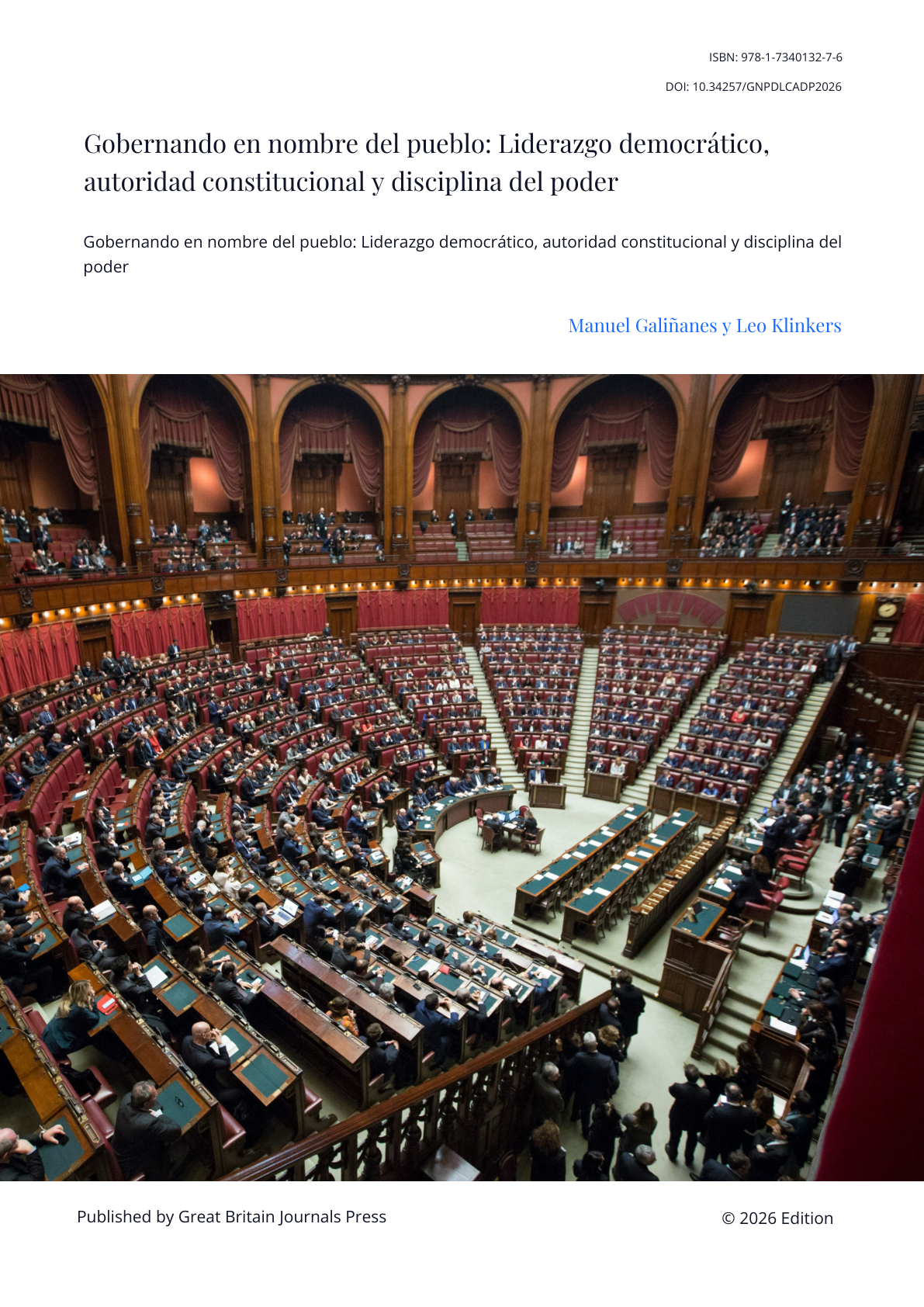


 Atom
Atom RSS 2.0
 RSS 1.0