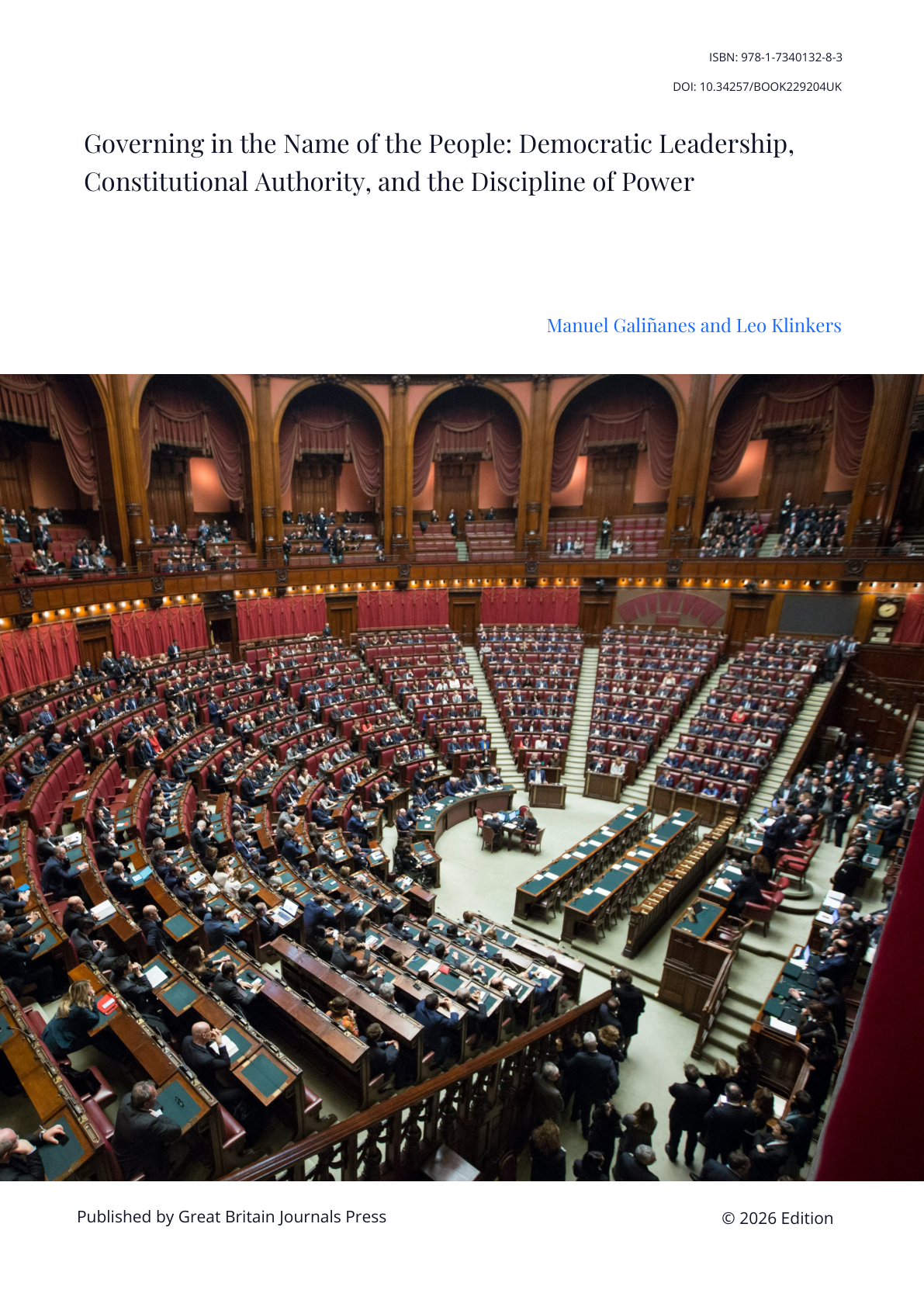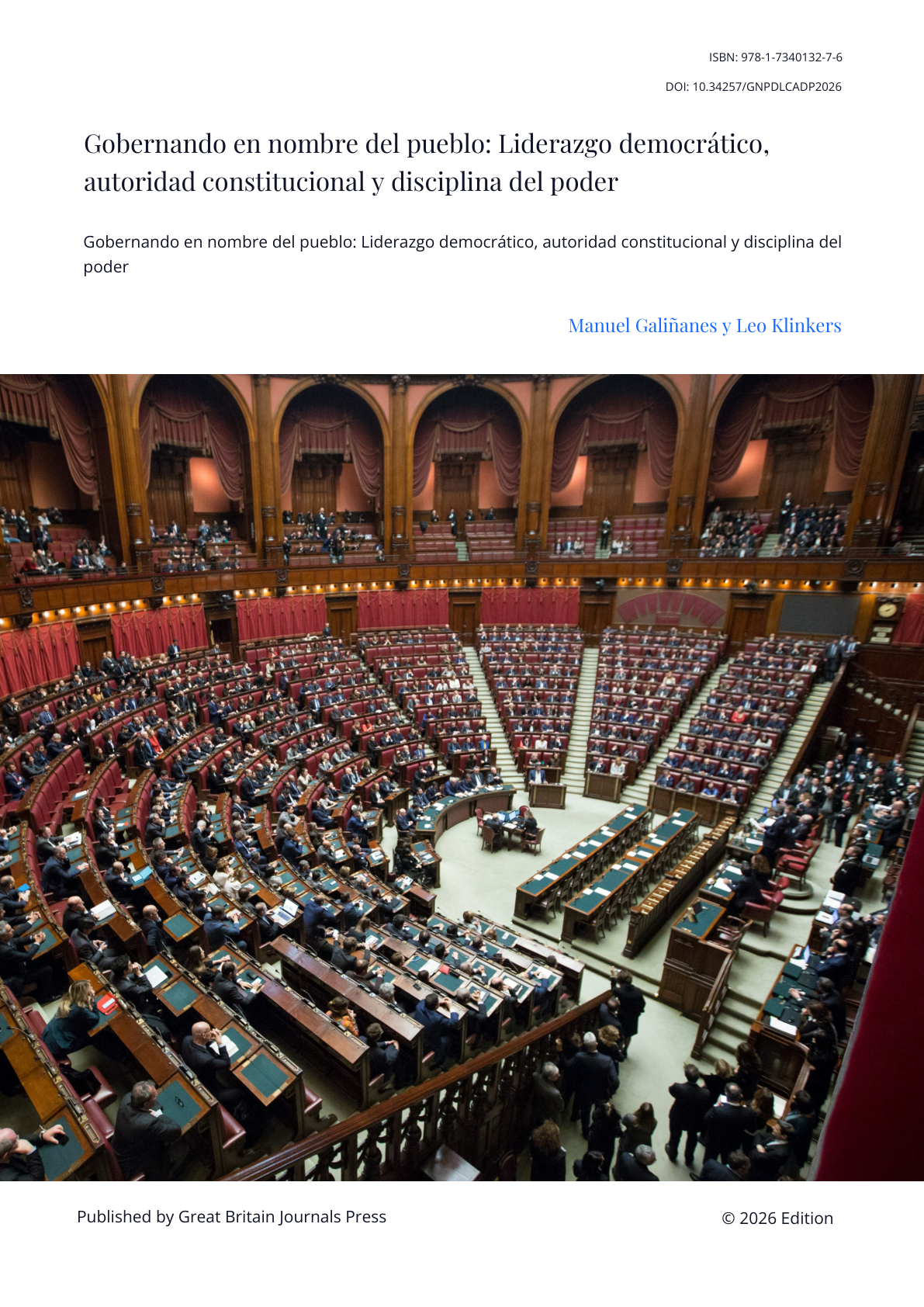
Gobernando en nombre del pueblo: Liderazgo democrático, autoridad constitucional y dis- ciplina del poder

Gobernando en nombre del pueblo: Liderazgo democrático, autoridad constitucional y dis- ciplina del poder

Authors

Manuel Galiñanes
Leo Klinkers
Published July 24, 2026
E-ISBN 978-1-7340132-7-6

Details about this monograph

Pages 172
Language Spanish

Keywords

Liderazgo democrático Soberanía popular Constitucionalismo Legitimidad democrática Renovación democrática Separación de poderes Sistemas de gobernanza Erosión institucional Autoridad pública Democracia constitucional

Synopsis

Gobernar en nombre del pueblo: Liderazgo democrático, autoridad constitucional y la disciplina del poder examina por qué las instituciones democráticas no pueden sostenerse únicamente mediante elecciones, leyes y procedimientos constitucionales. Su argumento central es que la democracia también depende de la competencia intelectual, ética e institucional de quienes ejercen la autoridad pública. Los líderes deben comprender no solo cómo obtener el poder, sino también por qué ese poder es limitado, condicionado y responsable ante el pueblo. El libro recorre la evolución de la soberanía popular desde el pensamiento político clásico hasta las cartas históricas, las revoluciones, el constitucionalismo y el gobierno representativo. Distingue la autoridad legítima del mero control y advierte contra la idea de considerar la victoria electoral, el apoyo mayoritario o el cargo legal como una autorización para ejercer un poder ilimitado. Las limitaciones constitucionales, la supervisión judicial, la separación de poderes, el federalismo, el pluralismo y la oposición política se presentan como componentes esenciales de la democracia, y no como obstáculos para un gobierno eficaz. Los autores analizan las responsabilidades de los líderes políticos y de los partidos, en particular su deber de seleccionar candidatos competentes, aceptar la derrota electoral, respetar el disenso y resistir los intentos populistas de identificar a un solo líder o facción con "el pueblo". También examinan cómo el miedo, la polarización, la desinformación, la concentración del poder ejecutivo, la inercia burocrática y la fragmentación institucional pueden erosionar gradualmente la rendición de cuentas democrática sin abolir formalmente las estructuras democráticas. Más allá del diseño constitucional, el libro analiza la gobernanza como un sistema complejo que abarca la formulación de políticas públicas, la administración, la responsabilidad ética, el aprendizaje institucional y la rendición de cuentas por las consecuencias perjudiciales de las decisiones gubernamentales. Incluso las instituciones bien diseñadas pueden fracasar cuando los funcionarios carecen de criterio, coordinación, valentía moral o de la capacidad para corregir debilidades sistémicas. Las secciones finales proponen una renovación democrática basada en un liderazgo guiado por principios, partidos políticos más sólidos, una mayor participación ciudadana, la deliberación pública, una supervisión institucional eficaz y la evaluación continua del desempeño democrático. En última instancia, el libro sostiene que gobernar democráticamente significa ejercer un poder público temporal con conocimiento, moderación, responsabilidad y fidelidad a los principios constitucionales. La democracia solo conserva su legitimidad cuando líderes, instituciones y ciudadanos trabajan de manera continua y conjunta para disciplinar el poder y proteger la libertad.

Author Biographies

Manuel Galiñanes

Manuel Galiñanes, licenciado en Medicina y Cirugía y doctor en Bioquímica y Fisiología, es cirujano cardiovascular, científico biomédico y estudioso de la ciencia política. Obtuvo la licenciatura en Medicina en la Universidad de Salamanca, se especializó en cirugía cardiovascular en la Universidad Complutense de Madrid y obtuvo el doctorado en Bioquímica y Fisiología por la Universidad de Londres. Ha sido profesor de cirugía cardíaca en la Universidad de Leicester, jefe del servicio de cirugía cardíaca del Hospital Universitario Vall d'Hebron de Barcelona y director del laboratorio de terapia de reparación cardíaca. En la actualidad, es miembro de la Academia de Ciencias Médicas y de la Salud de Cataluña y de Baleares, presidente de la Alianza Federal de Federalistas Europeos (FAEF) y miembro de la Comisión de Ratificación del Parlamento Mundial Provisional.rnrnSu labor investigadora más reciente se centra en el constitucionalismo, la gobernanza democrática, la gobernanza ecológica, el federalismo mundial y la rendición de cuentas institucional. Ha publicado ampliamente sobre la reforma constitucional democrática, la democracia ecológica, el liderazgo político y la gobernanza global.

Leo Klinkers

Leo Klinkers, doctor (PhD) (n. 1943), desempeñó un papel fundacional en el establecimiento de la administración pública como disciplina académica en la Facultad de Derecho de la Universidad de Utrecht, donde ejerció la docencia y la investigación entre 1970 y 1983. Posteriormente, fundó Klinkers Public Policy Consultants, desde donde ha asesorado sobre complejos desafíos de gobernanza y de formulación de políticas públicas en diversos países, trabajando en el marco de la Unión Europea y de las Naciones Unidas. El Dr. Klinkers está especializado en el abordaje de problemas políticos y sociales complejos mediante enfoques interdisciplinarios. Asimismo, ha dedicado una parte importante de su labor al desarrollo de estructuras federales de gobernanza, tanto en Europa como a escala mundial. Es autor y coautor de varios libros y numerosas publicaciones sobre administración pública, análisis de políticas públicas y federalismo constitucional. Además, es cofundador y primer presidente de la Alianza Federal de Federalistas Europeos (FAEF).

Academic Disclosures

Dedication

A todos los que creen que el poder político emana del pueblo, está limitado por los principios constitucionales y debe ejercerse siempre al servicio del bien común. Que cada generación posea la sabiduría y el valor cívico necesarios para gobernar en nombre del pueblo con justicia, integridad y humildad.

References

Althusius, J. (1995). Politica. Liberty Fund.
Arendt, H. (1958). The Human Condition. University of Chicago Press.
Arendt, H. (1963). Eichmann in Jerusalem: A Report on the Banality of Evil. Viking Press.
Arendt, H. (1967). Truth and Politics. Viking Press.
Arendt, H. (2005). Responsibility and Judgment. Schocken Books.
Argyris, C. (1990). Overcoming Organizational Defenses: Facilitating Organizational Learning. Allyn and Bacon.
Argyris, C., & Schön, D. A. (1978). Organizational Learning: A Theory of Action Perspective. Addison-Wesley.
Aristotle. (1998). Politics. Hackett Publishing.
Ashby, W. R. (1956). An Introduction to Cybernetics. Chapman & Hall.
Bauman, Z. (1989). Modernity and the Holocaust. Cornell University Press.
Bermeo, N. (2016). On Democratic Backsliding. Journal of Democracy, 27(1), 5-19.
Bevir, M. (2010). Democratic Governance. Princeton University Press.
Bodin, J. (1992). On Sovereignty: Four Chapters from The Six Books of the Commonwealth. Cambridge University Press.
Bovens, M. (1998). The Quest for Responsibility: Accountability and Citizenship in Complex Organisations. Cambridge University Press.
Brett, A. S. (2011). Changes of State: Nature and the Limits of the City in Early Modern Natural Law. Princeton University Press.
Brown, W. (2015). Undoing the Demos: Neoliberalism’s Stealth Revolution. Zone Books.
Burke, K. (1984). Permanence and Change: An Anatomy of Purpose. University of California Press.
Burns, J. M. (1978). Leadership. Harper & Row.
Cheibub, J. A. (2007). Presidentialism, Parliamentarism, and Democracy. Cambridge University Press.
Cox, G. W., & McCubbins, M. D. (2005). Setting the Agenda. Cambridge University Press.
De Tocqueville, A. (2000). Democracy in America. University of Chicago Press.
Dicey, A. V. (1982). Introduction to the Study of the Law of the Constitution. Liberty Fund.
Dryzek, J. S. (2000). Deliberative Democracy and Beyond. Oxford University Press.
Dunn, J. (1969). Western Political Theory in the Face of the Future. Cambridge University Press.
Dworkin, R. (1986). Law’s Empire. Harvard University Press.
Easton, D. (1965). A Systems Analysis of Political Life. Wiley.
Elazar, D. J. (1987). Exploring Federalism. University of Alabama Press.
Elgie, R. (2011). Semi-Presidentialism: Sub-Types and Democratic Performance. Oxford University Press.
Elster, J. (2000). Ulysses Unbound: Studies in Rationality, Precommitment, and Constraints. Cambridge University Press.
Erasmus, D. (2003). The Praise of Folly. Yale University Press.
Farmer, P. (2003). Pathologies of Power: Health, Human Rights, and the New War on the Poor. University of California Press.
Fishkin, J. S. (2009). When the People Speak: Deliberative Democracy and Public Consultation. Oxford University Press.
Fishkin, J. S. (2018). Democracy When the People Are Thinking: Revitalizing Our Politics Through Public Deliberation. Oxford University Press.
France. (1789). Declaration of the Rights of Man and of the Citizen.
Fukuyama, F. (2014). Political Order and Political Decay: From the Industrial Revolution to the Globalization of Democracy. Farrar, Straus and Giroux.
Fuller, L. L. (1964). The Morality of Law. Yale University Press.
Fung, A., & Wright, E. O. (2003). Deepening Democracy: Institutional Innovations in Empowered Participatory Governance. Verso.
Gadamer, H.-G. (1975). Truth and Method. Continuum.
Galiñanes, M., & Klinkers, L. (2025). Reimagining Checks and Balances: Establishing the Ombudsman Council as. Quarta Politica, 25(9), 43-51.
Galiñanes, M., & Klinkers, L. (2026). Beyond Left-Right Ideology: Assessing Party Performance through Social Needs and Democratic Institutions. Journal of Politics and Law, 19(2), 33-55.
Galiñanes, M., & Klinkers, L. (2026). Constitution for a World Federation. Letrame.
Galiñanes, M., & Klinkers, L. (2026). From Gatekeepers to Gravediggers: The Role of Political Party Leaders and Candidates in Democratic Decline?and the Case for Principled Leadership. Journal of Politics and Law, 19(1), 1-21.
Galiñanes, M., & Klinkers, L. (2026). Journalism and the. Quarta Politica.
Galiñanes, M., Bernhardt, S., & Klinkers, L. (2025). The Dual Seven Democratic Dimensions Index: A Novel and Simplified Metric to Accurately Assess Democracy. Journal of Politics and Law, 18(4), 19-35.
Galtung, J. (1969). Violence, Peace, and Peace Research. Journal of Peace Research, 6(3), 167-191.
Gibson, E. L. (2013). Boundary Control. Cambridge University Press.
Giddens, A. (1984). The Constitution of Society: Outline of the Theory of Structuration. University of California Press.
Ginsburg, T., & Huq, A. Z. (2018). How to Save a Constitutional Democracy. University of Chicago Press.
Goodsell, C. T. (2004). The Case for Bureaucracy. CQ Press.
Grimmelikhuijsen, S., Jilke, S., Olsen, A. L., & Tummers, L. (2017). Behavioral Public Administration: Combining Insights from Public Administration and Psychology. Public Administration Review, 77(1), 45-56.
Habermas, J. (1989). The Structural Transformation of the Public Sphere: An Inquiry into a Category of Bourgeois Society. MIT Press.
Habermas, J. (1996). Between Facts and Norms: Contributions to a Discourse Theory of Law and Democracy. MIT Press.
Habermas, J. (2006). Religion in the Public Sphere. European Journal of Philosophy, 14(1), 1-25.
Hacker, J. S. (2002). The Divided Welfare State: The Battle over Public and Private Social Benefits in the United States. Cambridge University Press.
Hamilton, A., Madison, J., & Jay, J. (2003). The Federalist Papers. Signet.
Hart, H. L. A. (1961). The Concept of Law. Clarendon Press.
Helms, L. (2012). Comparative Political Leadership. Palgrave Macmillan.
Hirschman, A. O. (1972). Exit, Voice, and Loyalty: Responses to Decline in Firms, Organizations, and States. Harvard University Press.
Hobbes, T. (1996). Leviathan. Cambridge University Press.
Hood, C. (2000). The Art of the State: Culture, Rhetoric, and Public Management. Oxford University Press.
Hood, C. (2006). Transparency in Historical Perspective. In Transparency: The Key to Better Governance? Oxford University Press.
Hueglin, T. O. (1999). Early Modern Concepts for a Late Modern World: Althusius on Community and Federalism. Wilfrid Laurier University Press.
Inglehart, R. (1997). Modernization and Postmodernization: Cultural, Economic, and Political Change in 43 Societies. Princeton University Press.
Jamieson, K. H. (1996). Packaging the Presidency. Oxford University Press.
Kahneman, D. (2011). Thinking, Fast and Slow. Farrar, Straus and Giroux.
Katz, R. S., & Mair, P. (1995). Changing Models of Party Organization and Party Democracy: The Emergence of the Cartel Party. Party Politics, 1(1), 5-28.
Kelsen, H. (1945). General Theory of Law and State. Harvard University Press.
Kickert, W. J. M., Klijn, E.-H., & Koppenjan, J. F. M. (1997). Managing Complex Networks. Sage.
Klinkers, L. (n.d.). Collected Works on Governance and Democratic Systems. http://www.leoklinkers.nl
Kuyper, A. (1998). Sphere Sovereignty. In Abraham Kuyper: A Centennial Reader. Eerdmans.
Landau, D. (2013). Abusive Constitutionalism. UC Davis Law Review, 47, 189-260.
Landemore, H. (2020). Open Democracy: Reinventing Popular Rule for the Twenty-First Century. Princeton University Press.
Leo XIII. (1891). Rerum Novarum.
Levitas, R. (1990). The Concept of Utopia. Syracuse University Press.
Levitsky, S., & Ziblatt, D. (2018). How Democracies Die. Crown.
Lijphart, A. (1999). Patterns of Democracy: Government Forms and Performance in Thirty-Six Countries. Yale University Press.
Lindblom, C. E. (1959). The Science of `Muddling Through.’. Public Administration Review, 19(2), 79-88.
Lindblom, C. E. (1977). Politics and Markets: The World’s Political-Economic Systems. Basic Books.
Linder, W. (2010). Swiss Democracy: Possible Solutions to Conflict in Multicultural Societies. Palgrave Macmillan.
Linz, J. J. (1990). The Perils of Presidentialism. Journal of Democracy, 1(1), 51-69.
Lipsky, M. (1980). Street-Level Bureaucracy: Dilemmas of the Individual in Public Services. Russell Sage Foundation.
Locke, J. (1988). Two Treatises of Government. Cambridge University Press.
Loughlin, M. (2003). The Idea of Public Law. Oxford University Press.
Luhmann, N. (1995). Social Systems. Stanford University Press.
Madison, J., Hamilton, A., & Jay, J. (2003). The Federalist Papers. Signet Classics.
Magna Carta. (1998). Magna Carta. In Magna Carta. University of Virginia Press.
Mair, P. (2013). Ruling the Void: The Hollowing of Western Democracy. Verso.
Mansbridge, J., & Democracy, et al. A. S. A. to D. (n.d.). Deliberative Systems.
Marmot, M. (2005). Social Determinants of Health Inequalities. The Lancet, 365(9464), 1099-1104.
Meadows, D. H. (2008). Thinking in Systems: A Primer. Chelsea Green.
Merton, R. K. (1940). Bureaucratic Structure and Personality. Social Forces, 18(4), 560-568.
Mettler, S. (2011). The Submerged State: How Invisible Government Policies Undermine American Democracy. University of Chicago Press.
Mezirow, J. (1991). Transformative Dimensions of Adult Learning. Jossey-Bass.
Mill, J. S. (1977). Considerations on Representative Government. Hackett Publishing.
Mill, J. S. (1978). On Liberty. Hackett Publishing.
Montesquieu, C. de S. (1989). The Spirit of the Laws. Cambridge University Press.
Mounk, Y. (2018). The People vs. Democracy: Why Our Freedom Is in Danger and How to Save It. Harvard University Press.
Müller, J.-W. (2016). What Is Populism? University of Pennsylvania Press.
Norris, P. (2002). Democratic Phoenix: Reinventing Political Activism. Cambridge University Press.
O’Donnell, G. (1998). Horizontal Accountability in New Democracies. Journal of Democracy, 9(3), 112-126.
Ostrom, E. (1990). Governing the Commons: The Evolution of Institutions for Collective Action. Cambridge University Press.
Ostrom, E. (1996). Crossing the Great Divide: Coproduction, Synergy, and Development. World Development, 24(6), 1073-1087.
Ostrom, E. (2010). Polycentric Systems for Coping with Collective Action and Global Environmental Change. Global Environmental Change, 20, 550-557.
Pagden, A. (2013). The Enlightenment and Why It Still Matters. Oxford University Press.
Panebianco, A. (1988). Political Parties: Organization and Power. Cambridge University Press.
Paoli, P. (2004). Scritti e Discorsi Politici. Edizioni di Storia e Letteratura.
Papadopoulos, Y. (2013). Democracy in Crisis? Politics, Governance and Policy. Palgrave Macmillan.
Parsons, T. (1951). The Social System. Free Press.
Pateman, C. (1970). Participation and Democratic Theory. Cambridge University Press.
Peters, B. G. (2015). Advanced Introduction to Public Policy. Edward Elgar.
Peters, B. G. (2018). The Politics of Bureaucracy. Routledge.
Pierre, J., & Peters, B. G. (2000). Governance, Politics and the State. Macmillan.
Pitkin, H. F. (1967). The Concept of Representation. University of California Press.
Plattel, M. G. (1970). Utopie en kritisch denken. Ambo.
Popper, K. (1935). The Logic of Scientific Discovery. Routledge.
Popper, K. (1945). The Open Society and Its Enemies. Routledge.
Popper, K. R. (1962). Conjectures and Refutations: The Growth of Scientific Knowledge. Routledge.
Pressman, J. L., & Wildavsky, A. (1973). Implementation. University of California Press.
Putnam, R. D. (2000). Bowling Alone: The Collapse and Revival of American Community. Simon & Schuster.
Rakove, J. N. (1997). Original Meanings: Politics and Ideas in the Making of the Constitution. Knopf.
Rawls, J. (1993). Political Liberalism. Columbia University Press.
Rodden, J. (2006). Hamilton’s Paradox: The Promise and Peril of Fiscal Federalism. Cambridge University Press.
Rosanvallon, P. (2011). Democratic Legitimacy: Impartiality, Reflexivity, Proximity. Princeton University Press.
Rosenblum, N. L. (2008). On the Side of the Angels: An Appreciation of Parties and Partisanship. Princeton University Press.
Rothstein, B. (2011). The Quality of Government: Corruption, Social Trust, and Inequality in International Perspective. University of Chicago Press.
Rousseau, J.-J. (1765). Projet de constitution pour la Corse.
Rousseau, J.-J. (1985). Considerations on the Government of Poland. Hackett Publishing.
Rousseau, J.-J. (1997). The Social Contract. Cambridge University Press.
Schattschneider, E. E. (1942). Party Government. Farrar and Rinehart.
Schedler, A. (1999). Conceptualizing Accountability. In The Self-Restraining State: Power and Accountability in New Democracies. Lynne Rienner.
Schedler, A. (2013). The Politics of Uncertainty: Sustaining and Subverting Electoral Authoritarianism. Oxford University Press.
Scheppele, K. L. (2018). Autocratic Legalism. University of Chicago Law Review, 85, 545-584.
Schmitt, C. (2005). Political Theology: Four Chapters on the Concept of Sovereignty. University of Chicago Press.
Schön, D. A. (1983). The Reflective Practitioner: How Professionals Think in Action. Basic Books.
Sen, A. (1999). Development as Freedom. Knopf.
Shugart, M. S., & Carey, J. M. (1992). Presidents and Assemblies: Constitutional Design and Electoral Dynamics. Cambridge University Press.
Skinner, Q. (1997). Liberty Before Liberalism. Cambridge University Press.
Stepan, A. C. (2011). The Multiple Secularisms of Modern Democratic and Non-Democratic Regimes. In Rethinking Secularism. Oxford University Press.
Strøm, K. (1990). Minority Government and Majority Rule. Cambridge University Press.
Sunstein, C. R. (2001). Designing Democracy: What Constitutions Do. Oxford University Press.
Sunstein, C. R. (2015). Why Nudge? The Politics of Libertarian Paternalism. Yale University Press.
Sunstein, C. R. (2017). #Republic: Divided Democracy in the Age of Social Media. Princeton University Press.
Taylor, C. (2007). A Secular Age. Harvard University Press.
Tetlock, P. E. (2006). Expert Political Judgment. Princeton University Press.
Thaler, R. H., & Sunstein, C. (2008). Nudge: Improving Decisions About Health, Wealth and Happiness. Yale University Press.
The States-General of the Netherlands. (1581). Act of Abjuration.
Tuck, R. (2002). Hobbes: A Very Short Introduction. Oxford University Press.
Tuck, R. (2016). The Sleeping Sovereign: The Invention of Modern Democracy. Cambridge University Press.
Tulis, J. K. (1987). The Rhetorical Presidency. Princeton University Press.
Tushnet, M. (2009). The Constitution of the United States of America: A Contextual Analysis. Hart Publishing.
United States. (1776). Declaration of Independence.
Urbinati, N. (2006). Representative Democracy: Principles and Genealogy. University of Chicago Press.
Urbinati, N. (2014). Democracy Disfigured: Opinion, Truth, and the People. Harvard University Press.
van Spengler, L. (1994). Hoe waarden veranderen: Een leerproces. Prometheus.
Vitoria, F. de. (1991). Political Writings. Cambridge University Press.
Waldron, J. (2016). Political Political Theory. Harvard University Press.
Ware, A. (1995). Political Parties and Party Systems. Oxford University Press.
Watts, R. L. (1998). Comparing Federal Systems. McGill-Queen’s University Press.
Weber, M. (1946). Politics as a Vocation. In From Max Weber: Essays in Sociology. Oxford University Press.
Weber, M. (1978). Economy and Society. University of California Press.
Wiener, N. (1948). Cybernetics: Or Control and Communication in the Animal and the Machine. MIT Press.
Williams, B. (2005). In the Beginning Was the Deed: Realism and Moralism in Political Argument. Princeton University Press.
Wright, E. O. (2010). Envisioning Real Utopias. Verso.
Young, I. M. (2011). Responsibility for Justice. Oxford University Press.

How to Cite

Gobernando en nombre del pueblo: Liderazgo democrático, autoridad constitucional y dis- ciplina del poder. (2026). Great Britain Journals Press. https://doi.org/10.34257/GNPDLCADP2026

License

Creative Commons Attribution 4.0 International

License: All Rights Reserved


Copyright: © 2026 Manuel Galiñanes, Leo Klinkers.


Gobernando en nombre del pueblo: Liderazgo democrático, autoridad constitucional y dis- ciplina del poder by Manuel Galiñanes, Leo Klinkers is protected under the stated copyright and license terms.


No part of this publication may be reproduced, stored, distributed, or transmitted in any form without prior permission, except where permitted by the selected license or applicable law.